

Comprehensive Human Physiology and Anatomy Review for Independent
Learners
Study online at https://quizlet.com/_jnsl0c
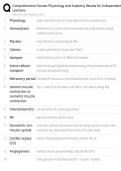
1. Physiology Study of normal functions of a living organism and its component parts.
2. Homeostasis Maintenance of a constant internal environment and quickly restores changed
conditions back to normal.
3. Placebo Drugs that have no pharmacological effect.
4. Cations Ion with positive electric charge, more P than E-.
5. Isotopes Element that has same # of P, different # of neutrons.
6. Active cellular Molecules go against gradients and require energy. Primary transport will use ATP,
transport secondary uses potential energy.
7. Refractory period Time where AP cannot occur, limits maximal firing rate. Due to VG Na+ ch resetting.
8. Isotonic muscle Tonic - creates force and moves a load. Metric - force without moving load.
contraction vs
isometric muscle
contraction
9. Intercalated disc Link myocardial cells, contain gap junctions.
10. MI Myocardial infarction aka heart attack.
11. Isovolumic ven- Contraction, ventricular blood volume does not change, pressure increases, semi-
tricular systole lunar valves open, blood ejected from arteries. All 4 valves closed.
12. Cardiac output Volume of blood pumped per ventricle per unit time. HR x SV.
(CO)
13. Angiogenesis New blood vessels grow and develop, especially after birth.
14. Driving pressure for blood flow, (diastolic + ⅓ systolic - diastolic).
1/6
, Comprehensive Human Physiology and Anatomy Review for Independent
Learners
Study online at https://quizlet.com/_jnsl0c
Mean Arterial
Pressure (MAP)
15. Erythropoietin Glycoprotein hormone produced by kidneys that regulate RBC production.
16. Pulmonary venti- Breathing, moving air in and out of lungs, gas exchange.
lation
17. Surfactant Chemical secreted by type 2 alveoli cells, that help prevent collapse.
18. Dalton's and Dalton's - total pressure of mix of gases = pressure of individuals gases in mixture.
Boyle's laws Boyle's - volume increases, pressure decreases (inversely proportional).
19. Glomerulus Bundle of capillaries in nephron that filter blood to form urine.
20. Osmoreceptors Receptors that monitor osmolarity, located in hypothalamus.
21. Juxtaglomerular Promote Na+ retention in kidneys. Smooth muscle cells that synthesize, store,
cells secrete renin enzyme.
22. ACE Drugs that relax, widen blood vessels to lower BP, improve blood flow, reduce heart
workload.
23. Aldosterone Hormone produced in adrenal cortex in response to ANG II, increases K+ levels.
Main function is to excrete potassium, absorbs sodium and water, LOWER BP.
24. Chemical diges- Breakdown of food with enzyme and acids helping. Broken down into carbs,
tion proteins, lipids.
25. Gluconeogenesis New glucose made from non-carbohydrates.
26. Acromegaly Growth hormone excess in adulthood.
27. Excess androgens in females.
2/6
Learners
Study online at https://quizlet.com/_jnsl0c
1. Physiology Study of normal functions of a living organism and its component parts.
2. Homeostasis Maintenance of a constant internal environment and quickly restores changed
conditions back to normal.
3. Placebo Drugs that have no pharmacological effect.
4. Cations Ion with positive electric charge, more P than E-.
5. Isotopes Element that has same # of P, different # of neutrons.
6. Active cellular Molecules go against gradients and require energy. Primary transport will use ATP,
transport secondary uses potential energy.
7. Refractory period Time where AP cannot occur, limits maximal firing rate. Due to VG Na+ ch resetting.
8. Isotonic muscle Tonic - creates force and moves a load. Metric - force without moving load.
contraction vs
isometric muscle
contraction
9. Intercalated disc Link myocardial cells, contain gap junctions.
10. MI Myocardial infarction aka heart attack.
11. Isovolumic ven- Contraction, ventricular blood volume does not change, pressure increases, semi-
tricular systole lunar valves open, blood ejected from arteries. All 4 valves closed.
12. Cardiac output Volume of blood pumped per ventricle per unit time. HR x SV.
(CO)
13. Angiogenesis New blood vessels grow and develop, especially after birth.
14. Driving pressure for blood flow, (diastolic + ⅓ systolic - diastolic).
1/6
, Comprehensive Human Physiology and Anatomy Review for Independent
Learners
Study online at https://quizlet.com/_jnsl0c
Mean Arterial
Pressure (MAP)
15. Erythropoietin Glycoprotein hormone produced by kidneys that regulate RBC production.
16. Pulmonary venti- Breathing, moving air in and out of lungs, gas exchange.
lation
17. Surfactant Chemical secreted by type 2 alveoli cells, that help prevent collapse.
18. Dalton's and Dalton's - total pressure of mix of gases = pressure of individuals gases in mixture.
Boyle's laws Boyle's - volume increases, pressure decreases (inversely proportional).
19. Glomerulus Bundle of capillaries in nephron that filter blood to form urine.
20. Osmoreceptors Receptors that monitor osmolarity, located in hypothalamus.
21. Juxtaglomerular Promote Na+ retention in kidneys. Smooth muscle cells that synthesize, store,
cells secrete renin enzyme.
22. ACE Drugs that relax, widen blood vessels to lower BP, improve blood flow, reduce heart
workload.
23. Aldosterone Hormone produced in adrenal cortex in response to ANG II, increases K+ levels.
Main function is to excrete potassium, absorbs sodium and water, LOWER BP.
24. Chemical diges- Breakdown of food with enzyme and acids helping. Broken down into carbs,
tion proteins, lipids.
25. Gluconeogenesis New glucose made from non-carbohydrates.
26. Acromegaly Growth hormone excess in adulthood.
27. Excess androgens in females.
2/6


