

Written by students who passed Immediately available after payment Read online or as PDF Wrong document? Swap it for free 4.6 TrustPilot
logo-home
Document preview thumbnail
Preview 1 out of 2 pages
Exam (elaborations)

RICA Subtest 3 Planning, Organization & Management Exam (Latest 2026/2027 Update) | Complete Q&A with Verified Answers and Detailed Rationales | Standards-Based Instruction, Assessment, Differentiated Instruction | A+ Grade

Document preview thumbnail
Preview 1 out of 2 pages

INSTANT PDF DOWNLOAD - This is the comprehensive study guide for RICA Subtest 3 (Latest 2026/2027 Update), featuring verified exam questions with correct answers and detailed rationales based on the official CTC RICA examination blueprint. Subtest 3 consists of 25 multiple-choice questions and 1 constructed-response case study with a 1 hour and 30 minute time limit. The exam focuses solely on Domain 1: Planning, Organizing, and Managing Reading Instruction Based on Ongoing Assessment. Passing score is 220 per subtest. Key Terms & Concepts: California English-Language Arts Content Standards (state what every child should know and be able to do at each grade level); The Reading/Language Arts Framework provides guidelines for what to teach and how to assess; A balanced instructional program strategically selects skills based on a child's reading development; A comprehensive reading program helps students meet all grade-level standards and includes teaching of skills/strategies plus opportunities for students to read and write; Systematic instruction means the teacher knows grade-level standards and uses ongoing assessment results to plan instruction; Explicit instruction is teacher-directed, uses varied resources, and teaches specific skills/strategies in small groups. Instructional Delivery Components: Orientation (overview of expectations/hook), Presentation (direct/explicit instruction), Structured and Guided Practice (students complete tasks under close teacher supervision with immediate corrective feedback), Independent Practice and Application. Grouping & Differentiation: Flexible grouping - students who share need for specific skill are taught efficiently, groups exist for single purpose and disband once lessons complete; Literature Circles - groups of students reading the same selected text meeting to discuss; I + I Strategy - Independent reading level + Personal interest = best chance of success; Reading Logs, book reports, oral presentations to monitor independent reading. Assessment Types: Entry-level assessment (determines which students possess prerequisite skills or have already mastered skills before instruction); Progress monitoring assessment (determines which students are making adequate progress during instruction); Summative assessment (determines level of student achievement after instruction ends). Assessment Quality Indicators: Reliability - test yields consistent scores across administrations; Validity - test measures what it claims to measure; Percentile scores - norm-referenced scores showing percentage of scores a particular score surpassed; Grade equivalent scores - translate raw score into grade level and month. Reading Level Criteria: Independent Level - reads aloud 95%+ words correctly, answers 90%+ comprehension questions correctly; Instructional Level - reads aloud 90%+ words correctly, answers 60%+ comprehension questions correctly (needs teacher assistance); Frustration Level - reads aloud less than 90% words correctly or answers less than 60% comprehension questions correctly. Instructional Strategies: Breaking reading assignments into small steps with self-monitoring for students with attention difficulties; Lesson planning must ensure targeted reading skills reflect appropriate instructional progression and student needs; Supporting at-home reading by recommending books parents would enjoy reading with their children; For English Learners, provide content-area texts at various levels that supplement/reinforce textbook information; Provide explicit instruction in targeted phonics and sight words; Use strategies that build fluency through repeated reading, choral reading (two or more reading aloud in unison), echo reading (adult/experienced reader reads line, student repeats), whisper reading (all students whisper read independently while teacher listens and provides support); Teach multi-syllabic words using syllable division (VC/CV pattern), closed/open syllable patterns, vowel patterns (closed, open, silent e, vowel digraph, diphthong, r-controlled, C+le), structural analysis (affixes, roots), Elkonin boxes for segmentation. Scaffolds: Temporary support provided to student to help master new or complex task; Two levels: those included in initial whole-group lessons, those used for small groups or individual lessons for students having difficulty. INSTANT DIGITAL DOWNLOAD (PDF) immediately upon purchase. Fully text-searchable, printable, and accessible anytime. Trusted by California teacher credential candidates for exam success. 100% satisfaction guarantee. RICA Subtest 3 Exam CTC Reading Instruction Competence Assessment Subtest 3 Domain 1 Planning Organizing Managing Reading Instruction California English Language Arts Content Standards Reading Language Arts Framework Balanced Instructional Program Comprehensive Reading Program Systematic Instruction Ongoing Assessment Explicit Instruction Small Group Direct Teaching Orientation Lesson Hook Overview Structured Guided Practice Immediate Corrective Feedback Flexible Grouping Common Skill Need Literature Circles Same Text Discussion I Plus I Strategy Independent Reading Level Plus Personal Interest Entry Level Assessment Prerequisite Skills Before Instruction Progress Monitoring Assessment Adequate Progress During Instruction Summative Assessment Achievement After Instruction Reliability Consistent Scores Across Administrations Validity Measures What It Claims Percentile Scores Norm Referenced Comparison Grade Equivalent Scores Raw Score to Grade Level Month Independent Reading Level 95 Percent Accuracy 90 Percent Comprehension Instructional Reading Level 90 Percent Accuracy 60 Percent Comprehension Frustration Reading Level Below 90 Percent Accuracy Below 60 Percent Comprehension Break Reading Assignments Small Steps Self Monitor Attention Targeted Reading Skills Instructional Progression Student Needs At Home Reading Support Recommend Books Parents Enjoy English Learners Content Area Texts Multiple Levels Consult IEP Specific Testing Accommodations Student Success Team Assessed Strengths Weaknesses Foundation Intervention Repeated Reading Fluency Practice Choral Reading Unison Oral Reading Fluency Echo Reading Adult Line Student Repeat Whisper Reading Independent Whisper Teacher Listen Support Multi Syllabic Words Syllable Division VC CV Pattern

Content preview

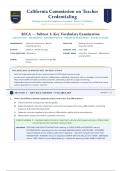
California Commission on Teacher


B A C OV • A C I R
RICA✦


SUB 3
Credentialing
Reading Instruction Competence Assessment · Subtest 3 Vocabulary
CA CTC
ENSURING EXCELLENCE IN READING INSTRUCTION


RICA — Subtest 3: Key Vocabulary Examination
I N ST R U C T I O N · A SS E SS M E N T · D I F F E R E N T I AT I O N · P R O G R E SS M O N I TO R I N G · CU E I N G SYST E M S

ORGANIZATION California Commission on Teacher EXAM TYPE Reading Instruction Competence
Credentialing (CTC) Assessment (RICA)
SUBTEST Subtest 3 — Key Terminology ACADEMIC YEAR
TOTAL QUESTIONS 25 Questions SUBJECT AREAS Instruction · Assessment · Differentiation ·
Cueing Systems
FORMAT Multiple Choice — Select the Single Best
Answer


VO CABULARY EXAMINATION INSTRUCTIONS
▸ Select the single best answer for each question based on RICA Subtest 3 key terminology.
▸ Content covers: systematic/explicit instruction, differentiation, scaffolding, intervention, skills vs. strategies, Curriculum-Based
Measurement (CBM), formative/summative assessment, alternative assessment, progress monitoring,
independent/instructional/frustration reading levels, screening and further assessment, running records, and the three cueing
systems (graphophonic, semantic, syntactic).


SECTION I — KEY RICA SUBTEST 3 VOCABULARY Questions 1 – 25

1. What is the difference between systematic/explicit instruction and differentiation?
A. They are identical concepts used interchangeably.
B. Systematic/explicit instruction is teaching in a structured and sequenced manner; differentiation is providing
instruction that meets individual needs.
C. Systematic instruction applies only to phonics; differentiation applies only to comprehension.
D. Differentiation replaces the need for systematic instruction.
CORRECT ANSWER B — Systematic/explicit instruction is teaching in a structured and sequenced manner; differentiation
is providing instruction that meets individual needs.
RATIONALE SYSTEMATIC AND EXPLICIT INSTRUCTION = teaching in a STRUCTURED and SEQUENCED manner.
DIFFERENTIATION = providing instruction that meets INDIVIDUAL NEEDS. SCAFFOLDING = TEMPORARY
supports added to ensure students master lesson objectives — does NOT change the instruction itself.
INTERVENTION = INTENSIVE instruction designed to REMEDY DEFICITS. SKILLS are the "WHAT"; STRATEGIES
are the "HOW." CBM (Curriculum-Based Measure) = a method for assessing student GROWTH OVER TIME.


Document information

Uploaded on
June 14, 2026
Number of pages
2
Written in
2025/2026
Type
Exam (elaborations)
Contains
Questions & answers
$12.49

Wrong document? Swap it for free Within 14 days of purchase and before downloading, you can choose a different document. You can simply spend the amount again.
Written by students who passed
Immediately available after payment
Read online or as PDF

Seller avatar
Reputation scores are based on the amount of documents a seller has sold for a fee and the reviews they have received for those documents. There are three levels: Bronze, Silver and Gold. The better the reputation, the more your can rely on the quality of the sellers work.
DoctorKen
3.8
(157)
Sold
856
Followers
119
Items
6584
Last sold
1 day ago


Why students choose Stuvia

Created by fellow students, verified by reviews

Quality you can trust: written by students who passed their tests and reviewed by others who've used these notes.

Didn't get what you expected? Choose another document

No worries! You can instantly pick a different document that better fits what you're looking for.

Pay as you like, start learning right away

No subscription, no commitments. Pay the way you're used to via credit card and download your PDF document instantly.

Student with book image

“Bought, downloaded, and aced it. It really can be that simple.”

Alisha Student

Working on your references?

Create accurate citations in APA, MLA and Harvard with our free citation generator.

Working on your references?

Frequently asked questions
