WGU D774 Intro to Business Accounting
OA (Latest 2026/2027 Update) 153+
Questions and Verified Answers | 100%
Correct | Grade A
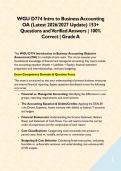
This WGU D774 Introduction to Business Accounting Objective
Assessment (OA) Is a multiple-choice exam. The course assesses your
foundational knowledge of financial and managerial accounting. Key topics include
the accounting equation (Assets = Liabilities + Equity), financial statement
preparation and interrelationships, and basic budgeting.
Exam Competency Domains & Question Focus
This exam is structured to test your understanding of primary business structures
and internal financial reporting. Expect questions distributed across the following
core areas:
• Financial vs. Managerial Accounting: Identifying the differences in user
groups, reporting requirements, and time horizons.
• The Accounting Equation & Debits/Credits: Applying the DEALER
rule (Draws, Expenses, Assets increase with debits) to balance T-accounts
and ledgers.
• Financial Statements: Understanding the Income Statement, Balance
Sheet, and Statement of Cash Flows. You will need to know the correct
order of preparation and the components of each report
• Cost Classifications: Categorizing costs accurately into product vs.
period costs, fixed vs. variable, and prime vs. conversion costs.
• Budgeting & Cost Behavior: Calculating break-even points, evaluating
favorable vs. unfavorable variances, and understanding cost-volume-profit
(CVP) analysis.
1
, • Ethics & Internal Controls: Identifying internal controls and recognizing
the impact of regulatory frameworks like the Sarbanes-Oxley Act (SOX).
Q1. How is 'equity' best described? [Multiple Choice]
A) The total of all liabilities
B) Total cash on hand after expenses
C) The value of an item that remains after considering what is owed for
that item
D) Amount of revenues collected
Answer: The value of an item that remains after considering what is owed
for that item
Explanation: Equity represents the residual value after subtracting obligations related to
an item — essentially what remains for the owners. It is not simply cash on hand, not the
total revenues collected, nor identical to liabilities (which are amounts owed). Equity
reflects ownership interest after allowed claims are deducted.
Q2. What does the Statement of Cash Flows show? [Multiple Choice]
A) Shows assets, liabilities, and owner's equity on a date
B) Reports revenues and expenses for a period
C) Lists the cash inflows & outflows of the business for a period of time
D) Shows how equity changed over time
Answer: Lists the cash inflows & outflows of the business for a period of
time
Explanation: The statement of cash flows summarizes cash receipts and payments over a
reporting period, showing how cash changed. It is distinct from the balance sheet (a
point-in-time snapshot), the income statement (revenues and expenses), and the
statement of owner's equity (equity changes).
Q3. What is the primary focus of cash basis accounting? [Multiple Choice]
2
, A) Tracks long-term assets acquisitions
B) Records changes in equity on a specific date
C) What did I earn and what did I use?
D) Focuses on the flow of cash, Did I receive or did I pay cash?
Answer: Focuses on the flow of cash, Did I receive or did I pay cash?
Explanation: Cash-basis accounting records transactions when cash is actually received
or paid, so the focus is on cash flow timing. It is different from accrual accounting (which
records when earnings are earned or expenses used), and it doesn't directly address
long-term assets or accrual timing.
Q4. Which items are reported on the income statement? [Multiple Choice]
A) Changes in owner's equity
B) Revenues & Expenses
C) Assets & Liabilities
D) Cash inflows & outflows
Answer: Revenues & Expenses
Explanation: The income statement summarizes the company’s performance by listing
revenues earned and expenses incurred over a period. Assets and liabilities describe
position at a point in time (balance sheet), cash inflows/outflows are on the cash flow
statement, and equity changes are shown on the statement of owner's equity.
Q5. What does the Statement of Owner's Equity show? [Multiple Choice]
A) Reports revenues and expenses for a period
B) Shows assets and liabilities on a specific date
C) Lists cash inflows and outflows for a period
D) Shows how the equity or value of the organization has changed over
time
Answer: Shows how the equity or value of the organization has changed
over time
3
, Explanation: The statement of owner's equity tracks beginning equity, additions (like
owner investments and net income), and subtractions (like distributions and losses)
across a period to show how equity changed. It is not a cash flow statement (which
tracks cash), not a snapshot balance sheet (which shows balances at a date), and not an
income statement (which shows revenues and expenses).
Q6. Which best defines gross profit? [Multiple Choice]
A) Sales revenue without subtracting costs
B) The amount made from selling a product before expenses
C) Net income after all expenses and taxes
D) Cash collected from customers
Answer: The amount made from selling a product before expenses
Explanation: Gross profit is the profit remaining after subtracting the direct costs of
goods sold from sales — that is, what you made from selling a product before deducting
other expenses. It is not net income (which accounts for all expenses and taxes), cash
collected, or simply sales revenue (which doesn't subtract costs).
Q7. What was a primary effect of the Sarbanes-Oxley Act (SOX)
introduced in 2002? [Multiple Choice]
A) It established the Committee of Sponsoring Organizations (COSO)
B) It brought in legal requirements for stronger internal controls & greater
executive accountability in financial reporting.
C) It abolished oversight of auditing firms
D) It created accounting standards like GAAP
Answer: It brought in legal requirements for stronger internal controls &
greater executive accountability in financial reporting.
Explanation: The Sarbanes-Oxley Act of 2002 imposed statutory reforms that
strengthened internal control requirements and increased executive responsibility for the
integrity of financial reports. It did not create COSO, the PCAOB existed to oversee audits
(but SOX created the PCAOB), nor did it establish accounting principles like GAAP directly.
4
OA (Latest 2026/2027 Update) 153+
Questions and Verified Answers | 100%
Correct | Grade A
This WGU D774 Introduction to Business Accounting Objective
Assessment (OA) Is a multiple-choice exam. The course assesses your
foundational knowledge of financial and managerial accounting. Key topics include
the accounting equation (Assets = Liabilities + Equity), financial statement
preparation and interrelationships, and basic budgeting.
Exam Competency Domains & Question Focus
This exam is structured to test your understanding of primary business structures
and internal financial reporting. Expect questions distributed across the following
core areas:
• Financial vs. Managerial Accounting: Identifying the differences in user
groups, reporting requirements, and time horizons.
• The Accounting Equation & Debits/Credits: Applying the DEALER
rule (Draws, Expenses, Assets increase with debits) to balance T-accounts
and ledgers.
• Financial Statements: Understanding the Income Statement, Balance
Sheet, and Statement of Cash Flows. You will need to know the correct
order of preparation and the components of each report
• Cost Classifications: Categorizing costs accurately into product vs.
period costs, fixed vs. variable, and prime vs. conversion costs.
• Budgeting & Cost Behavior: Calculating break-even points, evaluating
favorable vs. unfavorable variances, and understanding cost-volume-profit
(CVP) analysis.
1
, • Ethics & Internal Controls: Identifying internal controls and recognizing
the impact of regulatory frameworks like the Sarbanes-Oxley Act (SOX).
Q1. How is 'equity' best described? [Multiple Choice]
A) The total of all liabilities
B) Total cash on hand after expenses
C) The value of an item that remains after considering what is owed for
that item
D) Amount of revenues collected
Answer: The value of an item that remains after considering what is owed
for that item
Explanation: Equity represents the residual value after subtracting obligations related to
an item — essentially what remains for the owners. It is not simply cash on hand, not the
total revenues collected, nor identical to liabilities (which are amounts owed). Equity
reflects ownership interest after allowed claims are deducted.
Q2. What does the Statement of Cash Flows show? [Multiple Choice]
A) Shows assets, liabilities, and owner's equity on a date
B) Reports revenues and expenses for a period
C) Lists the cash inflows & outflows of the business for a period of time
D) Shows how equity changed over time
Answer: Lists the cash inflows & outflows of the business for a period of
time
Explanation: The statement of cash flows summarizes cash receipts and payments over a
reporting period, showing how cash changed. It is distinct from the balance sheet (a
point-in-time snapshot), the income statement (revenues and expenses), and the
statement of owner's equity (equity changes).
Q3. What is the primary focus of cash basis accounting? [Multiple Choice]
2
, A) Tracks long-term assets acquisitions
B) Records changes in equity on a specific date
C) What did I earn and what did I use?
D) Focuses on the flow of cash, Did I receive or did I pay cash?
Answer: Focuses on the flow of cash, Did I receive or did I pay cash?
Explanation: Cash-basis accounting records transactions when cash is actually received
or paid, so the focus is on cash flow timing. It is different from accrual accounting (which
records when earnings are earned or expenses used), and it doesn't directly address
long-term assets or accrual timing.
Q4. Which items are reported on the income statement? [Multiple Choice]
A) Changes in owner's equity
B) Revenues & Expenses
C) Assets & Liabilities
D) Cash inflows & outflows
Answer: Revenues & Expenses
Explanation: The income statement summarizes the company’s performance by listing
revenues earned and expenses incurred over a period. Assets and liabilities describe
position at a point in time (balance sheet), cash inflows/outflows are on the cash flow
statement, and equity changes are shown on the statement of owner's equity.
Q5. What does the Statement of Owner's Equity show? [Multiple Choice]
A) Reports revenues and expenses for a period
B) Shows assets and liabilities on a specific date
C) Lists cash inflows and outflows for a period
D) Shows how the equity or value of the organization has changed over
time
Answer: Shows how the equity or value of the organization has changed
over time
3
, Explanation: The statement of owner's equity tracks beginning equity, additions (like
owner investments and net income), and subtractions (like distributions and losses)
across a period to show how equity changed. It is not a cash flow statement (which
tracks cash), not a snapshot balance sheet (which shows balances at a date), and not an
income statement (which shows revenues and expenses).
Q6. Which best defines gross profit? [Multiple Choice]
A) Sales revenue without subtracting costs
B) The amount made from selling a product before expenses
C) Net income after all expenses and taxes
D) Cash collected from customers
Answer: The amount made from selling a product before expenses
Explanation: Gross profit is the profit remaining after subtracting the direct costs of
goods sold from sales — that is, what you made from selling a product before deducting
other expenses. It is not net income (which accounts for all expenses and taxes), cash
collected, or simply sales revenue (which doesn't subtract costs).
Q7. What was a primary effect of the Sarbanes-Oxley Act (SOX)
introduced in 2002? [Multiple Choice]
A) It established the Committee of Sponsoring Organizations (COSO)
B) It brought in legal requirements for stronger internal controls & greater
executive accountability in financial reporting.
C) It abolished oversight of auditing firms
D) It created accounting standards like GAAP
Answer: It brought in legal requirements for stronger internal controls &
greater executive accountability in financial reporting.
Explanation: The Sarbanes-Oxley Act of 2002 imposed statutory reforms that
strengthened internal control requirements and increased executive responsibility for the
integrity of financial reports. It did not create COSO, the PCAOB existed to oversee audits
(but SOX created the PCAOB), nor did it establish accounting principles like GAAP directly.
4