lOMoARcPSD| 63525276
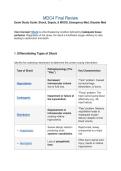
MDC4 Final Review
Exam Study Guide: Shock, Sepsis, & MODS, Emergency Med, Disaster Med
Core Concept: Shock is a life-threatening condition defined by inadequate tissue
perfusion. Regardless of the cause, the result is insufficient oxygen delivery to cells,
leading to dysfunction and death.
1. Differentiating Types of Shock
Identify the underlying mechanism to determine the correct nursing intervention.
Pathophysiology (The
Type of Shock Key Characteristics
"Why")
Decreased "Tank" problem. Caused
Hypovolemic intravascular volume by hemorrhage,
due to fluid loss. dehydration, or burns.
"Pump" problem. The
Impairment or failure of heart cannot pump blood
Cardiogenic
the myocardium. effectively (e.g., MI,
heart failure).
"Pipe" problem. Massive
Displacement of
vasodilation leads to
intravascular volume
Distributive inadequate oxygen
creating relative
delivery despite normal
hypovolemia.
blood volume.
Severe allergic reaction Rapid onset; airway
— Anaphylactic producing acute compromise is a major
systemic vasodilation. risk.
Often due to spinal cord
Loss of sympathetic
— Neurogenic injury; results in relative
tone.
hypovolemia.
, lOMoARcPSD| 63525276
A subset of distributive
Dysregulated host
— Septic shock; complex and high
response to infection.
mortality.
2. Sepsis & Septic Shock Continuum
Emergent recognition is vital. Progression is not always linear.
• Sepsis: Life-threatening organ dysfunction caused by a dysregulated host
response to infection.
• Septic Shock: A subset of sepsis where circulatory and cellular/metabolic
abnormalities are profound enough to substantially increase mortality.
◦ Nursing Priority: Differentiate "uncomplicated" infection from sepsis by
assessing for signs of organ dysfunction (e.g., altered mental status,
oliguria).
3. Emergent Nursing Management & Decision Making
Focus on perfusion, fluid resuscitation, and rapid assessment.
A. Fluid Resuscitation Priorities
Understanding the type of fluid is critical for restoring volume without causing
complications (e.g., fluid overload in cardiogenic shock).
• Crystalloids: Electrolyte solutions that move freely between intravascular and
interstitial spaces (e.g., Normal Saline, Lactated Ringer's). Primary choice for
volume expansion.
• Colloids: Solutions containing large molecules too big to pass capillary
membranes (e.g., Albumin). Used to keep fluid inside the blood vessels.
B. The "Cytokine Storm"
• Be aware of Systemic Inflammatory Response Syndrome (SIRS). This is a
systemic inflammatory response (cytokine storm) that can occur after a clinical
insult.
, lOMoARcPSD| 63525276
• Nursing Action: Monitor for systemic signs of inflammation (fever, tachycardia,
tachypnea, high WBC) even if the source of infection isn't immediately obvious.
C. Recognizing Complications: MODS
• Definition: Multiple Organ Dysfunction Syndrome. Altered function of two or
more organs requiring intervention to support function.
• Critical Decision: If shock is not effectively treated, MODS ensues. Early
recognition of subtle signs of shock (restlessness, slight tachycardia) prevents
progression to MODS.
4. Psychosocial & Transitional Care
• Patient/Family Support: Shock is sudden and life-threatening. Nurses must
provide psychosocial support to navigate the crisis and the "rollercoaster" of ICU
care.
• Transitional Care: Recovery does not end at discharge. Patients recovering
from sepsis/MODS often require significant rehabilitation and home-based care
support.
Based on the "Overview of Shock" and "Pathophysiology" sections provided in the text,
here is the continuation of your exam study guide.
5. Pathophysiology: The "Why" Behind the Symptoms
Nurses must understand these mechanisms to interpret lab values and anticipate
complications.
A. Cellular Hypoxia & Anaerobic Metabolism
• The Problem: When perfusion fails, cells lose their oxygen supply. They switch
from Aerobic (efficient) to Anaerobic (inefficient) metabolism.
• The Result: Anaerobic metabolism produces Lactic Acid as a toxic byproduct.
• Exam Key Point:
, lOMoARcPSD| 63525276
◦ Lactic Acid: Accumulation leads to metabolic acidosis and cell death.
◦ Nursing Responsibility: Monitor serum lactate levels. A rising lactate is a
late but critical indicator of ongoing tissue hypoperfusion.
B. The Stress Response (Hypermetabolism)
• Mechanism: Shock triggers the release of catecholamines (epinephrine),
cortisol, and glucagon.
• Clinical Consequence: This causes Hyperglycemia and insulin resistance,
even in non-diabetic patients.
• Nursing Decision: Anticipate orders for blood glucose monitoring and insulin
therapy. High glucose impairs the immune system and healing.
C. The Clotting Cascade
• Mechanism: Inflammation damages the vessel lining, activating the clotting
cascade.
• Complication: Microthrombi (small clots) form in the microcirculation, further
blocking blood flow to tissues. This can eventually consume clotting factors and
lead to bleeding (DIC).
6. Hemodynamics: The Numbers That Matter
Emergent decisions are based on Mean Arterial Pressure (MAP), not just Systolic BP.
A. Mean Arterial Pressure (MAP)
• Definition: The average pressure at which blood moves through the vasculature.
• The "Golden Number": MAP > 65 mm Hg.
• Why it matters: A MAP below 65 mm Hg is insufficient to perfuse vital organs
(kidneys, brain).
• Nursing Action:
MDC4 Final Review
Exam Study Guide: Shock, Sepsis, & MODS, Emergency Med, Disaster Med
Core Concept: Shock is a life-threatening condition defined by inadequate tissue
perfusion. Regardless of the cause, the result is insufficient oxygen delivery to cells,
leading to dysfunction and death.
1. Differentiating Types of Shock
Identify the underlying mechanism to determine the correct nursing intervention.
Pathophysiology (The
Type of Shock Key Characteristics
"Why")
Decreased "Tank" problem. Caused
Hypovolemic intravascular volume by hemorrhage,
due to fluid loss. dehydration, or burns.
"Pump" problem. The
Impairment or failure of heart cannot pump blood
Cardiogenic
the myocardium. effectively (e.g., MI,
heart failure).
"Pipe" problem. Massive
Displacement of
vasodilation leads to
intravascular volume
Distributive inadequate oxygen
creating relative
delivery despite normal
hypovolemia.
blood volume.
Severe allergic reaction Rapid onset; airway
— Anaphylactic producing acute compromise is a major
systemic vasodilation. risk.
Often due to spinal cord
Loss of sympathetic
— Neurogenic injury; results in relative
tone.
hypovolemia.
, lOMoARcPSD| 63525276
A subset of distributive
Dysregulated host
— Septic shock; complex and high
response to infection.
mortality.
2. Sepsis & Septic Shock Continuum
Emergent recognition is vital. Progression is not always linear.
• Sepsis: Life-threatening organ dysfunction caused by a dysregulated host
response to infection.
• Septic Shock: A subset of sepsis where circulatory and cellular/metabolic
abnormalities are profound enough to substantially increase mortality.
◦ Nursing Priority: Differentiate "uncomplicated" infection from sepsis by
assessing for signs of organ dysfunction (e.g., altered mental status,
oliguria).
3. Emergent Nursing Management & Decision Making
Focus on perfusion, fluid resuscitation, and rapid assessment.
A. Fluid Resuscitation Priorities
Understanding the type of fluid is critical for restoring volume without causing
complications (e.g., fluid overload in cardiogenic shock).
• Crystalloids: Electrolyte solutions that move freely between intravascular and
interstitial spaces (e.g., Normal Saline, Lactated Ringer's). Primary choice for
volume expansion.
• Colloids: Solutions containing large molecules too big to pass capillary
membranes (e.g., Albumin). Used to keep fluid inside the blood vessels.
B. The "Cytokine Storm"
• Be aware of Systemic Inflammatory Response Syndrome (SIRS). This is a
systemic inflammatory response (cytokine storm) that can occur after a clinical
insult.
, lOMoARcPSD| 63525276
• Nursing Action: Monitor for systemic signs of inflammation (fever, tachycardia,
tachypnea, high WBC) even if the source of infection isn't immediately obvious.
C. Recognizing Complications: MODS
• Definition: Multiple Organ Dysfunction Syndrome. Altered function of two or
more organs requiring intervention to support function.
• Critical Decision: If shock is not effectively treated, MODS ensues. Early
recognition of subtle signs of shock (restlessness, slight tachycardia) prevents
progression to MODS.
4. Psychosocial & Transitional Care
• Patient/Family Support: Shock is sudden and life-threatening. Nurses must
provide psychosocial support to navigate the crisis and the "rollercoaster" of ICU
care.
• Transitional Care: Recovery does not end at discharge. Patients recovering
from sepsis/MODS often require significant rehabilitation and home-based care
support.
Based on the "Overview of Shock" and "Pathophysiology" sections provided in the text,
here is the continuation of your exam study guide.
5. Pathophysiology: The "Why" Behind the Symptoms
Nurses must understand these mechanisms to interpret lab values and anticipate
complications.
A. Cellular Hypoxia & Anaerobic Metabolism
• The Problem: When perfusion fails, cells lose their oxygen supply. They switch
from Aerobic (efficient) to Anaerobic (inefficient) metabolism.
• The Result: Anaerobic metabolism produces Lactic Acid as a toxic byproduct.
• Exam Key Point:
, lOMoARcPSD| 63525276
◦ Lactic Acid: Accumulation leads to metabolic acidosis and cell death.
◦ Nursing Responsibility: Monitor serum lactate levels. A rising lactate is a
late but critical indicator of ongoing tissue hypoperfusion.
B. The Stress Response (Hypermetabolism)
• Mechanism: Shock triggers the release of catecholamines (epinephrine),
cortisol, and glucagon.
• Clinical Consequence: This causes Hyperglycemia and insulin resistance,
even in non-diabetic patients.
• Nursing Decision: Anticipate orders for blood glucose monitoring and insulin
therapy. High glucose impairs the immune system and healing.
C. The Clotting Cascade
• Mechanism: Inflammation damages the vessel lining, activating the clotting
cascade.
• Complication: Microthrombi (small clots) form in the microcirculation, further
blocking blood flow to tissues. This can eventually consume clotting factors and
lead to bleeding (DIC).
6. Hemodynamics: The Numbers That Matter
Emergent decisions are based on Mean Arterial Pressure (MAP), not just Systolic BP.
A. Mean Arterial Pressure (MAP)
• Definition: The average pressure at which blood moves through the vasculature.
• The "Golden Number": MAP > 65 mm Hg.
• Why it matters: A MAP below 65 mm Hg is insufficient to perfuse vital organs
(kidneys, brain).
• Nursing Action: