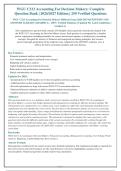
Elite Universal Test
Bank: Alberta Nursing
Practice Act
Jurisprudence
PART 0: THE (Table of Contents)
Section Cognitive Tier Focus Area
PART I The Preview Strategic Axioms & Regulatory
Frameworks
PART II Tier 1 (Questions 1–10) Foundational Syntax &
Statutory Application
PART II Tier 2 (Questions 11–20) Complex Application & Clinical
Simulation
PART II Tier 3 (Questions 21–30) Grandmaster Synthesis &
Jurisdictional Overlap
PART I: THE Preview
Mastering the intersection of clinical practice and Alberta's statutory frameworks separates the
competent technician from the legally invulnerable, elite practitioner. The regulatory landscape
in Alberta is not a set of abstract guidelines; it is a rigid, enforceable legal architecture that
dictates the absolute boundaries of professional survival. This test bank serves as a rigorous
cognitive forge. By internalizing these jurisdictional parameters, academic mastery translates
directly into flawless, high-stakes professional execution. The regulatory college (CRNA)
operates under the mandate to protect the public, not the practitioner, meaning every clinical
action must be defensible under provincial law.
To operate at the highest level of professional mastery, practitioners must deeply understand the
functional differences and intersecting boundaries of Alberta's core health legislation. Rather
than relying on rote memorization, elite scholars synthesize how these laws interact in real-time
clinical environments. The table below outlines the critical statutory domains that govern
practice, setting the foundation for the cognitive gauntlet that follows.
Legislative Statute Primary Regulatory Function Elite Application Concept
Health Professions Act (HPA) Defines the outer boundaries of Statute supersedes employer
nursing practice (Schedule 24) policy. A hospital cannot
and establishes the CRNA's authorize an out-of-scope
disciplinary authority. restricted activity.
,Legislative Statute Primary Regulatory Function Elite Application Concept
Health Information Act (HIA) Governs the collection, access, Unauthorized Netcare access
and disclosure of patient data, triggers Office of the
designating professionals as Information and Privacy
Custodians or Affiliates. Commissioner (OIPC)
prosecution.
Protection for Persons in Mandates the immediate The duty to report is personal
Care Act (PPCA) reporting of serious harm or and non-delegable. Informing a
exploitation in publicly funded manager does not satisfy the
care facilities. legal requirement.
Adult Guardianship and Provides the legal mechanism Health care providers must
Trusteeship Act (AGTA) (Specific Decision-Making) for strictly follow the ranked
proxy consent when an adult statutory list of relatives; clinical
lacks capacity. convenience cannot alter the
rank.
Personal Directives Act Empowers an adult to appoint A legally executed Personal
(PDA) an Agent for future personal Directive immediately
and health decisions. neutralizes and supersedes the
default AGTA ranked list of
relatives.
PART II: THE ELITE TEST BANK
Tier 1: Foundational Syntax & Application
Q1: A newly licensed Registered Nurse in Alberta is reviewing their authorized scope of
practice. They are asked by a unit manager to perform a specialized wound debridement
procedure that involves cutting below the dermis. According to the regulatory framework, which
statutory document defines the absolute outer limits of the Registered Nurse profession's scope
of practice? A) The Canadian Nurses Association (CNA) National Clinical Guidelines. B) The
specific employer’s internal clinical policy and procedure manual. C) Schedule 24 of the Health
Professions Act (HPA) and the Restricted Activity Regulation. D) The Protection for Persons in
Care Act (PPCA).
● The Answer: C (Schedule 24 of the Health Professions Act (HPA) and the Restricted
Activity Regulation.)
● Distractor Analysis:
○ A is incorrect: While national guidelines inform evidence-based practice, they do not
hold statutory legal authority over provincial licensure boundaries in Alberta.
○ B is incorrect: An employer's policy can restrict a nurse's scope, but it can never
expand it beyond the legislative limits established by provincial law.
○ D is incorrect: The PPCA governs the mandatory reporting of abuse in funded
facilities, not the clinical scope of restricted activities.
The Mentor's Analysis: Understanding jurisdictional supremacy is foundational to legal survival
in healthcare. When facing scope of practice uncertainties, the immediate priority is consulting
the provincial statute that governs your specific license. By utilizing Schedule 24 of the HPA, you
bypass the common trap of confusing administrative employer directives with actual legal
authority. Employer policies are operational protocols; the HPA is the supreme law of the
profession. Professional/Academic Intuition: Statute always supersedes policy. Your
, license belongs to the College under the HPA, not your employer.
Q2: Under the Health Information Act (HIA), health care professionals are designated with
specific roles regarding the control of patient data. If a Registered Nurse leaves Alberta Health
Services (AHS) to open a wholly independent, self-employed medical aesthetics clinic, how
does their legal designation under the HIA fundamentally change? A) They transition from an
Affiliate to a Custodian. B) They transition from a Custodian to an Affiliate. C) They remain an
Affiliate, as the CRNA holds the ultimate Custodian status for all registered nurses. D) They are
exempt from the HIA entirely and fall solely under federal privacy legislation.
● The Answer: A (They transition from an Affiliate to a Custodian.)
● Distractor Analysis:
○ B is incorrect: This is the reverse. AHS is the organizational Custodian when the
nurse operates as their employee, making the nurse an Affiliate.
○ C is incorrect: The regulatory college (CRNA) does not hold patient medical records
or act as the Custodian for independent practitioners' clinical data.
○ D is incorrect: The HIA directly applies to all individually identifying health
information collected to provide health services in Alberta, making the independent
clinic owner a statutory Custodian.
The Mentor's Analysis: Data liability shifts dramatically the moment a practitioner enters
private practice. When facing the transition to self-employment, the immediate priority is
establishing robust, compliant privacy protocols from day one. By utilizing Custodian status
parameters, you bypass the common trap of assuming your previous hospital-based privacy
training insulates you from your new, independent legal liabilities. As a Custodian, the ultimate
responsibility for privacy breaches rests entirely on your shoulders. Professional/Academic
Intuition: If you own the clinic and control the charts, you are the Custodian. If you work
for the hospital, you are the Affiliate.
Q3: The Continuing Competence Program (CCP) is mandated by the Health Professions Act to
ensure ongoing public safety. According to CRNA standards, how long must a registrant
maintain their completed CCP records, including self-assessments and learning plans, to
ensure compliance with a potential regulatory audit? A) Two years. B) Three years. C) Five
years. D) Ten years.
● The Answer: C (Five years.)
● Distractor Analysis:
○ A is incorrect: Two years is the statutory limit for a client to report historical abuse
under the PPCA, not the CCP audit retention period.
○ B is incorrect: Three years represents the timeline threshold for establishing an
adult interdependent relationship under the AGTA, completely unrelated to CCP
audits.
○ D is incorrect: Ten years is a standard for retaining pediatric medical records,
representing an overly burdensome and incorrect timeframe for personal
professional competence records.
The Mentor's Analysis: Regulatory audits are a standard mechanism of enforcing professional
accountability and protecting the public. When managing CCP documentation, the immediate
priority is secure, long-term retention of your learning trajectory. By utilizing the five-year
retention rule, you bypass the common trap of discarding self-reflective learning plans
immediately after your annual permit renewal clears. The regulatory body views competence not
as an annual checklist, but as a continuous, auditable evolution. Professional/Academic
Intuition: Competence is an auditable trail of continuous professional evolution; retain all
documentation for five years.
Bank: Alberta Nursing
Practice Act
Jurisprudence
PART 0: THE (Table of Contents)
Section Cognitive Tier Focus Area
PART I The Preview Strategic Axioms & Regulatory
Frameworks
PART II Tier 1 (Questions 1–10) Foundational Syntax &
Statutory Application
PART II Tier 2 (Questions 11–20) Complex Application & Clinical
Simulation
PART II Tier 3 (Questions 21–30) Grandmaster Synthesis &
Jurisdictional Overlap
PART I: THE Preview
Mastering the intersection of clinical practice and Alberta's statutory frameworks separates the
competent technician from the legally invulnerable, elite practitioner. The regulatory landscape
in Alberta is not a set of abstract guidelines; it is a rigid, enforceable legal architecture that
dictates the absolute boundaries of professional survival. This test bank serves as a rigorous
cognitive forge. By internalizing these jurisdictional parameters, academic mastery translates
directly into flawless, high-stakes professional execution. The regulatory college (CRNA)
operates under the mandate to protect the public, not the practitioner, meaning every clinical
action must be defensible under provincial law.
To operate at the highest level of professional mastery, practitioners must deeply understand the
functional differences and intersecting boundaries of Alberta's core health legislation. Rather
than relying on rote memorization, elite scholars synthesize how these laws interact in real-time
clinical environments. The table below outlines the critical statutory domains that govern
practice, setting the foundation for the cognitive gauntlet that follows.
Legislative Statute Primary Regulatory Function Elite Application Concept
Health Professions Act (HPA) Defines the outer boundaries of Statute supersedes employer
nursing practice (Schedule 24) policy. A hospital cannot
and establishes the CRNA's authorize an out-of-scope
disciplinary authority. restricted activity.
,Legislative Statute Primary Regulatory Function Elite Application Concept
Health Information Act (HIA) Governs the collection, access, Unauthorized Netcare access
and disclosure of patient data, triggers Office of the
designating professionals as Information and Privacy
Custodians or Affiliates. Commissioner (OIPC)
prosecution.
Protection for Persons in Mandates the immediate The duty to report is personal
Care Act (PPCA) reporting of serious harm or and non-delegable. Informing a
exploitation in publicly funded manager does not satisfy the
care facilities. legal requirement.
Adult Guardianship and Provides the legal mechanism Health care providers must
Trusteeship Act (AGTA) (Specific Decision-Making) for strictly follow the ranked
proxy consent when an adult statutory list of relatives; clinical
lacks capacity. convenience cannot alter the
rank.
Personal Directives Act Empowers an adult to appoint A legally executed Personal
(PDA) an Agent for future personal Directive immediately
and health decisions. neutralizes and supersedes the
default AGTA ranked list of
relatives.
PART II: THE ELITE TEST BANK
Tier 1: Foundational Syntax & Application
Q1: A newly licensed Registered Nurse in Alberta is reviewing their authorized scope of
practice. They are asked by a unit manager to perform a specialized wound debridement
procedure that involves cutting below the dermis. According to the regulatory framework, which
statutory document defines the absolute outer limits of the Registered Nurse profession's scope
of practice? A) The Canadian Nurses Association (CNA) National Clinical Guidelines. B) The
specific employer’s internal clinical policy and procedure manual. C) Schedule 24 of the Health
Professions Act (HPA) and the Restricted Activity Regulation. D) The Protection for Persons in
Care Act (PPCA).
● The Answer: C (Schedule 24 of the Health Professions Act (HPA) and the Restricted
Activity Regulation.)
● Distractor Analysis:
○ A is incorrect: While national guidelines inform evidence-based practice, they do not
hold statutory legal authority over provincial licensure boundaries in Alberta.
○ B is incorrect: An employer's policy can restrict a nurse's scope, but it can never
expand it beyond the legislative limits established by provincial law.
○ D is incorrect: The PPCA governs the mandatory reporting of abuse in funded
facilities, not the clinical scope of restricted activities.
The Mentor's Analysis: Understanding jurisdictional supremacy is foundational to legal survival
in healthcare. When facing scope of practice uncertainties, the immediate priority is consulting
the provincial statute that governs your specific license. By utilizing Schedule 24 of the HPA, you
bypass the common trap of confusing administrative employer directives with actual legal
authority. Employer policies are operational protocols; the HPA is the supreme law of the
profession. Professional/Academic Intuition: Statute always supersedes policy. Your
, license belongs to the College under the HPA, not your employer.
Q2: Under the Health Information Act (HIA), health care professionals are designated with
specific roles regarding the control of patient data. If a Registered Nurse leaves Alberta Health
Services (AHS) to open a wholly independent, self-employed medical aesthetics clinic, how
does their legal designation under the HIA fundamentally change? A) They transition from an
Affiliate to a Custodian. B) They transition from a Custodian to an Affiliate. C) They remain an
Affiliate, as the CRNA holds the ultimate Custodian status for all registered nurses. D) They are
exempt from the HIA entirely and fall solely under federal privacy legislation.
● The Answer: A (They transition from an Affiliate to a Custodian.)
● Distractor Analysis:
○ B is incorrect: This is the reverse. AHS is the organizational Custodian when the
nurse operates as their employee, making the nurse an Affiliate.
○ C is incorrect: The regulatory college (CRNA) does not hold patient medical records
or act as the Custodian for independent practitioners' clinical data.
○ D is incorrect: The HIA directly applies to all individually identifying health
information collected to provide health services in Alberta, making the independent
clinic owner a statutory Custodian.
The Mentor's Analysis: Data liability shifts dramatically the moment a practitioner enters
private practice. When facing the transition to self-employment, the immediate priority is
establishing robust, compliant privacy protocols from day one. By utilizing Custodian status
parameters, you bypass the common trap of assuming your previous hospital-based privacy
training insulates you from your new, independent legal liabilities. As a Custodian, the ultimate
responsibility for privacy breaches rests entirely on your shoulders. Professional/Academic
Intuition: If you own the clinic and control the charts, you are the Custodian. If you work
for the hospital, you are the Affiliate.
Q3: The Continuing Competence Program (CCP) is mandated by the Health Professions Act to
ensure ongoing public safety. According to CRNA standards, how long must a registrant
maintain their completed CCP records, including self-assessments and learning plans, to
ensure compliance with a potential regulatory audit? A) Two years. B) Three years. C) Five
years. D) Ten years.
● The Answer: C (Five years.)
● Distractor Analysis:
○ A is incorrect: Two years is the statutory limit for a client to report historical abuse
under the PPCA, not the CCP audit retention period.
○ B is incorrect: Three years represents the timeline threshold for establishing an
adult interdependent relationship under the AGTA, completely unrelated to CCP
audits.
○ D is incorrect: Ten years is a standard for retaining pediatric medical records,
representing an overly burdensome and incorrect timeframe for personal
professional competence records.
The Mentor's Analysis: Regulatory audits are a standard mechanism of enforcing professional
accountability and protecting the public. When managing CCP documentation, the immediate
priority is secure, long-term retention of your learning trajectory. By utilizing the five-year
retention rule, you bypass the common trap of discarding self-reflective learning plans
immediately after your annual permit renewal clears. The regulatory body views competence not
as an annual checklist, but as a continuous, auditable evolution. Professional/Academic
Intuition: Competence is an auditable trail of continuous professional evolution; retain all
documentation for five years.