

General Chemistry 2 Online
Hess's Law
Final Report
Student Name Bader Alanazi
Student ID 179041
Lesson Hess's Law
Institution Arkansas State University-Newport
Session Summer 2021 - D2-25
Course General Chemistry 2 Online
Instructor Ed Jones
Test Your Knowledge
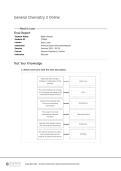
1. Match each term with the best description.
States the total change in
enthalpy is independent of the 1 Hess's Law
pathway
The unit of measure for change
in the enthalpy according to the 2 Joule
International System of Units
Reaction that absorbs heat
from the surrounding 3 Endothermic
environment
The study of heat that
accompanies chemical 4 Thermochemistry
reactions
Reaction that releases heat to
5 Exothermic
the surrounding environment
The internal energy of a system
that includes heat plus the 6 Enthalpy
product of pressure and volume
Copyright 2021 - Science Interactive | https://scienceinteractive.com
, 2. Categorize each statement as representing an exothermic or endothermic
reaction.
Exothermic Endothermic
1 Temperature increases 2 Heat is absorbed from surroundings
The change in enthalpy is a negative Temperature decreases
number
The change in enthalpy is a positive
Heat is released to surroundings number
3. Match term with the correct equation.
= Moles of solute (mol)/ volume of solution (L) 1 Molarity
= Final temperature - Initial temperature 2 Change in temperature
= (mass of solution) x (specific heat) x ΔT 3 Heat gain or loss
Experimental value - Theoretical value
× 100% 4 Percent Error
(Theoretical value)
= Hproducts - Hreactants 5 Change in enthalpy
Exploration
1. When an _____ reaction occurs in an aqueous solution, heat will be
released to the water.
endothermic
exothermic
Copyright 2021 - Science Interactive | https://scienceinteractive.com
, 2. Enthalpy is the external energy of the system, E, which includes heat
plus the product of pressure and volume.
True
False
3. The change in enthalpy of a reaction is equal to the enthalpy of the
reactants minus the enthalpy of the products.
True
False
4. When a reaction is exothermic, the enthalpy of the products is _____ the
reactants.
greater than
less than
equal to
5. Hess's law states that the total change in enthalpy is independent of the
pathway.
True
False
Exercise 1
Copyright 2021 - Science Interactive | https://scienceinteractive.com
Hess's Law
Final Report
Student Name Bader Alanazi
Student ID 179041
Lesson Hess's Law
Institution Arkansas State University-Newport
Session Summer 2021 - D2-25
Course General Chemistry 2 Online
Instructor Ed Jones
Test Your Knowledge
1. Match each term with the best description.
States the total change in
enthalpy is independent of the 1 Hess's Law
pathway
The unit of measure for change
in the enthalpy according to the 2 Joule
International System of Units
Reaction that absorbs heat
from the surrounding 3 Endothermic
environment
The study of heat that
accompanies chemical 4 Thermochemistry
reactions
Reaction that releases heat to
5 Exothermic
the surrounding environment
The internal energy of a system
that includes heat plus the 6 Enthalpy
product of pressure and volume
Copyright 2021 - Science Interactive | https://scienceinteractive.com
, 2. Categorize each statement as representing an exothermic or endothermic
reaction.
Exothermic Endothermic
1 Temperature increases 2 Heat is absorbed from surroundings
The change in enthalpy is a negative Temperature decreases
number
The change in enthalpy is a positive
Heat is released to surroundings number
3. Match term with the correct equation.
= Moles of solute (mol)/ volume of solution (L) 1 Molarity
= Final temperature - Initial temperature 2 Change in temperature
= (mass of solution) x (specific heat) x ΔT 3 Heat gain or loss
Experimental value - Theoretical value
× 100% 4 Percent Error
(Theoretical value)
= Hproducts - Hreactants 5 Change in enthalpy
Exploration
1. When an _____ reaction occurs in an aqueous solution, heat will be
released to the water.
endothermic
exothermic
Copyright 2021 - Science Interactive | https://scienceinteractive.com
, 2. Enthalpy is the external energy of the system, E, which includes heat
plus the product of pressure and volume.
True
False
3. The change in enthalpy of a reaction is equal to the enthalpy of the
reactants minus the enthalpy of the products.
True
False
4. When a reaction is exothermic, the enthalpy of the products is _____ the
reactants.
greater than
less than
equal to
5. Hess's law states that the total change in enthalpy is independent of the
pathway.
True
False
Exercise 1
Copyright 2021 - Science Interactive | https://scienceinteractive.com


