1
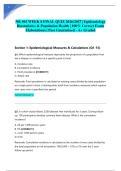
NR 503 WEEK 8 FINAL QUIZ 2026/2027 | Epidemiology
Biostatistics & Population Health | 100% Correct Exam
Elaborations | Pass Guaranteed - A+ Graded
Section 1: Epidemiological Measures & Calculations (Q1-15)
Q1. Which epidemiological measure represents the proportion of a population that
has a disease or condition at a specific point in time?
A. Incidence rate
B. Cumulative incidence
C. Point prevalence [CORRECT]
D. Attack rate
Rationale: Point prevalence is calculated as existing cases divided by total population
at a single point in time; it distinguishes itself from incidence measures which capture
new cases over a specified time period.
Correct Answer: C
Q2. A cohort study follows 2,000 disease-free individuals for 5 years. During follow-
up, 100 participants develop coronary heart disease. What is the cumulative
incidence?
A. 20 per 1,000 person-years
B. 5% [CORRECT]
C. 2 per 1,000 person-years
D. 0.5%
Rationale: Cumulative incidence is calculated as the number of new cases divided by
the total population at risk at baseline: 100/2,000 = 0.05 or 5% over the 5-year
follow-up period.
,2
Correct Answer: B
Q3. On January 1, 2025, a community has 400 existing cases of asthma. During 2025,
100 new cases are diagnosed. No cases migrate or are lost to follow-up. The total
population is 10,000. What is the period prevalence for 2025?
A. 400/10,000
B. 100/10,000
C. 500/10,000 [CORRECT]
D. 300/10,000
Rationale: Period prevalence includes all cases that exist at any time during the
specified period, calculated as existing cases plus new cases divided by total
population: (400 + 100)/10,000 = 5%.
Correct Answer: C
Q4. At a wedding reception with 150 guests, 45 guests who ate the chicken entrée
developed salmonella within 24 hours, while 10 guests who did not eat the chicken
also became ill. Among the 100 guests who ate chicken, what is the attack rate?
A. 30%
B. 35%
C. 45% [CORRECT]
D. 55%
Rationale: The attack rate is calculated as the number of people who ate the
implicated food and became ill divided by the total number who ate that food:
45/100 = 45%, indicating a strong association between chicken consumption and
illness.
Correct Answer: C
, 3
Q5. During a measles outbreak, a primary case occurs in a classroom of 30 students.
Over the next 14 days, 9 of the 25 susceptible classmates who had close contact with
the index case develop measles. What is the secondary attack rate?
A. 9/30 = 30%
B. 9/25 = 36% [CORRECT]
C. 9/10 = 90%
D. 10/25 = 40%
Rationale: The secondary attack rate is calculated as new cases among susceptible
contacts divided by total susceptible contacts: 9/25 = 36%, reflecting the high
infectivity of measles in a susceptible population.
Correct Answer: B
Q6. In a city with a population of 250,000, there were 1,250 deaths from all causes in
2024. What is the crude mortality rate?
A. 2.5 per 1,000
B. 5.0 per 1,000 [CORRECT]
C. 10.0 per 1,000
D. 1.25 per 1,000
Rationale: The crude mortality rate is calculated as total deaths divided by total
population multiplied by a standard denominator: (1,250/250,000) × 1,000 = 5.0
deaths per 1,000 population.
Correct Answer: B
Q7. During an Ebola outbreak, 200 people are diagnosed with the disease. Of these,
120 die. What is the case fatality rate?
A. 60% [CORRECT]
B. 40%
NR 503 WEEK 8 FINAL QUIZ 2026/2027 | Epidemiology
Biostatistics & Population Health | 100% Correct Exam
Elaborations | Pass Guaranteed - A+ Graded
Section 1: Epidemiological Measures & Calculations (Q1-15)
Q1. Which epidemiological measure represents the proportion of a population that
has a disease or condition at a specific point in time?
A. Incidence rate
B. Cumulative incidence
C. Point prevalence [CORRECT]
D. Attack rate
Rationale: Point prevalence is calculated as existing cases divided by total population
at a single point in time; it distinguishes itself from incidence measures which capture
new cases over a specified time period.
Correct Answer: C
Q2. A cohort study follows 2,000 disease-free individuals for 5 years. During follow-
up, 100 participants develop coronary heart disease. What is the cumulative
incidence?
A. 20 per 1,000 person-years
B. 5% [CORRECT]
C. 2 per 1,000 person-years
D. 0.5%
Rationale: Cumulative incidence is calculated as the number of new cases divided by
the total population at risk at baseline: 100/2,000 = 0.05 or 5% over the 5-year
follow-up period.
,2
Correct Answer: B
Q3. On January 1, 2025, a community has 400 existing cases of asthma. During 2025,
100 new cases are diagnosed. No cases migrate or are lost to follow-up. The total
population is 10,000. What is the period prevalence for 2025?
A. 400/10,000
B. 100/10,000
C. 500/10,000 [CORRECT]
D. 300/10,000
Rationale: Period prevalence includes all cases that exist at any time during the
specified period, calculated as existing cases plus new cases divided by total
population: (400 + 100)/10,000 = 5%.
Correct Answer: C
Q4. At a wedding reception with 150 guests, 45 guests who ate the chicken entrée
developed salmonella within 24 hours, while 10 guests who did not eat the chicken
also became ill. Among the 100 guests who ate chicken, what is the attack rate?
A. 30%
B. 35%
C. 45% [CORRECT]
D. 55%
Rationale: The attack rate is calculated as the number of people who ate the
implicated food and became ill divided by the total number who ate that food:
45/100 = 45%, indicating a strong association between chicken consumption and
illness.
Correct Answer: C
, 3
Q5. During a measles outbreak, a primary case occurs in a classroom of 30 students.
Over the next 14 days, 9 of the 25 susceptible classmates who had close contact with
the index case develop measles. What is the secondary attack rate?
A. 9/30 = 30%
B. 9/25 = 36% [CORRECT]
C. 9/10 = 90%
D. 10/25 = 40%
Rationale: The secondary attack rate is calculated as new cases among susceptible
contacts divided by total susceptible contacts: 9/25 = 36%, reflecting the high
infectivity of measles in a susceptible population.
Correct Answer: B
Q6. In a city with a population of 250,000, there were 1,250 deaths from all causes in
2024. What is the crude mortality rate?
A. 2.5 per 1,000
B. 5.0 per 1,000 [CORRECT]
C. 10.0 per 1,000
D. 1.25 per 1,000
Rationale: The crude mortality rate is calculated as total deaths divided by total
population multiplied by a standard denominator: (1,250/250,000) × 1,000 = 5.0
deaths per 1,000 population.
Correct Answer: B
Q7. During an Ebola outbreak, 200 people are diagnosed with the disease. Of these,
120 die. What is the case fatality rate?
A. 60% [CORRECT]
B. 40%