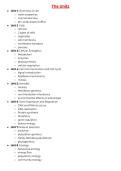
The Units
● Unit 1: Chemistry of Life
○ water properties
○ macromolecules
○ pH, acids, bases, buffers
● Unit 2: Cells
○ cell size
○ 2 types of cells
○ organelles
○ cell membrane
○ membrane transport
○ osmosis
● Unit 3: Cellular Energetics
○ Metabolism
○ enzymes
○ photosynthesis
○ cellular respiration.
● Unit 4: Cell Communication and Cell Cycle
○ signal transduction
○ feedback mechanisms
○ mitosis
● Unit 5: Heredity
○ meiosis
○ Mendelian genetics
○ non-Mendelian inheritance
○ environmental effects on phenotype
● Unit 6: Gene Expression and Regulation
○ DNA and RNA structure
○ DNA replication
○ Protein synthesis
○ Mutations
○ gene regulation
○ biotechnology.
● Unit 7: Natural Selection
○ evolution
○ population genetics
○ Hardy-Weinberg equilibrium
○ phylogenetics
● Unit 8: Ecology
○ behavioral ecology
○ energy flow
○ population ecology
○ community ecology
, Unit 1: Chemistry of Life
Topics:
● Properties of water
● Macromolecules
● pH scale
, Properties of Water
Cohesive & Adhesive Behavior
● Water has the ability to form hydrogen bonds (partial positive hydrogen atoms in the
water bond w/ partial negative oxygen atoms in other water molecules) which makes it
have the ability to do cohesion and adhesion as well as high surface tension
● Cohesion: The linking together of water molecules w/ other water molecules, often by
hydrogen bonds
○ Hint: think CO as in COoperative work w/ your buddy—the water molecules buddy
up and COoperate 4
● Adhesion: The clinging of water to other substances by means of hydrogen bonds
○ Hint: the of ADHESIVE tape that sticks other things together
○ Example: In the water lab, the microscope slide stuck to the lab table because of
adhesion—the water molecules clung to the surface of the slide and table
● Cohesion causes water to have high Surface Tension: it’s difficult for things to break the
surface of water
○ Example: the paper clips that floated on the water
High Heat Capacity & Heat of Vaporization
High Specific Heat
● Water will resist changes in temperature. When it does change temperature, it absorbs or
loses a relatively large amount of heat for each degree of change
● Water resists temperature change because hydrogen bonds must be broken before
molecules can move faster.
● Functions/Examples:
○ moderate air temperatures in coastal areas
○ creates ideal conditions for marine life
○ organisms are better able to resist changes in their own temperature
Heat of Vaporization
● A lot of heat is needed to evaporate water because hydrogen bonds need a lot of energy
to be broken
● Functions/Examples:
○ contributes to stability of temperature in lakes and ponds
○ Moderates Earth’s climate
○ evaporation of sweat dissipates body heat
Expansion Upon Freezing
● Water is less dense as a solid than as a liquid - ice floats on water
○ When water freezes, hydrogen bonds form a crystalline lattice that spaces
molecules farther apart
● Insulates aquatic organisms in winter when ice freezes
, Versatility As A Solvent
● Water is polar: has partial positive & negative charge
● Water can dissolve a lot of things
● Like dissolves like: polar dissolves polar
● Hydrophilic: attracted to water
○ substances can be hydrophilic w/o actually dissolving in water
○ ex: cotton doesn’t dissolve in water, but absorbs it because of its cellulose fibers
● Hydrophobic: repelled by water
○ Substances that are nonionic and nonpolar repel water
○ ex: vegetable oil, hydrophobic molecules related to oils in cell membranes
● Things soluble in water:
○ ionic compounds
○ nonionic polar molecules (ie sugars)
○ proteins
Summary
● Water has 4 properties: cohesive/adhesive behavior, temperature regulation, expands
when frozen, and is a versatile solvent
● Many of these properties are due to water’s ability to form hydrogen bonds, and is polar
Where This Topic Might Appear On The Exam
● The tree question: How does water get from roots to leaves in a tree/plan?
○ Answer: Transpiration (evaporation from leaves) creates negative pressure in the
xylem. Cohesion pulls water molecules upward, and adhesion helps water cling to
the xylem walls.
● Question gives an example of a specific water property and you have to match it
● Unit 1: Chemistry of Life
○ water properties
○ macromolecules
○ pH, acids, bases, buffers
● Unit 2: Cells
○ cell size
○ 2 types of cells
○ organelles
○ cell membrane
○ membrane transport
○ osmosis
● Unit 3: Cellular Energetics
○ Metabolism
○ enzymes
○ photosynthesis
○ cellular respiration.
● Unit 4: Cell Communication and Cell Cycle
○ signal transduction
○ feedback mechanisms
○ mitosis
● Unit 5: Heredity
○ meiosis
○ Mendelian genetics
○ non-Mendelian inheritance
○ environmental effects on phenotype
● Unit 6: Gene Expression and Regulation
○ DNA and RNA structure
○ DNA replication
○ Protein synthesis
○ Mutations
○ gene regulation
○ biotechnology.
● Unit 7: Natural Selection
○ evolution
○ population genetics
○ Hardy-Weinberg equilibrium
○ phylogenetics
● Unit 8: Ecology
○ behavioral ecology
○ energy flow
○ population ecology
○ community ecology
, Unit 1: Chemistry of Life
Topics:
● Properties of water
● Macromolecules
● pH scale
, Properties of Water
Cohesive & Adhesive Behavior
● Water has the ability to form hydrogen bonds (partial positive hydrogen atoms in the
water bond w/ partial negative oxygen atoms in other water molecules) which makes it
have the ability to do cohesion and adhesion as well as high surface tension
● Cohesion: The linking together of water molecules w/ other water molecules, often by
hydrogen bonds
○ Hint: think CO as in COoperative work w/ your buddy—the water molecules buddy
up and COoperate 4
● Adhesion: The clinging of water to other substances by means of hydrogen bonds
○ Hint: the of ADHESIVE tape that sticks other things together
○ Example: In the water lab, the microscope slide stuck to the lab table because of
adhesion—the water molecules clung to the surface of the slide and table
● Cohesion causes water to have high Surface Tension: it’s difficult for things to break the
surface of water
○ Example: the paper clips that floated on the water
High Heat Capacity & Heat of Vaporization
High Specific Heat
● Water will resist changes in temperature. When it does change temperature, it absorbs or
loses a relatively large amount of heat for each degree of change
● Water resists temperature change because hydrogen bonds must be broken before
molecules can move faster.
● Functions/Examples:
○ moderate air temperatures in coastal areas
○ creates ideal conditions for marine life
○ organisms are better able to resist changes in their own temperature
Heat of Vaporization
● A lot of heat is needed to evaporate water because hydrogen bonds need a lot of energy
to be broken
● Functions/Examples:
○ contributes to stability of temperature in lakes and ponds
○ Moderates Earth’s climate
○ evaporation of sweat dissipates body heat
Expansion Upon Freezing
● Water is less dense as a solid than as a liquid - ice floats on water
○ When water freezes, hydrogen bonds form a crystalline lattice that spaces
molecules farther apart
● Insulates aquatic organisms in winter when ice freezes
, Versatility As A Solvent
● Water is polar: has partial positive & negative charge
● Water can dissolve a lot of things
● Like dissolves like: polar dissolves polar
● Hydrophilic: attracted to water
○ substances can be hydrophilic w/o actually dissolving in water
○ ex: cotton doesn’t dissolve in water, but absorbs it because of its cellulose fibers
● Hydrophobic: repelled by water
○ Substances that are nonionic and nonpolar repel water
○ ex: vegetable oil, hydrophobic molecules related to oils in cell membranes
● Things soluble in water:
○ ionic compounds
○ nonionic polar molecules (ie sugars)
○ proteins
Summary
● Water has 4 properties: cohesive/adhesive behavior, temperature regulation, expands
when frozen, and is a versatile solvent
● Many of these properties are due to water’s ability to form hydrogen bonds, and is polar
Where This Topic Might Appear On The Exam
● The tree question: How does water get from roots to leaves in a tree/plan?
○ Answer: Transpiration (evaporation from leaves) creates negative pressure in the
xylem. Cohesion pulls water molecules upward, and adhesion helps water cling to
the xylem walls.
● Question gives an example of a specific water property and you have to match it