

1
,Number System (BS Level Notes)
A Number System is a way of representing numbers using digits or symbols. In Computer
Science and Digital Logic Design, number systems are very important because computers store
and process data in binary form.
Types of Number Systems
There are four main number systems:
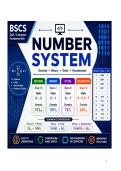
Number System Base (Radix) Digits Used
Decimal 10 0–9
Binary 2 0, 1
Octal 8 0–7
Hexadecimal 16 0–9, A–F
1. Decimal Number System (Base 10)
The decimal system is the number system used in daily life.
Digits Used
0, 1, 2, 3, 4, 5, 6, 7, 8, 9
Example
Number = 573
Expanded form:
2
, 573=(5×10²)+(7×101)+(3×100)573 = (5 \times 10^2) + (7 \times 10^1) + (3 \times
10^0)573=(5×10²)+(7×101)+(3×100) =500+70+3= 500 + 70 + 3=500+70+3 =573= 573=573
Applications
● Daily calculations
● Banking systems
● Mathematics
2. Binary Number System (Base 2)
The binary system is the most important number system in computers.
Digits Used
0 and 1
Each digit is called a Bit (Binary Digit).
Example
Binary Number = 1011₂
Expanded form:
10112=(1×23)+(0×22)+(1×21)+(1×20)1011_2
=(1\times2^3)+(0\times2^2)+(1\times2^1)+(1\times2^0)10112
=(1×23)+(0×22)+(1×21)+(1×20) =(1×8)+(0×4)+(1×2)+(1×1)
=(1\times8)+(0\times4)+(1\times2)+(1\times1)
=(1×8)+(0×4)+(1×2)+(1×1) =8+0+2+1=8+0+2+1=8+0+2+1 =1110=11_{10}=1110
Therefore,
10112=11101011_2 = 11_{10}10112=1110
Applications
● Computer memory
● Digital circuits
● Data storage
3. Octal Number System (Base 8)
3
,Number System (BS Level Notes)
A Number System is a way of representing numbers using digits or symbols. In Computer
Science and Digital Logic Design, number systems are very important because computers store
and process data in binary form.
Types of Number Systems
There are four main number systems:
Number System Base (Radix) Digits Used
Decimal 10 0–9
Binary 2 0, 1
Octal 8 0–7
Hexadecimal 16 0–9, A–F
1. Decimal Number System (Base 10)
The decimal system is the number system used in daily life.
Digits Used
0, 1, 2, 3, 4, 5, 6, 7, 8, 9
Example
Number = 573
Expanded form:
2
, 573=(5×10²)+(7×101)+(3×100)573 = (5 \times 10^2) + (7 \times 10^1) + (3 \times
10^0)573=(5×10²)+(7×101)+(3×100) =500+70+3= 500 + 70 + 3=500+70+3 =573= 573=573
Applications
● Daily calculations
● Banking systems
● Mathematics
2. Binary Number System (Base 2)
The binary system is the most important number system in computers.
Digits Used
0 and 1
Each digit is called a Bit (Binary Digit).
Example
Binary Number = 1011₂
Expanded form:
10112=(1×23)+(0×22)+(1×21)+(1×20)1011_2
=(1\times2^3)+(0\times2^2)+(1\times2^1)+(1\times2^0)10112
=(1×23)+(0×22)+(1×21)+(1×20) =(1×8)+(0×4)+(1×2)+(1×1)
=(1\times8)+(0\times4)+(1\times2)+(1\times1)
=(1×8)+(0×4)+(1×2)+(1×1) =8+0+2+1=8+0+2+1=8+0+2+1 =1110=11_{10}=1110
Therefore,
10112=11101011_2 = 11_{10}10112=1110
Applications
● Computer memory
● Digital circuits
● Data storage
3. Octal Number System (Base 8)
3


