Sherpath Notes PEDS Exam_NURS 3628 Sherpath Notes PEDS Exam Study Guide.
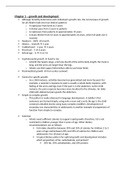
Chapter 1 – growth and development • Although heredity determines each individual’s growth rate, the normal pace of growth for all children falls into four distinct patterns: o A rapid pace from birth to 2 years o A slower pace from 2 years to puberty o A rapid pace from puberty to approximately 15 years o A sharp decline from 16 years to approximately 24 years, when full adult size is reached • Newborn – Birth 1month • Infancy – 1month 1 year • Toddlerhood – 1 year 3 years • Preschool – 3 6 years • School age – 6 11 or 12 • Cephalocaudal growth head to toe o At birth the head is large, a full one-fourth of the entire body length; the trunk is long; and the arms are longer than the legs. o Infants use their upper limbs before able to use lower limbs • Proximodistal growth from center outward • General to specific growth o As a child matures, activities become less generalized and more focused. For example, a neonate’s response to pain is usually a whole-body response, with flailing of the arms and legs even if the pain is in the abdomen. As the child matures, the pain response becomes more localized to the stimulus. An older child with abdominal pain guards the abdomen. • Simple to complex growth o This pattern is easily observed in language development. A toddler’s first sentences are formed simply, using only a noun and a verb. By age 5, the child constructs detailed stories using many complex modifiers. Development of secondary sex characteristics in adolescents is another example of progression of function from simple to complex. • Nutrition o Infants need sufficient calories to support rapid growth; therefore, fat is not restricted in children younger than 2 years of age. Other dietary recommendations are as follows: Fat intake should be between 30% and 35% of calories for children 2 to 3 years of age and between 25% and 35% of calories for children and adolescents 4 to 18 years of age. A typical dietary pattern for optimal growth and development includes which proportions of fat, carbohydrate, and protein? • 20% fat, 50% carbohydrate, and 30% protein
Document information
- Uploaded on
- June 2, 2021
- Number of pages
- 31
- Written in
- 2020/2021
- Type
- Exam (elaborations)
- Contains
- Questions & answers