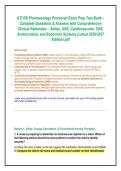
ATI RN Pharmacology Proctored Exam Prep Test Bank –
Complete Questions & Answers with Comprehensive
Clinical Rationales – Safety, ANS, Cardiovascular, CNS,
Antimicrobial, and Endocrine Systems (Latest 2026/2027
Edition) pdf
What’s Inside:
1. Foundational Nursing Safety & Math: Master dynamic IV drip calculations, elderly GFR dose reductions,
trough monitoring intervals, and immediate priority responses following a medication error.
2. Autonomic & Respiratory Therapeutics: Lock down your knowledge of SABA rescue mechanics, inhaled
steroid thrush prevention steps, and anticholinergic systemic checks.
3. Cardiovascular & Fluid Dynamics: Fully understand RAAS hyperkalemia risks, Digoxin apical pulse
margins, loop vs. potassium-sparing diuretic profiles, and high-alert coagulation monitors (PT/INR vs.
aPTT).
4. Central Nervous System Interventions: Perfect your tracking of Parkinson's wearing-off adjustments, the
opioid overdose triad, Phenytoin oral hygiene mandates, and life-threatening Serotonin Syndrome vs.
Neuroleptic Malignant Syndrome (NMS) markers.
5. Antimicrobials & Endocrine Regulators: Dominate high-alert medication protocols, including
Vancomycin rate safety steps, aminoglycoside organ toxicity checks, rapid-acting insulin meal alignments,
and acute adrenal crisis avoidance via HPA taper lines.
pass your proctored exam with a Level 3 score, and walk into your ATI testing center
with total confidence!
Section 1: Safety, Dosage Calculations, & Foundational Nursing Principles
1. A nurse is preparing to administer an intramuscular injection to a client. Which of
the following actions should the nurse perform to confirm the client's identity
securely?
A) Check the room number on the door against the medication administration record (MAR).
B) Compare the client's full name and medical record number on their identification
,band with the MAR.
C) Ask a coworker to verify the client's identity from memory.
D) Rely solely on the client answering "yes" when their name is called.
Safe medication administration requires using at least two independent identifiers (such as
full name, date of birth, or medical record number) cross-referenced directly with the MAR to
prevent errors.
2. A provider prescribes a medication to be administered "PC." The nurse should
schedule the administration of this medication for which of the following times?
A) One hour prior to a meal
B) Within 30 to 60 minutes after a meal
C) Immediately upon the client waking up
D) At bedtime on an empty stomach
The medical abbreviation "PC" (post cibum) means after meals. Medications with this
designation are usually given within 30 to 60 minutes after eating to optimize absorption or
reduce gastric irritation.
3. A nurse is calculating an intravenous infusion rate. The prescription is for 1,000
mL of 0.9% Normal Saline to infuse over 8 hours. The drop factor of the tubing is 15
gtt/mL. The nurse should regulate the infusion pump to deliver how many drops per
minute (gtt/min)? [
A) 21 gtt/min
B) 31 gtt/min
C) 42 gtt/min
D) 63 gtt/min
Use the formula: \(\frac{\text{Total\ Volume\ (mL)}\times \text{Drop\ Factor\
(gtt/mL)}}{\text{Total\ Time\ (minutes)}}\). This gives: \(\frac{1,000 \times 15}{8 \times 60} =
\frac{15,000}{480} = 31.25\). Rounding to the nearest whole number yields 31 gtt/min.
4. A client has a prescription for a transdermal fentanyl patch for chronic pain
management. Which of the following instructions should the nurse include in the
teaching plan?
A) Apply a heating pad over the patch site to accelerate absorption.
B) Cleanse the old site with water, apply the new patch to a hairless area, and fold the
old patch in half before discarding in a biohazard container.
C) Trim the edges of the patch with scissors if it is too large for the site.
D) Leave the old patch in place for 24 hours after applying a new patch.
, Applying external heat to a transdermal patch is dangerous because it can cause rapid,
toxic absorption of fentanyl. Old patches must be removed before new ones are placed,
folded to contain medication residue, and disposed of securely.
5. A nurse is preparing to administer an absolute high-alert liquid medication via an
enteral feeding tube. Which of the following actions is a safety priority?
A) Mix the medication thoroughly with the client's entire volume of enteral formula.
B) Flush the tube with 15 to 30 mL of water before and after administering the
medication.
C) Administer the medication directly into the tube without checking tube placement.
D) Clamp the enteral tube permanently for 4 hours following administration.
Enteral tubes must be flushed with water before and after each medication to maintain tube
patency, verify delivery, and prevent drug-formula interactions that can cause clogs.
6. A nurse is reviewing a client's medication profile and notes a prescription for an
extended-release capsule. Which of the following instructions should the nurse
provide to the client?
A) Chew the capsule thoroughly to accelerate its therapeutic onset.
B) Swallow the capsule whole without crushing, breaking, or chewing it.
C) Dissolve the capsule contents in a glass of warm orange juice.
D) Take the capsule content sublingually for immediate systemic absorption.
Crushing, chewing, or breaking an extended-release (ER/XR) or enteric-coated medication
destroys its slow-release matrix, which can lead to a dangerous, rapid absorption of the
entire dose. [1]
7. A nurse makes a medication error by administering the wrong dose of an
antihypertensive drug to a client. Which of the following actions should the nurse
take first?
A) Complete an institutional incident and variance report.
B) Notify the healthcare provider immediately.
C) Assess the client's vital signs and monitor for adverse effects.
D) Inform the nursing supervisor about the error.
The nurse's immediate priority must always be client safety. When a medication error
occurs, the first step is to assess the client for adverse effects and stabilize their condition
before completing administrative notifications. [1]
8. Which of the following pharmacokinetic terms describes the process by which a
drug transitions from its site of administration into the systemic bloodstream?
, A) Distribution
B) Metabolism
C) Absorption
D) Excretion
Absorption is the specific phase of pharmacokinetics that measures the movement of a
drug from its point of entry into the intravascular system. [1]
9. A nurse is caring for an older adult client who has age-related decreases in
glomerular filtration rate (GFR). The nurse should monitor this client for which of the
following medication alterations?
A) Accelerated hepatic biotransformation
B) Decreased systemic volume of distribution
C) Prolonged drug half-life and an increased risk of toxic drug accumulation
D) Malabsorption of liquid oral medications
Decreases in renal clearance slow down the excretion of water-soluble drugs and their
metabolites, extending their half-life and increasing the risk of systemic toxicity if dosages
are not adjusted.
10. A nurse is reviewing a medication level panel for a client who is receiving a
continuous infusion. A "trough level" should be drawn at which of the following
times?
A) Exactly 30 minutes after completing the drug infusion
B) Immediately (0 to 30 minutes) prior to administering the next scheduled dose
C) At the midpoint interval between scheduled administrations
D) 2 hours following the initial loading dose
Trough levels measure the lowest concentration of a drug in the client's blood. To catch this
accurately, the blood sample must be collected right before the next scheduled dose is
administered.
🫁 Section 2: Autonomic Nervous System & Respiratory Medications
11. A nurse is caring for a client experiencing an acute asthma exacerbation. Which
of the following medications should the nurse administer first for immediate
bronchodilation?
A) Salmeterol
B) Albuterol
Complete Questions & Answers with Comprehensive
Clinical Rationales – Safety, ANS, Cardiovascular, CNS,
Antimicrobial, and Endocrine Systems (Latest 2026/2027
Edition) pdf
What’s Inside:
1. Foundational Nursing Safety & Math: Master dynamic IV drip calculations, elderly GFR dose reductions,
trough monitoring intervals, and immediate priority responses following a medication error.
2. Autonomic & Respiratory Therapeutics: Lock down your knowledge of SABA rescue mechanics, inhaled
steroid thrush prevention steps, and anticholinergic systemic checks.
3. Cardiovascular & Fluid Dynamics: Fully understand RAAS hyperkalemia risks, Digoxin apical pulse
margins, loop vs. potassium-sparing diuretic profiles, and high-alert coagulation monitors (PT/INR vs.
aPTT).
4. Central Nervous System Interventions: Perfect your tracking of Parkinson's wearing-off adjustments, the
opioid overdose triad, Phenytoin oral hygiene mandates, and life-threatening Serotonin Syndrome vs.
Neuroleptic Malignant Syndrome (NMS) markers.
5. Antimicrobials & Endocrine Regulators: Dominate high-alert medication protocols, including
Vancomycin rate safety steps, aminoglycoside organ toxicity checks, rapid-acting insulin meal alignments,
and acute adrenal crisis avoidance via HPA taper lines.
pass your proctored exam with a Level 3 score, and walk into your ATI testing center
with total confidence!
Section 1: Safety, Dosage Calculations, & Foundational Nursing Principles
1. A nurse is preparing to administer an intramuscular injection to a client. Which of
the following actions should the nurse perform to confirm the client's identity
securely?
A) Check the room number on the door against the medication administration record (MAR).
B) Compare the client's full name and medical record number on their identification
,band with the MAR.
C) Ask a coworker to verify the client's identity from memory.
D) Rely solely on the client answering "yes" when their name is called.
Safe medication administration requires using at least two independent identifiers (such as
full name, date of birth, or medical record number) cross-referenced directly with the MAR to
prevent errors.
2. A provider prescribes a medication to be administered "PC." The nurse should
schedule the administration of this medication for which of the following times?
A) One hour prior to a meal
B) Within 30 to 60 minutes after a meal
C) Immediately upon the client waking up
D) At bedtime on an empty stomach
The medical abbreviation "PC" (post cibum) means after meals. Medications with this
designation are usually given within 30 to 60 minutes after eating to optimize absorption or
reduce gastric irritation.
3. A nurse is calculating an intravenous infusion rate. The prescription is for 1,000
mL of 0.9% Normal Saline to infuse over 8 hours. The drop factor of the tubing is 15
gtt/mL. The nurse should regulate the infusion pump to deliver how many drops per
minute (gtt/min)? [
A) 21 gtt/min
B) 31 gtt/min
C) 42 gtt/min
D) 63 gtt/min
Use the formula: \(\frac{\text{Total\ Volume\ (mL)}\times \text{Drop\ Factor\
(gtt/mL)}}{\text{Total\ Time\ (minutes)}}\). This gives: \(\frac{1,000 \times 15}{8 \times 60} =
\frac{15,000}{480} = 31.25\). Rounding to the nearest whole number yields 31 gtt/min.
4. A client has a prescription for a transdermal fentanyl patch for chronic pain
management. Which of the following instructions should the nurse include in the
teaching plan?
A) Apply a heating pad over the patch site to accelerate absorption.
B) Cleanse the old site with water, apply the new patch to a hairless area, and fold the
old patch in half before discarding in a biohazard container.
C) Trim the edges of the patch with scissors if it is too large for the site.
D) Leave the old patch in place for 24 hours after applying a new patch.
, Applying external heat to a transdermal patch is dangerous because it can cause rapid,
toxic absorption of fentanyl. Old patches must be removed before new ones are placed,
folded to contain medication residue, and disposed of securely.
5. A nurse is preparing to administer an absolute high-alert liquid medication via an
enteral feeding tube. Which of the following actions is a safety priority?
A) Mix the medication thoroughly with the client's entire volume of enteral formula.
B) Flush the tube with 15 to 30 mL of water before and after administering the
medication.
C) Administer the medication directly into the tube without checking tube placement.
D) Clamp the enteral tube permanently for 4 hours following administration.
Enteral tubes must be flushed with water before and after each medication to maintain tube
patency, verify delivery, and prevent drug-formula interactions that can cause clogs.
6. A nurse is reviewing a client's medication profile and notes a prescription for an
extended-release capsule. Which of the following instructions should the nurse
provide to the client?
A) Chew the capsule thoroughly to accelerate its therapeutic onset.
B) Swallow the capsule whole without crushing, breaking, or chewing it.
C) Dissolve the capsule contents in a glass of warm orange juice.
D) Take the capsule content sublingually for immediate systemic absorption.
Crushing, chewing, or breaking an extended-release (ER/XR) or enteric-coated medication
destroys its slow-release matrix, which can lead to a dangerous, rapid absorption of the
entire dose. [1]
7. A nurse makes a medication error by administering the wrong dose of an
antihypertensive drug to a client. Which of the following actions should the nurse
take first?
A) Complete an institutional incident and variance report.
B) Notify the healthcare provider immediately.
C) Assess the client's vital signs and monitor for adverse effects.
D) Inform the nursing supervisor about the error.
The nurse's immediate priority must always be client safety. When a medication error
occurs, the first step is to assess the client for adverse effects and stabilize their condition
before completing administrative notifications. [1]
8. Which of the following pharmacokinetic terms describes the process by which a
drug transitions from its site of administration into the systemic bloodstream?
, A) Distribution
B) Metabolism
C) Absorption
D) Excretion
Absorption is the specific phase of pharmacokinetics that measures the movement of a
drug from its point of entry into the intravascular system. [1]
9. A nurse is caring for an older adult client who has age-related decreases in
glomerular filtration rate (GFR). The nurse should monitor this client for which of the
following medication alterations?
A) Accelerated hepatic biotransformation
B) Decreased systemic volume of distribution
C) Prolonged drug half-life and an increased risk of toxic drug accumulation
D) Malabsorption of liquid oral medications
Decreases in renal clearance slow down the excretion of water-soluble drugs and their
metabolites, extending their half-life and increasing the risk of systemic toxicity if dosages
are not adjusted.
10. A nurse is reviewing a medication level panel for a client who is receiving a
continuous infusion. A "trough level" should be drawn at which of the following
times?
A) Exactly 30 minutes after completing the drug infusion
B) Immediately (0 to 30 minutes) prior to administering the next scheduled dose
C) At the midpoint interval between scheduled administrations
D) 2 hours following the initial loading dose
Trough levels measure the lowest concentration of a drug in the client's blood. To catch this
accurately, the blood sample must be collected right before the next scheduled dose is
administered.
🫁 Section 2: Autonomic Nervous System & Respiratory Medications
11. A nurse is caring for a client experiencing an acute asthma exacerbation. Which
of the following medications should the nurse administer first for immediate
bronchodilation?
A) Salmeterol
B) Albuterol