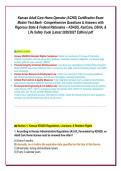
Kansas Adult Care Home Operator (ACHO) Certification Exam
Master Test Bank –Comprehensive Questions & Answers with
Rigorous State & Federal Rationales – KDADS, KanCare, OSHA, &
Life Safety Code (Latest 2026/2027 Edition) pdf
📦 What’s Inside:
1. Kansas KDADS & Resident Rights Compliance: Master the mechanics of Change of Ownership
(CHOW) applications, 24-hour abuse filing deadlines, Immediate Jeopardy mitigations, and Kansas legal
consent paths for room cameras [INDEX].
2. Financial Integrity & KanCare Reimbursement: Lock down your calculations for Patient Driven Payment
Model (PDPM) case-mixes, Medicare Part A coinsurance day splits, trust fund bonding margins, and CARE
level screenings.
3. Kansas Human Resource & Employment Law: Perfect your tracking of FLSA non-exempt guidelines,
KBI criminal background sweeps, and Kansas CNA registry continuity benchmarks.
4. Clinical Risk Controls & Quality Measures: Fully understand pressure injury avoidance documentation,
gradual dose reductions (GDR) for chemical restraints, and monthly consultant pharmacist reviews.
5. Environmental Engineering & Life Safety Code: Memorize the exact federal and state limits for resident
water fixtures (100°F–120°F), emergency power load transfer limits, NFPA 101 horizontal compartment
smoke walls, and 18-inch sprinkler deflector offsets.
Invest in your credentialing success. Eliminate test anxiety, master the Kansas long-term care regulations,
and pass your ACHO board exam with a top-tier score!
⚖️ Section 1: Kansas KDADS Regulations, Licensure, & Resident Rights
1. According to Kansas Administrative Regulations (K.A.R.) formulated by KDADS, an
Adult Care Home license must be renewed how often?
A) Every 6 months
B) Annually, on or before the expiration date specified on the face of the license
C) Bi-annually, during odd-numbered years
D) Every 3 calendar years
, Under Kansas state licensing regulations, all adult care home licenses expire exactly one
year from the date of issuance and must be renewed annually with KDADS.
2. If a Kansas Adult Care Home undergoes a change of ownership (CHOW), within
how many days prior to the transfer must the new operator file a complete licensure
application with KDADS?
A) 15 days
B) 30 days
C) 60 days
D) 90 days
Kansas regulations dictate that a change of ownership requires a new license application to
be submitted to the licensing agency at least 60 days before the projected date of the
transfer of ownership.
3. Under Kansas law, who has the primary legal responsibility to investigate
allegations of abuse, neglect, or exploitation within a licensed adult care home?
A) The local county sheriff's office exclusively
B) The Kansas Department for Aging and Disability Services (KDADS) Health
Facilities Program
C) The facility's private liability insurance vendor
D) The local municipal chamber of commerce
KDADS is the designated state regulatory body responsible for receiving, triage processing,
and investigating all reports of abuse, neglect, or financial exploitation in Kansas adult care
homes.
4. What is the maximum allowable chronological timeframe within which an operator
must report a suspected incident of resident abuse or neglect to the Kansas data
registry?
A) Immediately, but no later than 24 hours after the occurrence or discovery
B) Within 48 hours of completing an internal investigation
C) At the conclusion of the standard fiscal business week
D) During the facility’s next routine annual survey
Kansas mandatory abuse reporting statutes specify that any mandated reporter who
suspects a resident has been subjected to abuse or neglect must report it to KDADS
immediately, with an absolute outer threshold of 24 hours.
, 5. A licensed Adult Care Home Operator in Kansas must ensure that a copy of the
facility's most recent state inspection report (Survey Statement of Deficiencies, Form
CMS-2567) is posted in which location?
A) Inside the locked personal office of the Operator
B) In a conspicuous place readily accessible to residents, family members, and the
public without request
C) Tucked away in a drawer at the main nursing station hub
D) On a private, password-protected employee intranet server
Both state and federal public disclosure regulations require the most recent survey results
to be prominently displayed in a public area, allowing consumers to review the facility's
compliance history.
6. According to Kansas licensing requirements, what is the minimum age restriction
for an individual applying to take the state examination to become a certified Adult
Care Home Operator?
A) 18 years of age
B) 21 years of age
C) 25 years of age
D) 30 years of age
Kansas regulations governing the credentialing of adult care home operators specify that
an applicant must be at least 21 years old to obtain certification.
7. If a resident in a Kansas nursing facility files a formal appeal against an involuntary
discharge notice, the facility cannot transfer the resident until:
A) The resident's personal funds are completely depleted.
B) A formal administrative hearing is conducted by the state and an official decision
is issued upholding the transfer
C) The facility finds a roommate to replace the individual.
D) Exactly 15 days pass from the initial filing date.
Filing a timely discharge appeal acts as an immediate stay of the discharge action. The
resident has the legal right to remain in the facility until a state-appointed administrative law
judge reviews the case and issues a ruling.
8. Under KDADS guidelines, how often must the facility’s Quality Assessment and
Assurance (QAA) committee meet to review operational parameters?
A) Once every calendar year
B) Semi-annually
Master Test Bank –Comprehensive Questions & Answers with
Rigorous State & Federal Rationales – KDADS, KanCare, OSHA, &
Life Safety Code (Latest 2026/2027 Edition) pdf
📦 What’s Inside:
1. Kansas KDADS & Resident Rights Compliance: Master the mechanics of Change of Ownership
(CHOW) applications, 24-hour abuse filing deadlines, Immediate Jeopardy mitigations, and Kansas legal
consent paths for room cameras [INDEX].
2. Financial Integrity & KanCare Reimbursement: Lock down your calculations for Patient Driven Payment
Model (PDPM) case-mixes, Medicare Part A coinsurance day splits, trust fund bonding margins, and CARE
level screenings.
3. Kansas Human Resource & Employment Law: Perfect your tracking of FLSA non-exempt guidelines,
KBI criminal background sweeps, and Kansas CNA registry continuity benchmarks.
4. Clinical Risk Controls & Quality Measures: Fully understand pressure injury avoidance documentation,
gradual dose reductions (GDR) for chemical restraints, and monthly consultant pharmacist reviews.
5. Environmental Engineering & Life Safety Code: Memorize the exact federal and state limits for resident
water fixtures (100°F–120°F), emergency power load transfer limits, NFPA 101 horizontal compartment
smoke walls, and 18-inch sprinkler deflector offsets.
Invest in your credentialing success. Eliminate test anxiety, master the Kansas long-term care regulations,
and pass your ACHO board exam with a top-tier score!
⚖️ Section 1: Kansas KDADS Regulations, Licensure, & Resident Rights
1. According to Kansas Administrative Regulations (K.A.R.) formulated by KDADS, an
Adult Care Home license must be renewed how often?
A) Every 6 months
B) Annually, on or before the expiration date specified on the face of the license
C) Bi-annually, during odd-numbered years
D) Every 3 calendar years
, Under Kansas state licensing regulations, all adult care home licenses expire exactly one
year from the date of issuance and must be renewed annually with KDADS.
2. If a Kansas Adult Care Home undergoes a change of ownership (CHOW), within
how many days prior to the transfer must the new operator file a complete licensure
application with KDADS?
A) 15 days
B) 30 days
C) 60 days
D) 90 days
Kansas regulations dictate that a change of ownership requires a new license application to
be submitted to the licensing agency at least 60 days before the projected date of the
transfer of ownership.
3. Under Kansas law, who has the primary legal responsibility to investigate
allegations of abuse, neglect, or exploitation within a licensed adult care home?
A) The local county sheriff's office exclusively
B) The Kansas Department for Aging and Disability Services (KDADS) Health
Facilities Program
C) The facility's private liability insurance vendor
D) The local municipal chamber of commerce
KDADS is the designated state regulatory body responsible for receiving, triage processing,
and investigating all reports of abuse, neglect, or financial exploitation in Kansas adult care
homes.
4. What is the maximum allowable chronological timeframe within which an operator
must report a suspected incident of resident abuse or neglect to the Kansas data
registry?
A) Immediately, but no later than 24 hours after the occurrence or discovery
B) Within 48 hours of completing an internal investigation
C) At the conclusion of the standard fiscal business week
D) During the facility’s next routine annual survey
Kansas mandatory abuse reporting statutes specify that any mandated reporter who
suspects a resident has been subjected to abuse or neglect must report it to KDADS
immediately, with an absolute outer threshold of 24 hours.
, 5. A licensed Adult Care Home Operator in Kansas must ensure that a copy of the
facility's most recent state inspection report (Survey Statement of Deficiencies, Form
CMS-2567) is posted in which location?
A) Inside the locked personal office of the Operator
B) In a conspicuous place readily accessible to residents, family members, and the
public without request
C) Tucked away in a drawer at the main nursing station hub
D) On a private, password-protected employee intranet server
Both state and federal public disclosure regulations require the most recent survey results
to be prominently displayed in a public area, allowing consumers to review the facility's
compliance history.
6. According to Kansas licensing requirements, what is the minimum age restriction
for an individual applying to take the state examination to become a certified Adult
Care Home Operator?
A) 18 years of age
B) 21 years of age
C) 25 years of age
D) 30 years of age
Kansas regulations governing the credentialing of adult care home operators specify that
an applicant must be at least 21 years old to obtain certification.
7. If a resident in a Kansas nursing facility files a formal appeal against an involuntary
discharge notice, the facility cannot transfer the resident until:
A) The resident's personal funds are completely depleted.
B) A formal administrative hearing is conducted by the state and an official decision
is issued upholding the transfer
C) The facility finds a roommate to replace the individual.
D) Exactly 15 days pass from the initial filing date.
Filing a timely discharge appeal acts as an immediate stay of the discharge action. The
resident has the legal right to remain in the facility until a state-appointed administrative law
judge reviews the case and issues a ruling.
8. Under KDADS guidelines, how often must the facility’s Quality Assessment and
Assurance (QAA) committee meet to review operational parameters?
A) Once every calendar year
B) Semi-annually