

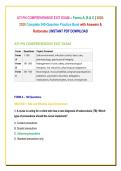
ATI PN COMPREHENSIVE EXIT EXAM – Forms A, B & C | 2026-
2028 Complete 540-Question Practice Bank with Answers &
Rationales | INSTANT PDF DOWNLOAD
ATI PN COMPREHENSIVE EXIT EXAM
Form Questions Topics Covered
Form 1-180 Safe environment, infection control, basic care,
A pharmacology, psychosocial integrity
Form 181-360 Management of care, safety, pharmacological
B therapies, risk reduction, physiological adaptation
Form 361-540 Neurological, musculoskeletal, pregnancy/postpartum,
C pediatrics, psychiatric disorders, delegation,
medications, fluid/electrolytes, shock, emergencies
FORM A – 180 Questions
SECTION 1: Safe and Effective Care Environment
1. A nurse is caring for a client who has a new diagnosis of tuberculosis (TB). Which
type of precautions should the nurse implement?
A. Contact precautions
B. Droplet precautions
C. Airborne precautions
D. Standard precautions only
,*Explanation: TB requires airborne precautions, including a negative-pressure room and
N95 respirator. Droplet precautions are for organisms like influenza; contact precautions for
MRSA.*
2. A nurse is preparing to administer a blood transfusion to a client. Which action is
most important prior to starting the transfusion?
A. Ensure the client has signed a consent form
B. Verify the blood product with another licensed nurse
C. Check the client's vital signs
D. Prime the blood tubing with normal saline
Explanation: Verification of the blood product with another licensed nurse is the most
critical step to ensure the correct blood product is being administered to the correct client.
3. A nurse is caring for a client who is receiving a continuous IV infusion. The IV
pump alarms "occlusion." Which action should the nurse take first?
A. Flush the IV line with normal saline
B. Check for kinks in the tubing
C. Assess the IV insertion site
D. Discontinue the IV line
Explanation: The first step is to check for simple causes like kinks in the tubing or a closed
clamp. If no kinks are found, then assess the insertion site.
4. A nurse is caring for a client following a cardiac catheterization. The nurse should
report which finding to the provider immediately?
A. Blood pressure 130/80 mm Hg
B. Heart rate 88/min
,C. Hematoma formation at the insertion site
D. Pedal pulse 2+ bilaterally
Explanation: Hematoma formation at the catheter insertion site indicates potential
bleeding, a serious complication requiring immediate notification.
5. A nurse is preparing to insert a nasogastric (NG) tube. Which position is most
appropriate for the client during insertion?
A. Supine with head turned to the side
B. Sitting upright with head tilted slightly forward
C. Lying flat with arms at the sides
D. Prone with head turned to the side
Explanation: Sitting upright with the head tilted forward facilitates passage of the NG tube
into the esophagus rather than the trachea, reducing the risk of aspiration.
6. A nurse is caring for a client with a new tracheostomy. Which action is most
important for maintaining airway patency?
A. Suctioning the tracheostomy tube every hour
B. Changing the inner cannula daily
C. Humidifying inspired air
D. Performing tracheostomy care every shift
Explanation: Humidifying inspired air is essential for maintaining airway patency because
the upper airway is bypassed, losing normal warming and humidification functions.
7. A nurse is caring for a client with a pressure injury on the sacrum. Which
intervention is most important for promoting wound healing?
A. Applying a hydrocolloid dressing
B. Massaging around the wound edges
, C. Repositioning the client every 2 hours
D. Using a donut-shaped cushion
*Explanation: Repositioning every 2 hours relieves pressure and prevents worsening of
pressure injuries. Massaging bony prominences can damage tissue; donut-shaped cushions
are contraindicated.*
8. A nurse is caring for a client who has a nasogastric tube for decompression. The
nurse should monitor the client for which electrolyte imbalance?
A. Hypernatremia
B. Hyperkalemia
C. Hypokalemia
D. Hypercalcemia
Explanation: Nasogastric suction removes gastric contents containing potassium, placing
the client at risk for hypokalemia.
9. A nurse is caring for a client who has a urinary catheter. Which action is most
important for preventing catheter-associated urinary tract infection (CAUTI)?
A. Empty the drainage bag every 8 hours
B. Keep the drainage bag below the level of the bladder
C. Clean the perineal area twice daily
D. Change the catheter every 72 hours
Explanation: Keeping the drainage bag below the level of the bladder prevents backflow of
urine into the bladder, which is a primary cause of CAUTI.
10. A nurse is preparing to transfer a client from the bed to a stretcher. Which action
demonstrates proper body mechanics?
2028 Complete 540-Question Practice Bank with Answers &
Rationales | INSTANT PDF DOWNLOAD
ATI PN COMPREHENSIVE EXIT EXAM
Form Questions Topics Covered
Form 1-180 Safe environment, infection control, basic care,
A pharmacology, psychosocial integrity
Form 181-360 Management of care, safety, pharmacological
B therapies, risk reduction, physiological adaptation
Form 361-540 Neurological, musculoskeletal, pregnancy/postpartum,
C pediatrics, psychiatric disorders, delegation,
medications, fluid/electrolytes, shock, emergencies
FORM A – 180 Questions
SECTION 1: Safe and Effective Care Environment
1. A nurse is caring for a client who has a new diagnosis of tuberculosis (TB). Which
type of precautions should the nurse implement?
A. Contact precautions
B. Droplet precautions
C. Airborne precautions
D. Standard precautions only
,*Explanation: TB requires airborne precautions, including a negative-pressure room and
N95 respirator. Droplet precautions are for organisms like influenza; contact precautions for
MRSA.*
2. A nurse is preparing to administer a blood transfusion to a client. Which action is
most important prior to starting the transfusion?
A. Ensure the client has signed a consent form
B. Verify the blood product with another licensed nurse
C. Check the client's vital signs
D. Prime the blood tubing with normal saline
Explanation: Verification of the blood product with another licensed nurse is the most
critical step to ensure the correct blood product is being administered to the correct client.
3. A nurse is caring for a client who is receiving a continuous IV infusion. The IV
pump alarms "occlusion." Which action should the nurse take first?
A. Flush the IV line with normal saline
B. Check for kinks in the tubing
C. Assess the IV insertion site
D. Discontinue the IV line
Explanation: The first step is to check for simple causes like kinks in the tubing or a closed
clamp. If no kinks are found, then assess the insertion site.
4. A nurse is caring for a client following a cardiac catheterization. The nurse should
report which finding to the provider immediately?
A. Blood pressure 130/80 mm Hg
B. Heart rate 88/min
,C. Hematoma formation at the insertion site
D. Pedal pulse 2+ bilaterally
Explanation: Hematoma formation at the catheter insertion site indicates potential
bleeding, a serious complication requiring immediate notification.
5. A nurse is preparing to insert a nasogastric (NG) tube. Which position is most
appropriate for the client during insertion?
A. Supine with head turned to the side
B. Sitting upright with head tilted slightly forward
C. Lying flat with arms at the sides
D. Prone with head turned to the side
Explanation: Sitting upright with the head tilted forward facilitates passage of the NG tube
into the esophagus rather than the trachea, reducing the risk of aspiration.
6. A nurse is caring for a client with a new tracheostomy. Which action is most
important for maintaining airway patency?
A. Suctioning the tracheostomy tube every hour
B. Changing the inner cannula daily
C. Humidifying inspired air
D. Performing tracheostomy care every shift
Explanation: Humidifying inspired air is essential for maintaining airway patency because
the upper airway is bypassed, losing normal warming and humidification functions.
7. A nurse is caring for a client with a pressure injury on the sacrum. Which
intervention is most important for promoting wound healing?
A. Applying a hydrocolloid dressing
B. Massaging around the wound edges
, C. Repositioning the client every 2 hours
D. Using a donut-shaped cushion
*Explanation: Repositioning every 2 hours relieves pressure and prevents worsening of
pressure injuries. Massaging bony prominences can damage tissue; donut-shaped cushions
are contraindicated.*
8. A nurse is caring for a client who has a nasogastric tube for decompression. The
nurse should monitor the client for which electrolyte imbalance?
A. Hypernatremia
B. Hyperkalemia
C. Hypokalemia
D. Hypercalcemia
Explanation: Nasogastric suction removes gastric contents containing potassium, placing
the client at risk for hypokalemia.
9. A nurse is caring for a client who has a urinary catheter. Which action is most
important for preventing catheter-associated urinary tract infection (CAUTI)?
A. Empty the drainage bag every 8 hours
B. Keep the drainage bag below the level of the bladder
C. Clean the perineal area twice daily
D. Change the catheter every 72 hours
Explanation: Keeping the drainage bag below the level of the bladder prevents backflow of
urine into the bladder, which is a primary cause of CAUTI.
10. A nurse is preparing to transfer a client from the bed to a stretcher. Which action
demonstrates proper body mechanics?


