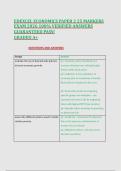
EDEXCEL ECONOMICS PAPER 2 25 MARKERS
EXAM 2026 100% VERIFIED ANSWERS
GUARANTEED PASS!
GRADED A+
QUESTIONS AND ANSWERS
Terms Answer
evaluate the use of demand-side policies p1: monetary policy beneficial as it
to boost economic growth increases demand wo/ risking budget
deficit unlike fiscal policy
p2: ineffective if low confidence in
economy (due to inelasticity of credit) -
fiscal policy is required in this case
p3: fiscal policy better at targetting
specific groups via multiplier - can
maximise increase in AD by targetting
those with highest MPC (low-income)
p4: depends where economy is operating
on keynesian lras
assess the different policies used to tackle p1: wealth tax - minimises the disparity
relative poverty btwn rich and poor, redistribution of
income via tax revenue
p2: difficult to enforce, rich may move
abroad to avoid tax
, p3: interventionist supply-side policy -
improve labour market mobility
p4: government risks huge budget deficit
'inequality isn't always undesirable in p1: provides incentive to work harder,
today's society', evaluate this statement 'climb the ladder', increases in labour
productivity -> access to higher wages,
reduces gap
p2: richard wilkinson's research showed
correlation btwn high inequality &
increased social crime e.g. crime and
infant mortality
p3: encourages risk-taking/enterprise,
rising LRAS
p4: prevalence of inequality - some
people may never have the chance to
acknowledge or refine their skills -
evidence of this potential growth may be
limited
assess whether a current account deficit p1: rising economic growth -> rising
is inevitable with rising economic growth national income, increased demand for
imports could cause CA deficit
p2: exception of export-led economies,
export levels could offset rising import
demand, preventing a poor balance of
payments
p3:
p4: depends if country engaging in
EXAM 2026 100% VERIFIED ANSWERS
GUARANTEED PASS!
GRADED A+
QUESTIONS AND ANSWERS
Terms Answer
evaluate the use of demand-side policies p1: monetary policy beneficial as it
to boost economic growth increases demand wo/ risking budget
deficit unlike fiscal policy
p2: ineffective if low confidence in
economy (due to inelasticity of credit) -
fiscal policy is required in this case
p3: fiscal policy better at targetting
specific groups via multiplier - can
maximise increase in AD by targetting
those with highest MPC (low-income)
p4: depends where economy is operating
on keynesian lras
assess the different policies used to tackle p1: wealth tax - minimises the disparity
relative poverty btwn rich and poor, redistribution of
income via tax revenue
p2: difficult to enforce, rich may move
abroad to avoid tax
, p3: interventionist supply-side policy -
improve labour market mobility
p4: government risks huge budget deficit
'inequality isn't always undesirable in p1: provides incentive to work harder,
today's society', evaluate this statement 'climb the ladder', increases in labour
productivity -> access to higher wages,
reduces gap
p2: richard wilkinson's research showed
correlation btwn high inequality &
increased social crime e.g. crime and
infant mortality
p3: encourages risk-taking/enterprise,
rising LRAS
p4: prevalence of inequality - some
people may never have the chance to
acknowledge or refine their skills -
evidence of this potential growth may be
limited
assess whether a current account deficit p1: rising economic growth -> rising
is inevitable with rising economic growth national income, increased demand for
imports could cause CA deficit
p2: exception of export-led economies,
export levels could offset rising import
demand, preventing a poor balance of
payments
p3:
p4: depends if country engaging in