

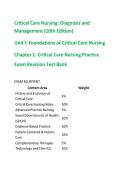
Critical Care Nursing: Diagnosis and
Management (10th Edition)
Unit I: Foundations of Critical Care Nursing
Chapter 1: Critical Care Nursing Practice
Exam Revision Test Bank
EXAM BLUEPRINT
Content Area Weight
History and Evolution of
5%
Critical Care
Critical Care Nursing Roles 10%
Advanced Practice Nursing 5%
Social Determinants of Health
10%
(SDOH)
Evidence-Based Practice 10%
Patient-Centered & Holistic
10%
Care
Complementary Therapies 5%
Technology and Tele-ICU 10%
,Interprofessional
10%
Collaboration
Rapid Response Teams 10%
Quality & Safety 10%
Healthy Work Environment 5%
Bloom level: Recall
Type: MCQ
Question: Which historical event most directly accelerated the
development of modern critical care units?
A. The need for long-term rehabilitation after stroke
B. The poliomyelitis epidemics that required respiratory
support and close physiologic monitoring
C. The introduction of home health nursing
D. The expansion of outpatient surgery
Correct answer: B
Rationale: Polio outbreaks created a need for ventilatory
support and intensive monitoring, which helped drive the
development of organized critical care.
Distractor analysis: A is related to rehabilitation, not ICU
development. C is important to nursing history but not the
,main driver of ICU creation. D reflects a different healthcare
trend.
Difficulty rating: Easy
Learning objective: Identify the major historical catalyst for the
development of critical care nursing.
Chapter reference: Unit I, Foundations of Critical Care Nursing
— Critical Care Nursing Practice
Clinical significance: Understanding ICU history supports
appreciation of why continuous monitoring and respiratory
support remain core critical care functions.
Bloom level: Recall
Type: MCQ
Question: Which organization is most closely associated with
standards for the healthy work environment in critical care
nursing?
A. SCCM
B. AACN
C. CDC
D. WHO
Correct answer: B
, Rationale: The American Association of Critical-Care Nurses
(AACN) is strongly associated with healthy work environment
standards and professional nursing practice in critical care.
Distractor analysis: A is a major critical care organization but
not the primary source for HWE standards. C focuses on public
health and infection control. D is a global health agency, not the
nursing standards body here.
Difficulty rating: Easy
Learning objective: Recognize major professional organizations
that guide critical care nursing practice.
Chapter reference: Unit I, Foundations of Critical Care Nursing
— Critical Care Nursing Practice
Clinical significance: Professional organizations shape safe
practice, standards, and advocacy for ICU nurses.
Bloom level: Recall
Type: SATA
Question: Which factors are recognized social determinants of
health (SDOH) domains? Select all that apply.
A. Economic stability
B. Education access and quality
C. Health care access and quality
Management (10th Edition)
Unit I: Foundations of Critical Care Nursing
Chapter 1: Critical Care Nursing Practice
Exam Revision Test Bank
EXAM BLUEPRINT
Content Area Weight
History and Evolution of
5%
Critical Care
Critical Care Nursing Roles 10%
Advanced Practice Nursing 5%
Social Determinants of Health
10%
(SDOH)
Evidence-Based Practice 10%
Patient-Centered & Holistic
10%
Care
Complementary Therapies 5%
Technology and Tele-ICU 10%
,Interprofessional
10%
Collaboration
Rapid Response Teams 10%
Quality & Safety 10%
Healthy Work Environment 5%
Bloom level: Recall
Type: MCQ
Question: Which historical event most directly accelerated the
development of modern critical care units?
A. The need for long-term rehabilitation after stroke
B. The poliomyelitis epidemics that required respiratory
support and close physiologic monitoring
C. The introduction of home health nursing
D. The expansion of outpatient surgery
Correct answer: B
Rationale: Polio outbreaks created a need for ventilatory
support and intensive monitoring, which helped drive the
development of organized critical care.
Distractor analysis: A is related to rehabilitation, not ICU
development. C is important to nursing history but not the
,main driver of ICU creation. D reflects a different healthcare
trend.
Difficulty rating: Easy
Learning objective: Identify the major historical catalyst for the
development of critical care nursing.
Chapter reference: Unit I, Foundations of Critical Care Nursing
— Critical Care Nursing Practice
Clinical significance: Understanding ICU history supports
appreciation of why continuous monitoring and respiratory
support remain core critical care functions.
Bloom level: Recall
Type: MCQ
Question: Which organization is most closely associated with
standards for the healthy work environment in critical care
nursing?
A. SCCM
B. AACN
C. CDC
D. WHO
Correct answer: B
, Rationale: The American Association of Critical-Care Nurses
(AACN) is strongly associated with healthy work environment
standards and professional nursing practice in critical care.
Distractor analysis: A is a major critical care organization but
not the primary source for HWE standards. C focuses on public
health and infection control. D is a global health agency, not the
nursing standards body here.
Difficulty rating: Easy
Learning objective: Recognize major professional organizations
that guide critical care nursing practice.
Chapter reference: Unit I, Foundations of Critical Care Nursing
— Critical Care Nursing Practice
Clinical significance: Professional organizations shape safe
practice, standards, and advocacy for ICU nurses.
Bloom level: Recall
Type: SATA
Question: Which factors are recognized social determinants of
health (SDOH) domains? Select all that apply.
A. Economic stability
B. Education access and quality
C. Health care access and quality


