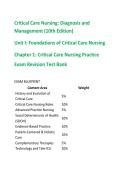
Critical Care Nursing: Diagnosis and
Management (10th Edition)
Unit I: Foundations of Critical Care Nursing
Chapter 1: Critical Care Nursing Practice
Exam Revision Test Bank
EXAM BLUEPRINT
Content Area Weight
History and Evolution of
5%
Critical Care
Critical Care Nursing Roles 10%
Advanced Practice Nursing 5%
Social Determinants of Health
10%
(SDOH)
Evidence-Based Practice 10%
Patient-Centered & Holistic
10%
Care
Complementary Therapies 5%
Technology and Tele-ICU 10%
,Interprofessional
10%
Collaboration
Rapid Response Teams 10%
Quality & Safety 10%
Healthy Work Environment 5%
Question 1 | MCQ | Recall
A nurse in a critical care unit is explaining the historical
development of critical care nursing. Which event most directly
contributed to the creation of modern intensive care units?
A. Development of community health nursing standards
B. Need for continuous monitoring of critically ill postoperative
patients
C. Expansion of outpatient specialty clinics
D. Introduction of hospice philosophy into acute care
Correct Answer: B
Rationale: Modern intensive care units evolved to provide close
physiologic monitoring and rapid intervention for patients with
unstable, life-threatening conditions, especially those requiring
postoperative and cardiorespiratory support.
Distractor Analysis:
A. Community health nursing did not drive ICU development.
C. Outpatient specialty care is unrelated to ICU origins.
,D. Hospice philosophy focuses on comfort-oriented care, not
ICU development.
Difficulty Rating: Easy
Learning Objective: Identify the historical rationale for the
development of critical care units.
Chapter Reference: Unit I, Chapter 1: Critical Care Nursing
Practice
Clinical Significance: Understanding ICU origins helps nurses
appreciate why continuous surveillance, rapid response, and
technology-intensive care remain central to critical care
practice.
Question 2 | MCQ | Comprehension
Which statement best reflects contemporary critical care
nursing practice?
A. Care is focused primarily on organ-specific treatment
delivered independently by nurses.
B. Critical care nursing is limited to ventilator management and
hemodynamic monitoring.
C. Care is delivered through interprofessional collaboration
using evidence-based, patient-centered interventions.
D. Critical care nursing excludes psychosocial and family
support because physiologic stabilization is the priority.
Correct Answer: C
, Rationale: Contemporary critical care nursing integrates
evidence-based practice, interprofessional collaboration, and
holistic patient-centered care while addressing physiologic,
psychosocial, and family needs.
Distractor Analysis:
A. Critical care is not nurse-only or organ-only.
B. Critical care includes much more than technology
management.
D. Psychosocial and family support are essential components of
ICU care.
Difficulty Rating: Easy
Learning Objective: Describe contemporary critical care nursing
as an interprofessional and holistic discipline.
Chapter Reference: Unit I, Chapter 1: Critical Care Nursing
Practice
Clinical Significance: ICU nurses must balance life-support
technologies with holistic assessment and coordination of care.
Question 3 | SATA | Recall
Which roles may be performed by critical care nurses? Select all
that apply.
A. Bedside staff nurse
B. Clinical nurse specialist
C. Nurse practitioner
Management (10th Edition)
Unit I: Foundations of Critical Care Nursing
Chapter 1: Critical Care Nursing Practice
Exam Revision Test Bank
EXAM BLUEPRINT
Content Area Weight
History and Evolution of
5%
Critical Care
Critical Care Nursing Roles 10%
Advanced Practice Nursing 5%
Social Determinants of Health
10%
(SDOH)
Evidence-Based Practice 10%
Patient-Centered & Holistic
10%
Care
Complementary Therapies 5%
Technology and Tele-ICU 10%
,Interprofessional
10%
Collaboration
Rapid Response Teams 10%
Quality & Safety 10%
Healthy Work Environment 5%
Question 1 | MCQ | Recall
A nurse in a critical care unit is explaining the historical
development of critical care nursing. Which event most directly
contributed to the creation of modern intensive care units?
A. Development of community health nursing standards
B. Need for continuous monitoring of critically ill postoperative
patients
C. Expansion of outpatient specialty clinics
D. Introduction of hospice philosophy into acute care
Correct Answer: B
Rationale: Modern intensive care units evolved to provide close
physiologic monitoring and rapid intervention for patients with
unstable, life-threatening conditions, especially those requiring
postoperative and cardiorespiratory support.
Distractor Analysis:
A. Community health nursing did not drive ICU development.
C. Outpatient specialty care is unrelated to ICU origins.
,D. Hospice philosophy focuses on comfort-oriented care, not
ICU development.
Difficulty Rating: Easy
Learning Objective: Identify the historical rationale for the
development of critical care units.
Chapter Reference: Unit I, Chapter 1: Critical Care Nursing
Practice
Clinical Significance: Understanding ICU origins helps nurses
appreciate why continuous surveillance, rapid response, and
technology-intensive care remain central to critical care
practice.
Question 2 | MCQ | Comprehension
Which statement best reflects contemporary critical care
nursing practice?
A. Care is focused primarily on organ-specific treatment
delivered independently by nurses.
B. Critical care nursing is limited to ventilator management and
hemodynamic monitoring.
C. Care is delivered through interprofessional collaboration
using evidence-based, patient-centered interventions.
D. Critical care nursing excludes psychosocial and family
support because physiologic stabilization is the priority.
Correct Answer: C
, Rationale: Contemporary critical care nursing integrates
evidence-based practice, interprofessional collaboration, and
holistic patient-centered care while addressing physiologic,
psychosocial, and family needs.
Distractor Analysis:
A. Critical care is not nurse-only or organ-only.
B. Critical care includes much more than technology
management.
D. Psychosocial and family support are essential components of
ICU care.
Difficulty Rating: Easy
Learning Objective: Describe contemporary critical care nursing
as an interprofessional and holistic discipline.
Chapter Reference: Unit I, Chapter 1: Critical Care Nursing
Practice
Clinical Significance: ICU nurses must balance life-support
technologies with holistic assessment and coordination of care.
Question 3 | SATA | Recall
Which roles may be performed by critical care nurses? Select all
that apply.
A. Bedside staff nurse
B. Clinical nurse specialist
C. Nurse practitioner