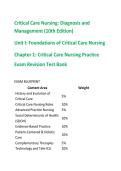
Critical Care Nursing: Diagnosis and
Management (10th Edition)
Unit I: Foundations of Critical Care Nursing
Chapter 1: Critical Care Nursing Practice
Exam Revision Test Bank
EXAM BLUEPRINT
Content Area Weight
History and Evolution of
5%
Critical Care
Critical Care Nursing Roles 10%
Advanced Practice Nursing 5%
Social Determinants of Health
10%
(SDOH)
Evidence-Based Practice 10%
Patient-Centered & Holistic
10%
Care
Complementary Therapies 5%
Technology and Tele-ICU 10%
,Interprofessional
10%
Collaboration
Rapid Response Teams 10%
Quality & Safety 10%
Healthy Work Environment 5%
Item 1
Type: MCQ
Bloom level: Recall
Difficulty: 2/5
Learning objective: Identify the historical driver that
established critical care nursing as a distinct specialty.
Chapter reference: Unit I, Critical Care Nursing Practice
Stem:
Which development most directly contributed to the
emergence of modern critical care nursing?
A. Expansion of hospice services
B. Creation of specialized units for unstable patients requiring
close monitoring
C. Replacement of bedside care with telehealth
D. Elimination of invasive hemodynamic monitoring
Correct answer: B
,Rationale:
Critical care nursing developed as hospitals created specialized
units for patients with rapidly changing physiologic status who
required continuous assessment and advanced technology
support.
Distractor analysis:
A: Hospice care addresses end-of-life support, not the origin of
critical care.
C: Telehealth is contemporary support, not the historical driver.
D: Invasive monitoring helped define the specialty rather than
eliminate it.
Clinical significance:
Understanding the specialty’s origin helps nurses recognize why
continuous surveillance, rapid intervention, and advanced
assessment remain central to ICU practice.
Item 2
Type: MCQ
Bloom level: Comprehension
Difficulty: 3/5
Learning objective: Distinguish the role of an advanced practice
nurse in critical care from that of a staff critical care RN.
Chapter reference: Unit I, Critical Care Nursing Roles
, Stem:
Which statement best describes an advanced practice nurse in
critical care?
A. Provides task-focused bedside care only
B. Functions primarily as a unit clerk during emergencies
C. Uses an expanded scope to assess, diagnose, and manage
complex patient problems
D. Replaces all interprofessional consultation in the ICU
Correct answer: C
Rationale:
Advanced practice nurses in critical care use graduate-level
preparation to assess, diagnose, prescribe, and manage
complex physiologic problems, often with leadership and
consultation responsibilities.
Distractor analysis:
A: Too narrow; staff RN care is broader than task performance
alone.
B: Incorrect and irrelevant.
D: APNs collaborate with, not replace, the interprofessional
team.
Clinical significance:
Clear understanding of role differentiation supports
appropriate delegation, consultation, and escalation of care.
Management (10th Edition)
Unit I: Foundations of Critical Care Nursing
Chapter 1: Critical Care Nursing Practice
Exam Revision Test Bank
EXAM BLUEPRINT
Content Area Weight
History and Evolution of
5%
Critical Care
Critical Care Nursing Roles 10%
Advanced Practice Nursing 5%
Social Determinants of Health
10%
(SDOH)
Evidence-Based Practice 10%
Patient-Centered & Holistic
10%
Care
Complementary Therapies 5%
Technology and Tele-ICU 10%
,Interprofessional
10%
Collaboration
Rapid Response Teams 10%
Quality & Safety 10%
Healthy Work Environment 5%
Item 1
Type: MCQ
Bloom level: Recall
Difficulty: 2/5
Learning objective: Identify the historical driver that
established critical care nursing as a distinct specialty.
Chapter reference: Unit I, Critical Care Nursing Practice
Stem:
Which development most directly contributed to the
emergence of modern critical care nursing?
A. Expansion of hospice services
B. Creation of specialized units for unstable patients requiring
close monitoring
C. Replacement of bedside care with telehealth
D. Elimination of invasive hemodynamic monitoring
Correct answer: B
,Rationale:
Critical care nursing developed as hospitals created specialized
units for patients with rapidly changing physiologic status who
required continuous assessment and advanced technology
support.
Distractor analysis:
A: Hospice care addresses end-of-life support, not the origin of
critical care.
C: Telehealth is contemporary support, not the historical driver.
D: Invasive monitoring helped define the specialty rather than
eliminate it.
Clinical significance:
Understanding the specialty’s origin helps nurses recognize why
continuous surveillance, rapid intervention, and advanced
assessment remain central to ICU practice.
Item 2
Type: MCQ
Bloom level: Comprehension
Difficulty: 3/5
Learning objective: Distinguish the role of an advanced practice
nurse in critical care from that of a staff critical care RN.
Chapter reference: Unit I, Critical Care Nursing Roles
, Stem:
Which statement best describes an advanced practice nurse in
critical care?
A. Provides task-focused bedside care only
B. Functions primarily as a unit clerk during emergencies
C. Uses an expanded scope to assess, diagnose, and manage
complex patient problems
D. Replaces all interprofessional consultation in the ICU
Correct answer: C
Rationale:
Advanced practice nurses in critical care use graduate-level
preparation to assess, diagnose, prescribe, and manage
complex physiologic problems, often with leadership and
consultation responsibilities.
Distractor analysis:
A: Too narrow; staff RN care is broader than task performance
alone.
B: Incorrect and irrelevant.
D: APNs collaborate with, not replace, the interprofessional
team.
Clinical significance:
Clear understanding of role differentiation supports
appropriate delegation, consultation, and escalation of care.