

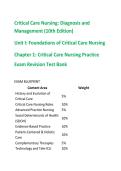
Critical Care Nursing: Diagnosis and
Management (10th Edition)
Unit I: Foundations of Critical Care Nursing
Chapter 1: Critical Care Nursing Practice
Exam Revision Test Bank
EXAM BLUEPRINT
Content Area Weight
History and Evolution of
5%
Critical Care
Critical Care Nursing Roles 10%
Advanced Practice Nursing 5%
Social Determinants of Health
10%
(SDOH)
Evidence-Based Practice 10%
Patient-Centered & Holistic
10%
Care
Complementary Therapies 5%
Technology and Tele-ICU 10%
,Interprofessional
10%
Collaboration
Rapid Response Teams 10%
Quality & Safety 10%
Healthy Work Environment 5%
1. Critical care nursing practice is best described as care for
patients who:
Bloom’s Level: Recall
Difficulty: Easy
Chapter Reference: Unit I, Chapter 1: Critical Care Nursing
Practice
Learning Objective: Define the core population and purpose of
critical care nursing.
Clinical Significance: Identifying the critical care population
guides surveillance, prioritization, and timely intervention.
Question: Which patient is the best example of a critical care
patient?
A. A stable adult receiving oral antibiotics for uncomplicated
pneumonia
B. A postoperative patient with continuous vasoactive
medication titration and invasive monitoring
C. A child seen in clinic for seasonal allergies
,D. An adult recovering at home after an uncomplicated ankle
sprain
Correct Answer: B
Rationale: Critical care patients are those with actual or
potential life-threatening conditions requiring close monitoring,
invasive support, and rapid intervention. Vasoactive titration
and invasive monitoring are classic ICU needs.
Distractor Analysis:
• A: This patient is stable and does not require critical care.
• C: Outpatient allergy management is not critical care.
• D: Home recovery for an ankle sprain does not require
intensive monitoring.
2. Which statement best reflects contemporary critical care?
Bloom’s Level: Comprehension
Difficulty: Moderate
Chapter Reference: Unit I, Chapter 1: Critical Care Nursing
Practice
Learning Objective: Explain how modern critical care has
expanded beyond bedside stabilization.
Clinical Significance: Contemporary ICU practice includes
, prevention, coordination, technology, and family-centered
care.
Question: Which statement best reflects contemporary critical
care?
A. Critical care is limited to ventilator management and
resuscitation only
B. Critical care focuses primarily on diagnosing diseases rather
than managing instability
C. Critical care includes interprofessional collaboration,
prevention of complications, and technology-enabled
monitoring
D. Critical care replaces the need for evidence-based practice
because of urgency
Correct Answer: C
Rationale: Contemporary critical care integrates advanced
monitoring, prevention of complications, evidence-based
interventions, family involvement, and coordinated team care.
Distractor Analysis:
• A: ICU care includes much more than ventilators and
resuscitation.
• B: The emphasis is stabilization and management of
physiologic instability, not just diagnosis.
Management (10th Edition)
Unit I: Foundations of Critical Care Nursing
Chapter 1: Critical Care Nursing Practice
Exam Revision Test Bank
EXAM BLUEPRINT
Content Area Weight
History and Evolution of
5%
Critical Care
Critical Care Nursing Roles 10%
Advanced Practice Nursing 5%
Social Determinants of Health
10%
(SDOH)
Evidence-Based Practice 10%
Patient-Centered & Holistic
10%
Care
Complementary Therapies 5%
Technology and Tele-ICU 10%
,Interprofessional
10%
Collaboration
Rapid Response Teams 10%
Quality & Safety 10%
Healthy Work Environment 5%
1. Critical care nursing practice is best described as care for
patients who:
Bloom’s Level: Recall
Difficulty: Easy
Chapter Reference: Unit I, Chapter 1: Critical Care Nursing
Practice
Learning Objective: Define the core population and purpose of
critical care nursing.
Clinical Significance: Identifying the critical care population
guides surveillance, prioritization, and timely intervention.
Question: Which patient is the best example of a critical care
patient?
A. A stable adult receiving oral antibiotics for uncomplicated
pneumonia
B. A postoperative patient with continuous vasoactive
medication titration and invasive monitoring
C. A child seen in clinic for seasonal allergies
,D. An adult recovering at home after an uncomplicated ankle
sprain
Correct Answer: B
Rationale: Critical care patients are those with actual or
potential life-threatening conditions requiring close monitoring,
invasive support, and rapid intervention. Vasoactive titration
and invasive monitoring are classic ICU needs.
Distractor Analysis:
• A: This patient is stable and does not require critical care.
• C: Outpatient allergy management is not critical care.
• D: Home recovery for an ankle sprain does not require
intensive monitoring.
2. Which statement best reflects contemporary critical care?
Bloom’s Level: Comprehension
Difficulty: Moderate
Chapter Reference: Unit I, Chapter 1: Critical Care Nursing
Practice
Learning Objective: Explain how modern critical care has
expanded beyond bedside stabilization.
Clinical Significance: Contemporary ICU practice includes
, prevention, coordination, technology, and family-centered
care.
Question: Which statement best reflects contemporary critical
care?
A. Critical care is limited to ventilator management and
resuscitation only
B. Critical care focuses primarily on diagnosing diseases rather
than managing instability
C. Critical care includes interprofessional collaboration,
prevention of complications, and technology-enabled
monitoring
D. Critical care replaces the need for evidence-based practice
because of urgency
Correct Answer: C
Rationale: Contemporary critical care integrates advanced
monitoring, prevention of complications, evidence-based
interventions, family involvement, and coordinated team care.
Distractor Analysis:
• A: ICU care includes much more than ventilators and
resuscitation.
• B: The emphasis is stabilization and management of
physiologic instability, not just diagnosis.


