

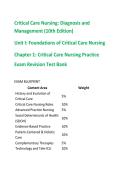
Critical Care Nursing: Diagnosis and
Management (10th Edition)
Unit I: Foundations of Critical Care Nursing
Chapter 1: Critical Care Nursing Practice
Exam Revision Test Bank
EXAM BLUEPRINT
Content Area Weight
History and Evolution of
5%
Critical Care
Critical Care Nursing Roles 10%
Advanced Practice Nursing 5%
Social Determinants of Health
10%
(SDOH)
Evidence-Based Practice 10%
Patient-Centered & Holistic
10%
Care
Complementary Therapies 5%
Technology and Tele-ICU 10%
,Interprofessional
10%
Collaboration
Rapid Response Teams 10%
Quality & Safety 10%
Healthy Work Environment 5%
Unit I — Foundations of Critical Care Nursing
Chapter 1: Critical Care Nursing Practice
1. MCQ | Bloom: Recall | Difficulty: Easy
Question: Which statement best describes the historical
development of critical care nursing?
A. It developed primarily in outpatient clinics to monitor
chronic disease
B. It emerged from the need to care for unstable patients
requiring continuous assessment and intervention
C. It began as a subspecialty focused only on surgical recovery
D. It evolved mainly from community health nursing models
Correct Answer: B
Rationale: Critical care nursing developed to meet the needs of
patients with life-threatening conditions requiring close
,surveillance, rapid intervention, and advanced technology.
Distractor Analysis:
• A: Outpatient care is not the origin of critical care nursing.
• C: Surgical recovery is only one part of critical care, not its
basis.
• D: Community health nursing is a separate practice area.
Learning Objective: Describe the historical purpose and
evolution of critical care nursing.
Chapter Reference: Critical Care Nursing Practice —
History of Critical Care
Clinical Significance: Understanding the specialty’s origins
supports appreciation of the need for vigilance,
prioritization, and rapid decision-making in ICU care.
2. MCQ | Bloom: Comprehension | Difficulty: Moderate
Question: A nurse explains contemporary critical care nursing
to a new graduate. Which statement is most accurate?
A. Critical care focuses only on advanced technology and
ignores patient-centered care
B. Critical care nursing integrates technology, teamwork,
evidence-based practice, and holistic care
C. Critical care is limited to physician-driven interventions
, D. Critical care nursing avoids family involvement to reduce
stress
Correct Answer: B
Rationale: Modern critical care uses technology,
interprofessional collaboration, evidence-based interventions,
and holistic, patient-centered nursing.
Distractor Analysis:
• A: Patient-centered and holistic care are central, not
ignored.
• C: Critical care is collaborative, not physician-only.
• D: Family involvement is often essential and beneficial.
Learning Objective: Explain the defining features of
contemporary critical care nursing.
Chapter Reference: Contemporary Critical Care
Clinical Significance: Nurses must balance high-tech care
with compassionate, individualized support for patients
and families.
3. SATA | Bloom: Recall | Difficulty: Moderate
Question: Which roles may be performed by critical care
nurses? Select all that apply.
A. Direct bedside care
B. Patient advocacy
Management (10th Edition)
Unit I: Foundations of Critical Care Nursing
Chapter 1: Critical Care Nursing Practice
Exam Revision Test Bank
EXAM BLUEPRINT
Content Area Weight
History and Evolution of
5%
Critical Care
Critical Care Nursing Roles 10%
Advanced Practice Nursing 5%
Social Determinants of Health
10%
(SDOH)
Evidence-Based Practice 10%
Patient-Centered & Holistic
10%
Care
Complementary Therapies 5%
Technology and Tele-ICU 10%
,Interprofessional
10%
Collaboration
Rapid Response Teams 10%
Quality & Safety 10%
Healthy Work Environment 5%
Unit I — Foundations of Critical Care Nursing
Chapter 1: Critical Care Nursing Practice
1. MCQ | Bloom: Recall | Difficulty: Easy
Question: Which statement best describes the historical
development of critical care nursing?
A. It developed primarily in outpatient clinics to monitor
chronic disease
B. It emerged from the need to care for unstable patients
requiring continuous assessment and intervention
C. It began as a subspecialty focused only on surgical recovery
D. It evolved mainly from community health nursing models
Correct Answer: B
Rationale: Critical care nursing developed to meet the needs of
patients with life-threatening conditions requiring close
,surveillance, rapid intervention, and advanced technology.
Distractor Analysis:
• A: Outpatient care is not the origin of critical care nursing.
• C: Surgical recovery is only one part of critical care, not its
basis.
• D: Community health nursing is a separate practice area.
Learning Objective: Describe the historical purpose and
evolution of critical care nursing.
Chapter Reference: Critical Care Nursing Practice —
History of Critical Care
Clinical Significance: Understanding the specialty’s origins
supports appreciation of the need for vigilance,
prioritization, and rapid decision-making in ICU care.
2. MCQ | Bloom: Comprehension | Difficulty: Moderate
Question: A nurse explains contemporary critical care nursing
to a new graduate. Which statement is most accurate?
A. Critical care focuses only on advanced technology and
ignores patient-centered care
B. Critical care nursing integrates technology, teamwork,
evidence-based practice, and holistic care
C. Critical care is limited to physician-driven interventions
, D. Critical care nursing avoids family involvement to reduce
stress
Correct Answer: B
Rationale: Modern critical care uses technology,
interprofessional collaboration, evidence-based interventions,
and holistic, patient-centered nursing.
Distractor Analysis:
• A: Patient-centered and holistic care are central, not
ignored.
• C: Critical care is collaborative, not physician-only.
• D: Family involvement is often essential and beneficial.
Learning Objective: Explain the defining features of
contemporary critical care nursing.
Chapter Reference: Contemporary Critical Care
Clinical Significance: Nurses must balance high-tech care
with compassionate, individualized support for patients
and families.
3. SATA | Bloom: Recall | Difficulty: Moderate
Question: Which roles may be performed by critical care
nurses? Select all that apply.
A. Direct bedside care
B. Patient advocacy


