.
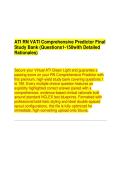
ATI RN COMPREHENSIVE PREDICTOR
RETAKE | 400 COMPREHENSIVE NGN
PRACTICE Q&As & CLINICAL
RATIONALES (PASS GUARANTEED)
Secure your passing score and clear your exit exam
with this premium, 400-question practice guide
engineered specifically for the ATI RN
Comprehensive Predictor Retake.
This comprehensive resource targets high-yield Next
Generation NCLEX (NGN) clinical judgment
domains, including advanced medical-surgical
nursing, maternal-newborn health, pharmacology
titrations, complex delegation, and prioritisation
frameworks. Formatted meticulously with bold
answers and isolated spacing, every question
includes an in-depth clinical rationale to sharpen
,your test-taking critical thinking and boost your store
visibility for immediate digital downloads on Stuvia.
Question 1
A nurse is caring for an adult client who is 24 hours post-operative following an
abdominal hysterectomy. The client reports acute abdominal pain rated as 8/10. The
abdominal dressing is intact with a moderate amount of saturated bright red drainage.
Vital signs are: BP 92/54 mmHg, HR 118/min, RR 22/min, Temp 37°C (98.6°F). Which
of the following actions should the nurse prioritize first?
A) Administer the prescribed opioid analgesic for pain.
B) Obtain a STAT complete blood count (CBC) and type and crossmatch.
C) Increase the intravenous fluid infusion rate and reinforce the dressing.
D) Request an immediate consultation from the wound care specialist.
Answer: C
Rationale: The client is exhibiting classic clinical signs of hypovolemic shock secondary
to post-operative hemorrhage (hypotension, tachycardia, tachypnea, and saturated
bright red blood on the dressing). The immediate nursing priority is to stabilize the
intravascular volume by increasing intravenous fluids and applying direct
pressure/reinforcing the dressing. Pain management (Option A) and lab collection
(Option B) are necessary but secondary to stabilizing the client's hemodynamics.
,Question 2
A nurse on a medical-surgical unit is reviewing the laboratory results for a client who is
receiving a continuous intravenous heparin infusion for a deep vein thrombosis. Which
of the following findings require an immediate notification to the healthcare provider?
A) Activated partial thromboplastin time (aPTT) of 75 seconds
B) Platelet count of 92,000/mm³
C) Hemoglobin level of 14.2 g/dL
D) International Normalized Ratio (INR) of 1.1
Answer: B
Rationale: A platelet count below 100,000/mm³ indicates a high risk for Heparin-Induced
Thrombocytopenia (HIT), a life-threatening immune complication requiring immediate
cessation of heparin. An aPTT of 75 seconds (Option A) is within the expected
therapeutic range for heparin therapy (1.5 to 2.5 times the normal control). Normal
hemoglobin (Option C) and a baseline INR (Option D) do not require immediate
intervention.
Question 3
A nurse is assigning tasks to a licensed practical nurse (LPN) and an assistive
personnel (AP). Which of the following clients should the nurse safely assign to the
LPN?
A) A client who was admitted 2 hours ago experiencing acute chest pain radiating to the
jaw.
B) A client with chronic obstructive pulmonary disease (COPD) who requires a sterile
tracheostomy dressing change.
C) A client who is 4 hours post-operative from a total hip arthroplasty and needs their
initial ambulation.
D) A client with an evolving ischemic stroke whose neurological checks are required
every 15 minutes.
Answer: B
Rationale: LPN scope of practice includes caring for stable clients with predictable
outcomes and performing sterile procedures such as tracheostomy wound care. Fresh
post-operative ambulation (Option C), acute unstable chest pain (Option A), and rapid
neurological deterioration (Option D) are unpredictable and complex, requiring the
advanced assessment and clinical judgment of an RN.
, Question 4
A nurse in the emergency department is assessing a client brought in with severe
lithium toxicity. Which of the following clinical findings should the nurse expect the client
to exhibit?
A) Mild anxiety, dry mouth, and an increased appetite
B) Coarse hand tremors, severe diarrhea, and altered mental status
C) Significant weight gain, bradycardia, and a maculopapular rash
D) Urinary retention, hypertension, and hyperreflexia
Answer: B
Rationale: Advanced or severe lithium toxicity (serum levels >2.0 mEq/L)
characteristically causes severe gastrointestinal upset (vomiting, diarrhea), advanced
neurological impairment (coarse tremors, ataxia, slurred speech, confusion, seizures),
and cardiovascular collapse. Fine hand tremors are associated with therapeutic or mild
toxicity.
Question 5
A nurse is reviewing prescriptions for a client who has a new diagnosis of acute angle-
closure glaucoma. Which of the following medications should the nurse clarify with the
provider before administering?
A) Timolol ophthalmic drops
B) Atropine ophthalmic drops
C) Pilocarpine ophthalmic drops
D) Acetazolamide oral tablets
Answer: B
Rationale: Atropine is a potent mydriatic (anticholinergic) agent that dilates the pupil and
paralyzes the ciliary muscle. In acute angle-closure glaucoma, pupillary dilation further
narrows the anterior chamber angle, completely blocking the outflow of aqueous humor
and causing a catastrophic increase in intraocular pressure. Timolol, pilocarpine, and
acetazolamide are used to lower intraocular pressure.
Question 6
A nurse is caring for an infant who has congenital heart disease and is prescribed oral
digoxin. Which of the following parameters should the nurse assess prior to
administering each dose?
A) Apical heart rate for 1 full minute
B) Blood pressure in all four extremities
ATI RN COMPREHENSIVE PREDICTOR
RETAKE | 400 COMPREHENSIVE NGN
PRACTICE Q&As & CLINICAL
RATIONALES (PASS GUARANTEED)
Secure your passing score and clear your exit exam
with this premium, 400-question practice guide
engineered specifically for the ATI RN
Comprehensive Predictor Retake.
This comprehensive resource targets high-yield Next
Generation NCLEX (NGN) clinical judgment
domains, including advanced medical-surgical
nursing, maternal-newborn health, pharmacology
titrations, complex delegation, and prioritisation
frameworks. Formatted meticulously with bold
answers and isolated spacing, every question
includes an in-depth clinical rationale to sharpen
,your test-taking critical thinking and boost your store
visibility for immediate digital downloads on Stuvia.
Question 1
A nurse is caring for an adult client who is 24 hours post-operative following an
abdominal hysterectomy. The client reports acute abdominal pain rated as 8/10. The
abdominal dressing is intact with a moderate amount of saturated bright red drainage.
Vital signs are: BP 92/54 mmHg, HR 118/min, RR 22/min, Temp 37°C (98.6°F). Which
of the following actions should the nurse prioritize first?
A) Administer the prescribed opioid analgesic for pain.
B) Obtain a STAT complete blood count (CBC) and type and crossmatch.
C) Increase the intravenous fluid infusion rate and reinforce the dressing.
D) Request an immediate consultation from the wound care specialist.
Answer: C
Rationale: The client is exhibiting classic clinical signs of hypovolemic shock secondary
to post-operative hemorrhage (hypotension, tachycardia, tachypnea, and saturated
bright red blood on the dressing). The immediate nursing priority is to stabilize the
intravascular volume by increasing intravenous fluids and applying direct
pressure/reinforcing the dressing. Pain management (Option A) and lab collection
(Option B) are necessary but secondary to stabilizing the client's hemodynamics.
,Question 2
A nurse on a medical-surgical unit is reviewing the laboratory results for a client who is
receiving a continuous intravenous heparin infusion for a deep vein thrombosis. Which
of the following findings require an immediate notification to the healthcare provider?
A) Activated partial thromboplastin time (aPTT) of 75 seconds
B) Platelet count of 92,000/mm³
C) Hemoglobin level of 14.2 g/dL
D) International Normalized Ratio (INR) of 1.1
Answer: B
Rationale: A platelet count below 100,000/mm³ indicates a high risk for Heparin-Induced
Thrombocytopenia (HIT), a life-threatening immune complication requiring immediate
cessation of heparin. An aPTT of 75 seconds (Option A) is within the expected
therapeutic range for heparin therapy (1.5 to 2.5 times the normal control). Normal
hemoglobin (Option C) and a baseline INR (Option D) do not require immediate
intervention.
Question 3
A nurse is assigning tasks to a licensed practical nurse (LPN) and an assistive
personnel (AP). Which of the following clients should the nurse safely assign to the
LPN?
A) A client who was admitted 2 hours ago experiencing acute chest pain radiating to the
jaw.
B) A client with chronic obstructive pulmonary disease (COPD) who requires a sterile
tracheostomy dressing change.
C) A client who is 4 hours post-operative from a total hip arthroplasty and needs their
initial ambulation.
D) A client with an evolving ischemic stroke whose neurological checks are required
every 15 minutes.
Answer: B
Rationale: LPN scope of practice includes caring for stable clients with predictable
outcomes and performing sterile procedures such as tracheostomy wound care. Fresh
post-operative ambulation (Option C), acute unstable chest pain (Option A), and rapid
neurological deterioration (Option D) are unpredictable and complex, requiring the
advanced assessment and clinical judgment of an RN.
, Question 4
A nurse in the emergency department is assessing a client brought in with severe
lithium toxicity. Which of the following clinical findings should the nurse expect the client
to exhibit?
A) Mild anxiety, dry mouth, and an increased appetite
B) Coarse hand tremors, severe diarrhea, and altered mental status
C) Significant weight gain, bradycardia, and a maculopapular rash
D) Urinary retention, hypertension, and hyperreflexia
Answer: B
Rationale: Advanced or severe lithium toxicity (serum levels >2.0 mEq/L)
characteristically causes severe gastrointestinal upset (vomiting, diarrhea), advanced
neurological impairment (coarse tremors, ataxia, slurred speech, confusion, seizures),
and cardiovascular collapse. Fine hand tremors are associated with therapeutic or mild
toxicity.
Question 5
A nurse is reviewing prescriptions for a client who has a new diagnosis of acute angle-
closure glaucoma. Which of the following medications should the nurse clarify with the
provider before administering?
A) Timolol ophthalmic drops
B) Atropine ophthalmic drops
C) Pilocarpine ophthalmic drops
D) Acetazolamide oral tablets
Answer: B
Rationale: Atropine is a potent mydriatic (anticholinergic) agent that dilates the pupil and
paralyzes the ciliary muscle. In acute angle-closure glaucoma, pupillary dilation further
narrows the anterior chamber angle, completely blocking the outflow of aqueous humor
and causing a catastrophic increase in intraocular pressure. Timolol, pilocarpine, and
acetazolamide are used to lower intraocular pressure.
Question 6
A nurse is caring for an infant who has congenital heart disease and is prescribed oral
digoxin. Which of the following parameters should the nurse assess prior to
administering each dose?
A) Apical heart rate for 1 full minute
B) Blood pressure in all four extremities