

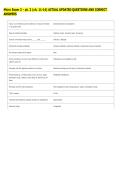
Micro Exam 2 - pt. 2 (ch. 11-14) ACTUAL UPDATED QUESTIONS AND CORRECT
ANSWERS
Focus is on methods used to destroy or reduce microbes Decontamination procedures
in a given area
How to control microbes Washing hands, brushing teeth, showering
Control of microbes helps prevent ______ and _______ Infection, disease
Control of microbe methods Physical methods, chemical methods, mechanical removal methods
Are humans meant to be sterile Nno
Some microbes are much more difficult to control than Endospores and vegetative cells
others such as
Microbes with the highest resistance to control Bacterial endospores and prions (infectious proteins)
Pseudomonas sp., M.tuberculosis, and S. Aureus, staph, Moderate resistance
protozoan cysts, makes viruses (Hep B, poliovirus) all
have
Microbes with the least resistance Most vegetative cells, fungal spores, yeast, enveloped viruses
"Cide" means To kill
Chemical that destroys bacteria except for endospores Bactericide
Destroys fungi Fungicide
, Destroys viruses Virucide
Destroys pathogenic organisms Germicide (microbicide)
Sterile means Free of life
Who came up with aseptic technique Joseph Lister
Process that destroys all viable microbes, including Sterilization
viruses and endospores
-for inanimate objects only
Chemicals that can sterilize by destroying spores (and Sterilants
everything else then, too)
Destroys vegetative cells Bacteriocidal agents
Reduces microbe numbers (not actually killing) Bacteriostatic agents
Process that destroys vegetative pathogens, not Disinfection
endospores (for inanimate objects)
Any practice prevents infection (by preventing entry of Asepsis
infectious agents into sterile tissues)
Growth of microbes in blood or tissues Sepsis
Process where antiseptics are applied to exposed body Antisepsis
surfaces, wounds and surgical incisions to destroy or
inhibit vegetative pathogens
Destroy or inhibit vegetative cells on skin or body Antiseptics
surfaces
Cleansing technique that mechanically removes microbes Sanitization
Reduces the number of microbes (on human skin) Degermination
-similar to antisepsis
Permanent loss of reproductive capability, even under Mortality (death)
optimum growth conditions
Affected by Mortality
-numbers of microbes
-nature of microbes in population
-temp and ph of environment
—concen or dosage of agent
-mode of action
-presence of solvents, organic matter, or inhibitors
ANSWERS
Focus is on methods used to destroy or reduce microbes Decontamination procedures
in a given area
How to control microbes Washing hands, brushing teeth, showering
Control of microbes helps prevent ______ and _______ Infection, disease
Control of microbe methods Physical methods, chemical methods, mechanical removal methods
Are humans meant to be sterile Nno
Some microbes are much more difficult to control than Endospores and vegetative cells
others such as
Microbes with the highest resistance to control Bacterial endospores and prions (infectious proteins)
Pseudomonas sp., M.tuberculosis, and S. Aureus, staph, Moderate resistance
protozoan cysts, makes viruses (Hep B, poliovirus) all
have
Microbes with the least resistance Most vegetative cells, fungal spores, yeast, enveloped viruses
"Cide" means To kill
Chemical that destroys bacteria except for endospores Bactericide
Destroys fungi Fungicide
, Destroys viruses Virucide
Destroys pathogenic organisms Germicide (microbicide)
Sterile means Free of life
Who came up with aseptic technique Joseph Lister
Process that destroys all viable microbes, including Sterilization
viruses and endospores
-for inanimate objects only
Chemicals that can sterilize by destroying spores (and Sterilants
everything else then, too)
Destroys vegetative cells Bacteriocidal agents
Reduces microbe numbers (not actually killing) Bacteriostatic agents
Process that destroys vegetative pathogens, not Disinfection
endospores (for inanimate objects)
Any practice prevents infection (by preventing entry of Asepsis
infectious agents into sterile tissues)
Growth of microbes in blood or tissues Sepsis
Process where antiseptics are applied to exposed body Antisepsis
surfaces, wounds and surgical incisions to destroy or
inhibit vegetative pathogens
Destroy or inhibit vegetative cells on skin or body Antiseptics
surfaces
Cleansing technique that mechanically removes microbes Sanitization
Reduces the number of microbes (on human skin) Degermination
-similar to antisepsis
Permanent loss of reproductive capability, even under Mortality (death)
optimum growth conditions
Affected by Mortality
-numbers of microbes
-nature of microbes in population
-temp and ph of environment
—concen or dosage of agent
-mode of action
-presence of solvents, organic matter, or inhibitors


