

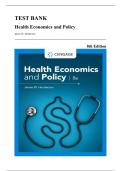
TEST BANK
Health Economics and Policy
James W. Henderson
─────────────────────────────────────────────────────
ST
8th Edition
UV
IA
?_
M
GE
EK
??
, TABLE OF CONTENTS
Test Bank: Health Economics and Policy, 8th Edition
By James Henderson
Part 1. The Relevance of Economics in Health and Medical Care
Chapter 1 U.S. Medical Care: A System at the Crossroads
Chapter 2 Health Care Spending Issues
Chapter 3 Health Care Markets: Can They Work?
ST
Chapter 4 Welfare Implications in Medical Markets
Chapter 5 Economic Evaluation in Health Care
Part 2. Demand-Side Consideration
UV
R
Chapter 6 Demand for Health and Medical Care
U
Chapter 7 Population Health
SE
Part 3. Supply-Side Consideration
Chapter 8 The Market for Health Insurance
IA
IS
Chapter 9 Managed Care
Chapter 10 The Physicians’ Services Market
O
?_
Chapter 11 The Hospital Services Market
N
Chapter 12 Pharmaceuticals
Part 4. Public Policy in Medical Care Delivery
N M
Chapter 13 Medicare
CO
Chapter 14 Medicaid
Chapter 15 Health Systems in High Income Countries
GE
Chapter 16 Medical Care Reform in the United States
ED
Chapter 17 Lessons for Public Policy
M
EK
??
1
,Chapter 01: U.S. Medical Care: A System at the Crossroads
1. Charging higher prices for one category of patients in order to provide free or subsidized care to another group is called:
a. price discrimination.
b. cost shifting.
c. categorical costing.
d. reprehensible and
unethical.
e. creative accounting.
ST
ANSWER: b
FEEDBACK: a.Incorrect. Cost shifting is the practice of charging higher prices to one
group of patients, usually those with private health insurance, in order
to subsidize the care of those whose payments do not cover the fully
allocated cost of the care they receive.
UV
b. Correct. Cost shifting is the practice of charging higher prices to one
group of patients, usually those with private health insurance, in order
to subsidize the care of those whose payments do not cover the fully
allocated cost of the care they receive.
c. Incorrect. Cost shifting is the practice of charging higher prices to one
IA
group of patients, usually those with private health insurance, in order
to subsidize the care of those whose payments do not cover the fully
allocated cost of the care they receive.
d. Incorrect. Cost shifting is the practice of charging higher prices to one
group of patients, usually those with private health insurance, in order
?_
to subsidize the care of those whose payments do not cover the fully
allocated cost of the care they receive.
e. Incorrect. Cost shifting is the practice of charging higher prices to one
group of patients, usually those with private health insurance, in order
M
to subsidize the care of those whose payments do not cover the fully
allocated cost of the care they receive.
POINTS: 1
QUESTION T Multiple Choice
GE
YPE:
HAS VARIAB False
LES:
LEARNING O 1-1a - Emergence of the Modern Medical System
EK
BJECTIVES:
DATE CREAT 1/24/2022 3:04 AM
ED:
DATE MODIFI 2/9/2022 7:28 AM
ED:
??
2. In the 1960s, individuals paid for the majority of their medical care out of pocket. Increased insurance coverage, both
private and public, displaced out-of-pocket spending as the primary source of payment. By 2020, what was the forecasted
percentage amount of health care spending paid by individuals?
a. 6 percent
b. 10.4 percent
c. 11.6 percent
d. 17.4 percent
e. Whatever amount we are currently
spending
, ANSWER: b
FEEDBACK: a.Incorrect. The amount that individuals paid out of pocket for health
care expenditures declined from 17.4 percent in the 1960s to a
forecasted 10.4 percent in 2020, according to Centers for Medicare
and Medicaid Services (CMS.gov).
b. Correct. The amount that individuals paid out of pocket for health care
expenditures declined from 17.4 percent in the 1960s to a forecasted
10.4 percent in 2020, according to Centers for Medicare and Medicaid
Services (CMS.gov).
c. Incorrect. The amount that individuals paid out of pocket for health
ST
care expenditures declined from 17.4 percent in the 1960s to a
forecasted 10.4 percent in 2020, according to Centers for Medicare
and Medicaid Services (CMS.gov).
d. Incorrect. The amount that individuals paid out of pocket for health
care expenditures declined from 17.4 percent in the 1960s to a
UV
forecasted 10.4 percent in 2020, according to Centers for Medicare
and Medicaid Services (CMS.gov).
e. Incorrect. The amount that individuals paid out of pocket for health
care expenditures declined from 17.4 percent in the 1960s to a
forecasted 10.4 percent in 2020, according to Centers for Medicare
and Medicaid Services (CMS.gov).
IA
POINTS: 1
QUESTION T Multiple Choice
YPE:
?_
HAS VARIAB False
LES:
LEARNING O 1-1c - Recent Changes in the Payment Structure
BJECTIVES:
M
DATE CREAT 1/24/2022 3:09 AM
ED:
DATE MODIFI 2/9/2022 7:41 AM
ED:
GE
3. When someone mentions the “managed care” approach to health care, what are they referring to? Be sure to include the
term “horizontal integration” in your answer.
ANSWER: Managed care refers to a delivery system that originally integrated the financing
and provision of medical care into one organization. Now the term encompasses
EK
different arrangements designed to coordinate services and control costs, such as
an HMO, a PPO, or a point-of-service plan. Horizontal integration is the process
by which this was carried out, transforming a highly fragmented industry into a
single multihospital system.
??
POINTS: 1
QUESTION T Essay
YPE:
HAS VARIAB False
LES:
STUDENT EN Basic
TRY MODE:
LEARNING O 1-1b - Recent Changes in Medical Care Delivery
BJECTIVES:
DATE CREAT 1/24/2022 3:14 AM
ED:
Health Economics and Policy
James W. Henderson
─────────────────────────────────────────────────────
ST
8th Edition
UV
IA
?_
M
GE
EK
??
, TABLE OF CONTENTS
Test Bank: Health Economics and Policy, 8th Edition
By James Henderson
Part 1. The Relevance of Economics in Health and Medical Care
Chapter 1 U.S. Medical Care: A System at the Crossroads
Chapter 2 Health Care Spending Issues
Chapter 3 Health Care Markets: Can They Work?
ST
Chapter 4 Welfare Implications in Medical Markets
Chapter 5 Economic Evaluation in Health Care
Part 2. Demand-Side Consideration
UV
R
Chapter 6 Demand for Health and Medical Care
U
Chapter 7 Population Health
SE
Part 3. Supply-Side Consideration
Chapter 8 The Market for Health Insurance
IA
IS
Chapter 9 Managed Care
Chapter 10 The Physicians’ Services Market
O
?_
Chapter 11 The Hospital Services Market
N
Chapter 12 Pharmaceuticals
Part 4. Public Policy in Medical Care Delivery
N M
Chapter 13 Medicare
CO
Chapter 14 Medicaid
Chapter 15 Health Systems in High Income Countries
GE
Chapter 16 Medical Care Reform in the United States
ED
Chapter 17 Lessons for Public Policy
M
EK
??
1
,Chapter 01: U.S. Medical Care: A System at the Crossroads
1. Charging higher prices for one category of patients in order to provide free or subsidized care to another group is called:
a. price discrimination.
b. cost shifting.
c. categorical costing.
d. reprehensible and
unethical.
e. creative accounting.
ST
ANSWER: b
FEEDBACK: a.Incorrect. Cost shifting is the practice of charging higher prices to one
group of patients, usually those with private health insurance, in order
to subsidize the care of those whose payments do not cover the fully
allocated cost of the care they receive.
UV
b. Correct. Cost shifting is the practice of charging higher prices to one
group of patients, usually those with private health insurance, in order
to subsidize the care of those whose payments do not cover the fully
allocated cost of the care they receive.
c. Incorrect. Cost shifting is the practice of charging higher prices to one
IA
group of patients, usually those with private health insurance, in order
to subsidize the care of those whose payments do not cover the fully
allocated cost of the care they receive.
d. Incorrect. Cost shifting is the practice of charging higher prices to one
group of patients, usually those with private health insurance, in order
?_
to subsidize the care of those whose payments do not cover the fully
allocated cost of the care they receive.
e. Incorrect. Cost shifting is the practice of charging higher prices to one
group of patients, usually those with private health insurance, in order
M
to subsidize the care of those whose payments do not cover the fully
allocated cost of the care they receive.
POINTS: 1
QUESTION T Multiple Choice
GE
YPE:
HAS VARIAB False
LES:
LEARNING O 1-1a - Emergence of the Modern Medical System
EK
BJECTIVES:
DATE CREAT 1/24/2022 3:04 AM
ED:
DATE MODIFI 2/9/2022 7:28 AM
ED:
??
2. In the 1960s, individuals paid for the majority of their medical care out of pocket. Increased insurance coverage, both
private and public, displaced out-of-pocket spending as the primary source of payment. By 2020, what was the forecasted
percentage amount of health care spending paid by individuals?
a. 6 percent
b. 10.4 percent
c. 11.6 percent
d. 17.4 percent
e. Whatever amount we are currently
spending
, ANSWER: b
FEEDBACK: a.Incorrect. The amount that individuals paid out of pocket for health
care expenditures declined from 17.4 percent in the 1960s to a
forecasted 10.4 percent in 2020, according to Centers for Medicare
and Medicaid Services (CMS.gov).
b. Correct. The amount that individuals paid out of pocket for health care
expenditures declined from 17.4 percent in the 1960s to a forecasted
10.4 percent in 2020, according to Centers for Medicare and Medicaid
Services (CMS.gov).
c. Incorrect. The amount that individuals paid out of pocket for health
ST
care expenditures declined from 17.4 percent in the 1960s to a
forecasted 10.4 percent in 2020, according to Centers for Medicare
and Medicaid Services (CMS.gov).
d. Incorrect. The amount that individuals paid out of pocket for health
care expenditures declined from 17.4 percent in the 1960s to a
UV
forecasted 10.4 percent in 2020, according to Centers for Medicare
and Medicaid Services (CMS.gov).
e. Incorrect. The amount that individuals paid out of pocket for health
care expenditures declined from 17.4 percent in the 1960s to a
forecasted 10.4 percent in 2020, according to Centers for Medicare
and Medicaid Services (CMS.gov).
IA
POINTS: 1
QUESTION T Multiple Choice
YPE:
?_
HAS VARIAB False
LES:
LEARNING O 1-1c - Recent Changes in the Payment Structure
BJECTIVES:
M
DATE CREAT 1/24/2022 3:09 AM
ED:
DATE MODIFI 2/9/2022 7:41 AM
ED:
GE
3. When someone mentions the “managed care” approach to health care, what are they referring to? Be sure to include the
term “horizontal integration” in your answer.
ANSWER: Managed care refers to a delivery system that originally integrated the financing
and provision of medical care into one organization. Now the term encompasses
EK
different arrangements designed to coordinate services and control costs, such as
an HMO, a PPO, or a point-of-service plan. Horizontal integration is the process
by which this was carried out, transforming a highly fragmented industry into a
single multihospital system.
??
POINTS: 1
QUESTION T Essay
YPE:
HAS VARIAB False
LES:
STUDENT EN Basic
TRY MODE:
LEARNING O 1-1b - Recent Changes in Medical Care Delivery
BJECTIVES:
DATE CREAT 1/24/2022 3:14 AM
ED:


