

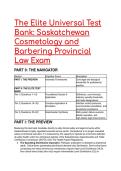
The Elite Universal Test
Bank: Saskatchewan
Cosmetology and
Barbering Provincial
Law Exam
PART 0: THE NAVIGATOR
Section Cognitive Focus Description
PART I: THE PREVIEW Axiomatic Frameworks Core legal and biological
thresholds for professional
practice.
PART II: THE ELITE TEST
BANK
Tier 1 (Questions 1–15) Foundational Syntax & Definitions, core formulas,
Application statutory penalty thresholds,
and trade designations.
Tier 2 (Questions 16–35) Complex Application & Infection control protocols,
Simulation environmental remediation, and
procedural compliance.
Tier 3 (Questions 36–60) Grandmaster Synthesis Multi-system failure aversion,
liability cascades, and
high-stakes legal interventions.
PART I: THE PREVIEW
Mastering this test bank translates directly to elite clinical safety and legal immunity within
Saskatchewan's highly regulated personal service sector. Competence is no longer evaluated
solely on technical execution; it is measured by the capacity to operate as a front-line defender
of public health under the unforgiving statutes of the Saskatchewan Apprenticeship and Trade
Certification Commission (SATCC) and The Health Hazard Regulations.
● The Spaulding Disinfection Imperative: Pathogen eradication is dictated by anatomical
depth. Critical items (penetrating skin/blood) demand total Sterilization. Semi-critical items
(contacting non-intact skin/mucous membranes) require High-Level Disinfection (HLD).
Non-critical items (intact skin only) require Intermediate-Level Disinfection (ILD) or
, Low-Level Disinfection (LLD).
● The SATCC Ratio & Wage Matrix: The structural integrity of apprenticeship in the
Hairstylist trade rests on a strict 3:1 ratio (three apprentices to one journeyperson).
Economically, an apprentice's wage floor begins at the provincial minimum wage for the
first six months, scaling to a mandatory 110% of the minimum wage beyond the first half
of the apprenticeship year.
● The Jurisdictional Firewall (Prior Notice): Under Section 6 of The Health Hazard
Regulations, no operator may construct, renovate, or operate a facility without providing
prior written notice to the local health authority. The only exemption is routine
maintenance.
● The Expiry & On-Duty Mandates: An uncertified practitioner's right to work expires
exactly one year post-training or after 5,400 hours, unless actively testing. Furthermore, a
business cannot legally open its doors unless at least one certified journeyperson is
physically on duty.
● The Statutory Liability Threshold: Ignorance of The Public Health Act, 1994 carries
devastating mathematical consequences. First-offense statutory breaches yield fines up
to $75,000 for individuals and $100,000 for corporations, compounding with daily
continuation penalties.
PART II: THE ELITE TEST BANK
Tier 1: Foundational Syntax & Application
The foundational framework of Saskatchewan's personal service industry is governed by a
dual-axis regulatory system. The biological safety axis is dictated by The Health Hazard
Regulations under The Public Health Act, 1994. The occupational competence axis is governed
by The Apprenticeship and Trade Certification Commission (SATCC). Understanding the
intersection of these mandates is non-negotiable for professional survival. In Saskatchewan,
Hairstylist is the singular compulsory (regulated) trade in the personal service sector, demanding
strict adherence to pre-employment training, indentureship ratios, and specific wage floors.
Conversely, Esthetician sub-trades (Skin Care Technician and Nail Technician) operate as
designated but voluntary trades.
Statutory Violation Offender Classification Maximum Base Fine Maximum Daily
Continuation Fine
First Offense Individual $75,000 $100 / day
First Offense Corporation $100,000 $250,000 / day
Second/Subsequent Individual $100,000 Variable
Second/Subsequent Corporation $250,000 $250,000 / day
Q1: Under the Saskatchewan Apprenticeship and Trade Certification Commission (SATCC)
framework, which of the following personal service trades requires compulsory certification to
legally practice within the province? A) Esthetician - Skin Care Technician B) Electrologist C)
Hairstylist D) Esthetician - Nail Technician
● The Answer: C (Hairstylist)
● Distractor Analysis:
○ A is incorrect: Esthetician (Skin Care) is a designated provincial trade, but it
operates as a voluntary trade, meaning certification is not legally required to
practice.
, ○ B is incorrect: Electrology is an unregulated, voluntary practice, though specific
laser programs may be recommended.
○ D is incorrect: Nail Technician is a voluntary designated trade.
The Mentor's Analysis: Regulatory authority is not uniformly applied across all beauty
disciplines. The SATCC has designated the Hairstylist trade as the singular compulsory
personal service profession. By identifying compulsory trades, the practitioner recognizes where
the state mandates formal indentureship versus where it merely offers voluntary qualification.
Professional/Academic Intuition: Hair is compulsory; skin and nails are voluntary.
Regulate your hiring accordingly.
Q2: According to the Spaulding Classification system integrated into Saskatchewan's Personal
Service Facility Best Management Practices, which definition perfectly captures a critical item?
A) An instrument that contacts intact skin and requires Intermediate-Level Disinfection. B) An
instrument intended to penetrate the skin or mucous membrane, requiring total Sterilization. C)
An instrument that contacts non-intact skin but does not penetrate the dermal layer, requiring
High-Level Disinfection. D) An environmental surface that houses clients, requiring Low-Level
Disinfection.
● The Answer: B (An instrument intended to penetrate the skin or mucous membrane,
requiring total Sterilization.)
● Distractor Analysis:
○ A is incorrect: This defines a non-critical item.
○ C is incorrect: This defines a semi-critical item.
○ D is incorrect: This defines non-critical environmental equipment.
The Mentor's Analysis: Infection control logic relies on anatomical boundaries. The moment an
instrument breaches the body's natural armor (the epidermis or mucous membrane), it enters
the sterile environment of the bloodstream. By classifying these as critical items, the protocol
dictates the absolute thermal or chemical annihilation of all pathogens (Sterilization).
Professional/Academic Intuition: If it pierces the armor, it must be sterile.
Q3: A corporation operating a chain of tanning salons is found guilty of a first-time structural
violation under The Health Hazard Regulations. According to Section 61 of The Public Health
Act, 1994, what is the absolute maximum base fine the corporation faces? A) $10,000 B)
$75,000 C) $100,000 D) $250,000
● The Answer: C ($100,000)
● Distractor Analysis:
○ A is incorrect: This represents a minor municipal bylaw infraction, not a provincial
health hazard penalty.
○ B is incorrect: $75,000 is the maximum first-offense fine for an individual, not a
corporation.
○ D is incorrect: $250,000 is the maximum penalty for a second or subsequent
offense by a corporation.
The Mentor's Analysis: Public health law distinguishes heavily between individual practitioners
and corporate entities. The Crown scales financial penalties to ensure deterrence at an
enterprise level. By recognizing the $100,000 corporate threshold, management understands
that systemic non-compliance poses an existential threat to organizational solvency.
Professional/Academic Intuition: Corporate liability carries a premium penalty. The
Crown does not issue warnings; it issues bankruptcies.
Q4: A salon operator decides to renovate their existing facility by moving the plumbing lines and
adding two new pedicure basins. To maintain compliance with Section 6 of The Health Hazard
Regulations, what action MUST occur before the renovation begins? A) The operator must
, submit a revised apprentice ratio to the SATCC. B) The operator must provide prior written
notice to the local authority. C) The operator must flush the municipal water lines with
High-Level Disinfectant. D) No action is required, as this qualifies as routine maintenance.
● The Answer: B (The operator must provide prior written notice to the local authority.)
● Distractor Analysis:
○ A is incorrect: The SATCC governs trades training, not structural facility plumbing
and health hazards.
○ C is incorrect: Municipal water lines cannot be flushed with HLD by a private citizen.
○ D is incorrect: Moving plumbing and adding basins is a structural alteration, strictly
voiding the "routine maintenance" exemption.
The Mentor's Analysis: The state demands oversight of infrastructure that handles biological
waste. You cannot alter the physical architecture of a personal service facility without granting
the health inspector the opportunity to review the blueprints. By executing prior written notice,
the operator prevents the forced dismantling of non-compliant, newly built infrastructure.
Professional/Academic Intuition: Notification precedes alteration. The local authority
must vet the blueprint before the hammer swings.
Q5: An employer operates a salon with two Journeyperson Hairstylists. Under Table 6 of The
Apprenticeship and Trade Certification Regulations, 2020, what is the maximum number of
indentured hairstylist apprentices this facility can legally employ? A) Two B) Four C) Six D) Eight
● The Answer: C (Six)
● Distractor Analysis:
○ A is incorrect: This incorrectly assumes a 1:1 ratio.
○ B is incorrect: This incorrectly assumes a 2:1 ratio.
○ D is incorrect: This illegally exceeds the statutory capacity for supervision.
The Mentor's Analysis: Human infrastructure is heavily regulated to ensure the safe transfer of
complex skills. Saskatchewan has determined that one master can safely divide their attention
among three novices. By applying the 3:1 ratio, the operator mathematically scales their
workforce safely without diluting the mandatory supervision required for compulsory trades.
Professional/Academic Intuition: Multiply your Journeypersons by three. That is your
absolute apprenticeship ceiling.
Q6: A new Hairstylist apprentice completes their first six months of indentured employment.
Moving into the second half of their first apprenticeship year, what is the new statutory minimum
wage they must receive under Table 5 of the Saskatchewan regulations? A) Exactly the
provincial minimum wage. B) 110% of the provincial minimum wage. C) 40% of the newly
qualified journeyperson rate. D) 90% of the newly qualified journeyperson rate.
● The Answer: B (110% of the provincial minimum wage.)
● Distractor Analysis:
○ A is incorrect: Minimum wage is only applicable for the first six months.
○ C is incorrect: This is a legacy/generalized metric for other trades; Hairstylists have
a specific entry in Table 5 dictating minimum wage multipliers.
○ D is incorrect: The 90% threshold applies to apprentices in the last half of their final
year across standard trades, not first-year hairstylists.
The Mentor's Analysis: Apprenticeship is an escalating economic contract. As the learner
gains fundamental competence, their statutory floor rises to prevent exploitation. By executing
the 110% wage adjustment, the employer remains compliant with the Department of Labour and
the SATCC, avoiding severe retroactive wage theft penalties. Professional/Academic
Intuition: After six months, the apprentice's baseline outgrows the minimum wage.
Q7: To achieve Journeyperson status in Saskatchewan's regulated personal service trades, a
Bank: Saskatchewan
Cosmetology and
Barbering Provincial
Law Exam
PART 0: THE NAVIGATOR
Section Cognitive Focus Description
PART I: THE PREVIEW Axiomatic Frameworks Core legal and biological
thresholds for professional
practice.
PART II: THE ELITE TEST
BANK
Tier 1 (Questions 1–15) Foundational Syntax & Definitions, core formulas,
Application statutory penalty thresholds,
and trade designations.
Tier 2 (Questions 16–35) Complex Application & Infection control protocols,
Simulation environmental remediation, and
procedural compliance.
Tier 3 (Questions 36–60) Grandmaster Synthesis Multi-system failure aversion,
liability cascades, and
high-stakes legal interventions.
PART I: THE PREVIEW
Mastering this test bank translates directly to elite clinical safety and legal immunity within
Saskatchewan's highly regulated personal service sector. Competence is no longer evaluated
solely on technical execution; it is measured by the capacity to operate as a front-line defender
of public health under the unforgiving statutes of the Saskatchewan Apprenticeship and Trade
Certification Commission (SATCC) and The Health Hazard Regulations.
● The Spaulding Disinfection Imperative: Pathogen eradication is dictated by anatomical
depth. Critical items (penetrating skin/blood) demand total Sterilization. Semi-critical items
(contacting non-intact skin/mucous membranes) require High-Level Disinfection (HLD).
Non-critical items (intact skin only) require Intermediate-Level Disinfection (ILD) or
, Low-Level Disinfection (LLD).
● The SATCC Ratio & Wage Matrix: The structural integrity of apprenticeship in the
Hairstylist trade rests on a strict 3:1 ratio (three apprentices to one journeyperson).
Economically, an apprentice's wage floor begins at the provincial minimum wage for the
first six months, scaling to a mandatory 110% of the minimum wage beyond the first half
of the apprenticeship year.
● The Jurisdictional Firewall (Prior Notice): Under Section 6 of The Health Hazard
Regulations, no operator may construct, renovate, or operate a facility without providing
prior written notice to the local health authority. The only exemption is routine
maintenance.
● The Expiry & On-Duty Mandates: An uncertified practitioner's right to work expires
exactly one year post-training or after 5,400 hours, unless actively testing. Furthermore, a
business cannot legally open its doors unless at least one certified journeyperson is
physically on duty.
● The Statutory Liability Threshold: Ignorance of The Public Health Act, 1994 carries
devastating mathematical consequences. First-offense statutory breaches yield fines up
to $75,000 for individuals and $100,000 for corporations, compounding with daily
continuation penalties.
PART II: THE ELITE TEST BANK
Tier 1: Foundational Syntax & Application
The foundational framework of Saskatchewan's personal service industry is governed by a
dual-axis regulatory system. The biological safety axis is dictated by The Health Hazard
Regulations under The Public Health Act, 1994. The occupational competence axis is governed
by The Apprenticeship and Trade Certification Commission (SATCC). Understanding the
intersection of these mandates is non-negotiable for professional survival. In Saskatchewan,
Hairstylist is the singular compulsory (regulated) trade in the personal service sector, demanding
strict adherence to pre-employment training, indentureship ratios, and specific wage floors.
Conversely, Esthetician sub-trades (Skin Care Technician and Nail Technician) operate as
designated but voluntary trades.
Statutory Violation Offender Classification Maximum Base Fine Maximum Daily
Continuation Fine
First Offense Individual $75,000 $100 / day
First Offense Corporation $100,000 $250,000 / day
Second/Subsequent Individual $100,000 Variable
Second/Subsequent Corporation $250,000 $250,000 / day
Q1: Under the Saskatchewan Apprenticeship and Trade Certification Commission (SATCC)
framework, which of the following personal service trades requires compulsory certification to
legally practice within the province? A) Esthetician - Skin Care Technician B) Electrologist C)
Hairstylist D) Esthetician - Nail Technician
● The Answer: C (Hairstylist)
● Distractor Analysis:
○ A is incorrect: Esthetician (Skin Care) is a designated provincial trade, but it
operates as a voluntary trade, meaning certification is not legally required to
practice.
, ○ B is incorrect: Electrology is an unregulated, voluntary practice, though specific
laser programs may be recommended.
○ D is incorrect: Nail Technician is a voluntary designated trade.
The Mentor's Analysis: Regulatory authority is not uniformly applied across all beauty
disciplines. The SATCC has designated the Hairstylist trade as the singular compulsory
personal service profession. By identifying compulsory trades, the practitioner recognizes where
the state mandates formal indentureship versus where it merely offers voluntary qualification.
Professional/Academic Intuition: Hair is compulsory; skin and nails are voluntary.
Regulate your hiring accordingly.
Q2: According to the Spaulding Classification system integrated into Saskatchewan's Personal
Service Facility Best Management Practices, which definition perfectly captures a critical item?
A) An instrument that contacts intact skin and requires Intermediate-Level Disinfection. B) An
instrument intended to penetrate the skin or mucous membrane, requiring total Sterilization. C)
An instrument that contacts non-intact skin but does not penetrate the dermal layer, requiring
High-Level Disinfection. D) An environmental surface that houses clients, requiring Low-Level
Disinfection.
● The Answer: B (An instrument intended to penetrate the skin or mucous membrane,
requiring total Sterilization.)
● Distractor Analysis:
○ A is incorrect: This defines a non-critical item.
○ C is incorrect: This defines a semi-critical item.
○ D is incorrect: This defines non-critical environmental equipment.
The Mentor's Analysis: Infection control logic relies on anatomical boundaries. The moment an
instrument breaches the body's natural armor (the epidermis or mucous membrane), it enters
the sterile environment of the bloodstream. By classifying these as critical items, the protocol
dictates the absolute thermal or chemical annihilation of all pathogens (Sterilization).
Professional/Academic Intuition: If it pierces the armor, it must be sterile.
Q3: A corporation operating a chain of tanning salons is found guilty of a first-time structural
violation under The Health Hazard Regulations. According to Section 61 of The Public Health
Act, 1994, what is the absolute maximum base fine the corporation faces? A) $10,000 B)
$75,000 C) $100,000 D) $250,000
● The Answer: C ($100,000)
● Distractor Analysis:
○ A is incorrect: This represents a minor municipal bylaw infraction, not a provincial
health hazard penalty.
○ B is incorrect: $75,000 is the maximum first-offense fine for an individual, not a
corporation.
○ D is incorrect: $250,000 is the maximum penalty for a second or subsequent
offense by a corporation.
The Mentor's Analysis: Public health law distinguishes heavily between individual practitioners
and corporate entities. The Crown scales financial penalties to ensure deterrence at an
enterprise level. By recognizing the $100,000 corporate threshold, management understands
that systemic non-compliance poses an existential threat to organizational solvency.
Professional/Academic Intuition: Corporate liability carries a premium penalty. The
Crown does not issue warnings; it issues bankruptcies.
Q4: A salon operator decides to renovate their existing facility by moving the plumbing lines and
adding two new pedicure basins. To maintain compliance with Section 6 of The Health Hazard
Regulations, what action MUST occur before the renovation begins? A) The operator must
, submit a revised apprentice ratio to the SATCC. B) The operator must provide prior written
notice to the local authority. C) The operator must flush the municipal water lines with
High-Level Disinfectant. D) No action is required, as this qualifies as routine maintenance.
● The Answer: B (The operator must provide prior written notice to the local authority.)
● Distractor Analysis:
○ A is incorrect: The SATCC governs trades training, not structural facility plumbing
and health hazards.
○ C is incorrect: Municipal water lines cannot be flushed with HLD by a private citizen.
○ D is incorrect: Moving plumbing and adding basins is a structural alteration, strictly
voiding the "routine maintenance" exemption.
The Mentor's Analysis: The state demands oversight of infrastructure that handles biological
waste. You cannot alter the physical architecture of a personal service facility without granting
the health inspector the opportunity to review the blueprints. By executing prior written notice,
the operator prevents the forced dismantling of non-compliant, newly built infrastructure.
Professional/Academic Intuition: Notification precedes alteration. The local authority
must vet the blueprint before the hammer swings.
Q5: An employer operates a salon with two Journeyperson Hairstylists. Under Table 6 of The
Apprenticeship and Trade Certification Regulations, 2020, what is the maximum number of
indentured hairstylist apprentices this facility can legally employ? A) Two B) Four C) Six D) Eight
● The Answer: C (Six)
● Distractor Analysis:
○ A is incorrect: This incorrectly assumes a 1:1 ratio.
○ B is incorrect: This incorrectly assumes a 2:1 ratio.
○ D is incorrect: This illegally exceeds the statutory capacity for supervision.
The Mentor's Analysis: Human infrastructure is heavily regulated to ensure the safe transfer of
complex skills. Saskatchewan has determined that one master can safely divide their attention
among three novices. By applying the 3:1 ratio, the operator mathematically scales their
workforce safely without diluting the mandatory supervision required for compulsory trades.
Professional/Academic Intuition: Multiply your Journeypersons by three. That is your
absolute apprenticeship ceiling.
Q6: A new Hairstylist apprentice completes their first six months of indentured employment.
Moving into the second half of their first apprenticeship year, what is the new statutory minimum
wage they must receive under Table 5 of the Saskatchewan regulations? A) Exactly the
provincial minimum wage. B) 110% of the provincial minimum wage. C) 40% of the newly
qualified journeyperson rate. D) 90% of the newly qualified journeyperson rate.
● The Answer: B (110% of the provincial minimum wage.)
● Distractor Analysis:
○ A is incorrect: Minimum wage is only applicable for the first six months.
○ C is incorrect: This is a legacy/generalized metric for other trades; Hairstylists have
a specific entry in Table 5 dictating minimum wage multipliers.
○ D is incorrect: The 90% threshold applies to apprentices in the last half of their final
year across standard trades, not first-year hairstylists.
The Mentor's Analysis: Apprenticeship is an escalating economic contract. As the learner
gains fundamental competence, their statutory floor rises to prevent exploitation. By executing
the 110% wage adjustment, the employer remains compliant with the Department of Labour and
the SATCC, avoiding severe retroactive wage theft penalties. Professional/Academic
Intuition: After six months, the apprentice's baseline outgrows the minimum wage.
Q7: To achieve Journeyperson status in Saskatchewan's regulated personal service trades, a


