

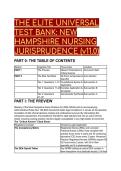
THE ELITE UNIVERSAL
TEST BANK: NEW
HAMPSHIRE NURSING
JURISPRUDENCE (v11.0)
PART 0: THE TABLE OF CONTENTS
Section Cognitive Tier Focus Area Location
PART I The Preview Mission Parameters & Document Start
Critical Axioms
PART II The Elite Test Bank 30-Point Jurisprudence Core Section
Gauntlet
- Tier 1: Questions 1–10 Foundational Syntax & Sub-section A
Application
- Tier 2: Questions 11–20 Complex Application & Sub-section B
Simulation
- Tier 3: Questions Grandmaster Synthesis Sub-section C
21–30
PART I: THE PREVIEW
Mastery of the New Hampshire Nurse Practice Act (RSA 326-B) and its accompanying
Administrative Rules (Nur 100-800) transcends basic legal compliance; it serves as the absolute
foundation of elite clinical decision-making and professional survival. By internalizing this
exhaustive assessment, the practitioner transforms rigid statutory text into an active clinical
shield, ensuring nursing practice remains legally unassailable in any high-stakes environment.
The "Critical Axioms" Cheat Sheet:
Regulatory Concept Clinical & Legal Application
The Competency Matrix Registered Nurses (RNs) and Licensed
Practical Nurses (LPNs) must complete 400
practice hours every 4 years and 30 continuing
education (CE) hours every 2 years. Advanced
Practice Registered Nurses (APRNs) require 60
CE hours every 2 years, with 30 in their
specialty and 5 in pharmacology.
The DEA Opioid Tether Any APRN holding an active DEA number in
New Hampshire must dedicate exactly 3 of their
,Regulatory Concept Clinical & Legal Application
5 required pharmacology CE hours specifically
to opioid prescribing, pain management, or
substance use disorder.
The Delegation Hierarchy RNs and APRNs possess independent
authority to delegate nursing-related activities.
LPNs maintain delegation authority only when
practicing under the direct supervision and
direction of an RN, APRN, physician, or dentist.
The Stability Doctrine Delegation to an Unlicensed Assistive
Personnel (UAP), Licensed Nursing Assistant
(LNA), or Medication Nursing Assistant (MNA)
strictly requires the patient's condition to be
stable and predictable pursuant to Nur 101.21.
The Temporal Limit A temporary permit issued by the Board to
out-of-state endorsement applicants or new
graduates is valid for an absolute maximum of
120 days or until background check results are
received.
PART II: THE ELITE TEST BANK
Sub-section A: Tier 1 - Foundational Syntax & Application
Q1: A newly licensed Registered Nurse in New Hampshire is reviewing the regulatory oversight
structure that governs their professional license. Based on the principles of RSA 326-B:3 and
Nur 102.01 regarding the New Hampshire Board of Nursing, which conclusion regarding the
Board's composition is the MOST ACCURATE? A) The Board is composed of 13 members
appointed by the State Legislature, primarily consisting of physicians and public advocates. B)
The Board is composed of 11 members appointed by the Governor, heavily weighted with 6
Registered Nurses (including 2 APRNs), 2 LPNs, and 3 public members. C) The Board consists
of 7 executive officers elected by active licensees every four years to establish local hospital
policies. D) The Board operates with 11 members appointed by the Department of Health and
Human Services, all of whom must be actively practicing bedside nurses.
● The Answer: B (The Board is composed of 11 members appointed by the Governor,
heavily weighted with 6 Registered Nurses (including 2 APRNs), 2 LPNs, and 3 public
members.)
● Distractor Analysis:
○ A is incorrect: The Board's members are appointed by the Governor and Executive
Council, not the State Legislature, and it is explicitly controlled by nursing
professionals rather than physicians.
○ C is incorrect: This represents a fundamental misunderstanding of regulatory board
architecture. Board members are appointed executives of the state who execute
statutory law, not peer-elected union officials managing hospital policies.
○ D is incorrect: While active practice is required for RN members, appointments are
made by the Governor (not DHHS), and the Board explicitly includes public
members who do not practice nursing to ensure objective civilian oversight.
The Mentor's Analysis: Regulatory authority in nursing is derived from the state's police power
, to protect the public, executed through a Governor-appointed Board. When facing questions of
licensure oversight, the immediate priority is recognizing that the Board is a state regulatory
agency, not a professional advocacy union. By utilizing the RSA 326-B:3 Composition Rule, you
bypass the common trap of assuming boards are peer-elected bodies designed to protect the
nurse. Professional/Academic Intuition: The Board of Nursing protects the public, not the
practitioner, and is architecturally designed to be governed by nursing professionals appointed
by the state's highest executive.
Q2: A travel nurse from a non-compact state applies for licensure by endorsement in New
Hampshire. The Board issues a temporary permit while awaiting the final results of a federal
criminal background check. Based on the constraints of New Hampshire nursing licensure,
which action by the nurse is the MOST ACCURATE application of the law? A) The nurse may
practice indefinitely on the temporary permit provided the background check delay is the fault of
the federal government. B) The nurse must cease practice immediately upon the 90th day of
employment, as temporary permits cannot exceed three months. C) The nurse must cease
practice on the 120th day if the background check is not received, as the temporary permit
becomes legally void. D) The nurse may practice for 180 days, corresponding with the standard
expiration date of an incomplete licensure application.
● The Answer: C (The nurse must cease practice on the 120th day if the background
check is not received, as the temporary permit becomes legally void.)
● Distractor Analysis:
○ A is incorrect: The statutory framework makes no allowances or clinical extensions
for bureaucratic delays at the federal level. The timeline is absolute, and practicing
beyond it constitutes the unauthorized practice of nursing.
○ B is incorrect: Legacy data in surrounding states utilizes a 90-day window, but New
Hampshire explicitly grants a 120-day timeframe for temporary permits to
accommodate processing realities.
○ D is incorrect: While an incomplete application file is held open for 180 days before
being discarded and requiring a new fee, the temporary permit to practice expires
strictly at 120 days.
The Mentor's Analysis: Temporary licensure is a provisional privilege, not a constitutional right,
designed to facilitate immediate workforce entry while maintaining ultimate public safety. When
tracking licensure timelines, the immediate priority is adhering to the rigid expiration date without
exception. By utilizing the 120-Day Temporary Permit Mandate, you bypass the common trap of
confusing application validity limits with active practice authorization. Professional/Academic
Intuition: The 120-day countdown is an absolute legal hard-stop; bureaucratic delays do not
grant clinical extensions, and unauthorized practice triggers immediate disciplinary sanctions.
Q3: An experienced LPN is preparing to renew their New Hampshire nursing license. The nurse
has maintained continuous full-time employment for the past five years. Based on Nur 403.01
and continuing competence requirements, which combination of achievements MOST
ACCURATELY satisfies the Board's renewal criteria? A) 400 hours of active practice in the last
4 years and 30 contact hours of continuing education in the last 2 years. B) 200 hours of active
practice in the last 2 years and 24 contact hours of continuing education. C) Verification of
continuous full-time employment, which entirely waives the continuing education requirement.
D) 400 hours of active practice in the last 4 years and successful completion of the NCLEX
examination within the last 5 years.
● The Answer: A (400 hours of active practice in the last 4 years and 30 contact hours of
continuing education in the last 2 years.)
● Distractor Analysis:
TEST BANK: NEW
HAMPSHIRE NURSING
JURISPRUDENCE (v11.0)
PART 0: THE TABLE OF CONTENTS
Section Cognitive Tier Focus Area Location
PART I The Preview Mission Parameters & Document Start
Critical Axioms
PART II The Elite Test Bank 30-Point Jurisprudence Core Section
Gauntlet
- Tier 1: Questions 1–10 Foundational Syntax & Sub-section A
Application
- Tier 2: Questions 11–20 Complex Application & Sub-section B
Simulation
- Tier 3: Questions Grandmaster Synthesis Sub-section C
21–30
PART I: THE PREVIEW
Mastery of the New Hampshire Nurse Practice Act (RSA 326-B) and its accompanying
Administrative Rules (Nur 100-800) transcends basic legal compliance; it serves as the absolute
foundation of elite clinical decision-making and professional survival. By internalizing this
exhaustive assessment, the practitioner transforms rigid statutory text into an active clinical
shield, ensuring nursing practice remains legally unassailable in any high-stakes environment.
The "Critical Axioms" Cheat Sheet:
Regulatory Concept Clinical & Legal Application
The Competency Matrix Registered Nurses (RNs) and Licensed
Practical Nurses (LPNs) must complete 400
practice hours every 4 years and 30 continuing
education (CE) hours every 2 years. Advanced
Practice Registered Nurses (APRNs) require 60
CE hours every 2 years, with 30 in their
specialty and 5 in pharmacology.
The DEA Opioid Tether Any APRN holding an active DEA number in
New Hampshire must dedicate exactly 3 of their
,Regulatory Concept Clinical & Legal Application
5 required pharmacology CE hours specifically
to opioid prescribing, pain management, or
substance use disorder.
The Delegation Hierarchy RNs and APRNs possess independent
authority to delegate nursing-related activities.
LPNs maintain delegation authority only when
practicing under the direct supervision and
direction of an RN, APRN, physician, or dentist.
The Stability Doctrine Delegation to an Unlicensed Assistive
Personnel (UAP), Licensed Nursing Assistant
(LNA), or Medication Nursing Assistant (MNA)
strictly requires the patient's condition to be
stable and predictable pursuant to Nur 101.21.
The Temporal Limit A temporary permit issued by the Board to
out-of-state endorsement applicants or new
graduates is valid for an absolute maximum of
120 days or until background check results are
received.
PART II: THE ELITE TEST BANK
Sub-section A: Tier 1 - Foundational Syntax & Application
Q1: A newly licensed Registered Nurse in New Hampshire is reviewing the regulatory oversight
structure that governs their professional license. Based on the principles of RSA 326-B:3 and
Nur 102.01 regarding the New Hampshire Board of Nursing, which conclusion regarding the
Board's composition is the MOST ACCURATE? A) The Board is composed of 13 members
appointed by the State Legislature, primarily consisting of physicians and public advocates. B)
The Board is composed of 11 members appointed by the Governor, heavily weighted with 6
Registered Nurses (including 2 APRNs), 2 LPNs, and 3 public members. C) The Board consists
of 7 executive officers elected by active licensees every four years to establish local hospital
policies. D) The Board operates with 11 members appointed by the Department of Health and
Human Services, all of whom must be actively practicing bedside nurses.
● The Answer: B (The Board is composed of 11 members appointed by the Governor,
heavily weighted with 6 Registered Nurses (including 2 APRNs), 2 LPNs, and 3 public
members.)
● Distractor Analysis:
○ A is incorrect: The Board's members are appointed by the Governor and Executive
Council, not the State Legislature, and it is explicitly controlled by nursing
professionals rather than physicians.
○ C is incorrect: This represents a fundamental misunderstanding of regulatory board
architecture. Board members are appointed executives of the state who execute
statutory law, not peer-elected union officials managing hospital policies.
○ D is incorrect: While active practice is required for RN members, appointments are
made by the Governor (not DHHS), and the Board explicitly includes public
members who do not practice nursing to ensure objective civilian oversight.
The Mentor's Analysis: Regulatory authority in nursing is derived from the state's police power
, to protect the public, executed through a Governor-appointed Board. When facing questions of
licensure oversight, the immediate priority is recognizing that the Board is a state regulatory
agency, not a professional advocacy union. By utilizing the RSA 326-B:3 Composition Rule, you
bypass the common trap of assuming boards are peer-elected bodies designed to protect the
nurse. Professional/Academic Intuition: The Board of Nursing protects the public, not the
practitioner, and is architecturally designed to be governed by nursing professionals appointed
by the state's highest executive.
Q2: A travel nurse from a non-compact state applies for licensure by endorsement in New
Hampshire. The Board issues a temporary permit while awaiting the final results of a federal
criminal background check. Based on the constraints of New Hampshire nursing licensure,
which action by the nurse is the MOST ACCURATE application of the law? A) The nurse may
practice indefinitely on the temporary permit provided the background check delay is the fault of
the federal government. B) The nurse must cease practice immediately upon the 90th day of
employment, as temporary permits cannot exceed three months. C) The nurse must cease
practice on the 120th day if the background check is not received, as the temporary permit
becomes legally void. D) The nurse may practice for 180 days, corresponding with the standard
expiration date of an incomplete licensure application.
● The Answer: C (The nurse must cease practice on the 120th day if the background
check is not received, as the temporary permit becomes legally void.)
● Distractor Analysis:
○ A is incorrect: The statutory framework makes no allowances or clinical extensions
for bureaucratic delays at the federal level. The timeline is absolute, and practicing
beyond it constitutes the unauthorized practice of nursing.
○ B is incorrect: Legacy data in surrounding states utilizes a 90-day window, but New
Hampshire explicitly grants a 120-day timeframe for temporary permits to
accommodate processing realities.
○ D is incorrect: While an incomplete application file is held open for 180 days before
being discarded and requiring a new fee, the temporary permit to practice expires
strictly at 120 days.
The Mentor's Analysis: Temporary licensure is a provisional privilege, not a constitutional right,
designed to facilitate immediate workforce entry while maintaining ultimate public safety. When
tracking licensure timelines, the immediate priority is adhering to the rigid expiration date without
exception. By utilizing the 120-Day Temporary Permit Mandate, you bypass the common trap of
confusing application validity limits with active practice authorization. Professional/Academic
Intuition: The 120-day countdown is an absolute legal hard-stop; bureaucratic delays do not
grant clinical extensions, and unauthorized practice triggers immediate disciplinary sanctions.
Q3: An experienced LPN is preparing to renew their New Hampshire nursing license. The nurse
has maintained continuous full-time employment for the past five years. Based on Nur 403.01
and continuing competence requirements, which combination of achievements MOST
ACCURATELY satisfies the Board's renewal criteria? A) 400 hours of active practice in the last
4 years and 30 contact hours of continuing education in the last 2 years. B) 200 hours of active
practice in the last 2 years and 24 contact hours of continuing education. C) Verification of
continuous full-time employment, which entirely waives the continuing education requirement.
D) 400 hours of active practice in the last 4 years and successful completion of the NCLEX
examination within the last 5 years.
● The Answer: A (400 hours of active practice in the last 4 years and 30 contact hours of
continuing education in the last 2 years.)
● Distractor Analysis:


