Exercise Physiology
1. Limits of VO2peak/VO2max
The maximal amount of oxygen delivered to the working tissues and utilised in aerobic
metabolism. VO2 is a measure of the rate of aerobic metabolism and VO2max is a measure
of the maximal rate of aerobic metabolism.
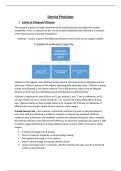
VO2max = cardiac output x the difference between arterial and venous oxygen content
VO2peak is the highest value attained during exercise and represents an individual exercise
tolerance. VO2max represents the highest physiologically attainable value. VO2max is always
a peak, but VO2peak is not always maximal. This is because the subject may be fatigued
pretest, or they have an underlying issue preventing them reaching VOmax.
VO2max is expressed in units of litres of O2 per minute (L.minˉ¹) and in millimetres of O2
per Kg of body mass per minute (ml.Kg.minˉ¹) to remove the confounding effect of body
size. VO2max relative to body weight allows us to compare the VO2max of individuals of
different sizes since larger people tend to consume more oxygen.
Graded Exercise Test – this requires a systematic and linear increase in exercise intensity
over time until the individual is unable to maintain or tolerate the workload. Selected
cardiovascular, pulmonary and metabolic variables are collected during the test to evaluate
the exercise tolerance and represent the efficiency in which the cardiovascular system is able
to deliver oxygenated blood to working skeletal muscle and the ability of muscle to utilise
oxygen.
It should use large muscle groups.
Forms of exercise should be running/cycling/rowing.
The optimal test length is 8-10 minutes.
There is direct testing of maximal aerobic power.
Load is increased every 1-4 minutes until the desired work rate can’t be maintained
(ramp or step protocol.)
,VO2max attained using treadmill protocols tend to produce up to 20% greater VO2max
values when compared to cycle protocols.
Treadmill Protocols:
Balke protocol – maintains a constant speed (3.3mph) but increases grade by 1% each
minute.
Bruce protocol – increases speed and grade every 3 minutes.
Ellestad protocol – increases speed each stage until the 10th minute upon introduction of a
single increase in grade (to 5%) followed by increases in speed.
Astrand protocol – maintains a constant running speed with an increase in grade (2.5%)
every 2 minutes.
Criteria for achieving VO2max:
A plateau in the oxygen uptake-exercise intensity relationship. This is defined as an increase
in oxygen uptake of less than 2ml/kg/min or 3% with an increase in exercise intensity.
Secondary criteria include a respiratory exchange ration of over or equal to 1.15, subjective
fatigue, a final HR of within 10bpm of the predicted age-related maximum, an RPE of 19-20
on the Borg 6-20 RPE scale or a post-exercise (4-5min) blood lactate concentration (over
8mmol/L.)
The determinants of VO2max are cardiac output (central) and the extraction of O2 from
capillary blood (peripheral.) These represent delivery of oxygen and the extraction of oxygen
respectively.
The correlation between VO2max and exercise performance is good when looking at people
with a wide range of VO2max values. However, it’s a poor predictor of performance when
only looking at athletes of similar abilities. Overall though it’s an important contributor to
performance because it sets the theoretical upper limit for prolonged endurance exercise.
,
, 2. Metabolic and Ventilatory Thresholds
Glycolysis/glycogenolysis – the
conversion of one
glucose/glycogen to two
pyruvate (lactate) molecules.
This occurs in the cytosol
without the presence of
oxygen.
Rapid recycling of NAD+ is
necessary to facilitate glycolysis
for high rates of ATP
resynthesis.
The lactate shuttle:
Monocarboxylate transport proteins (MCTs) are crucial in this process. MCT 4
transports lactate out of the cell and MCT 1 transports lactate into the cell for
oxidation.
Type II (FG) muscle fibres are producers and have increased MCT 4 and decreased
MCT 1. In contrast, type 1 (SO) muscle fibres are consumers and have decreased MCT
4 and increased MCT 1.
The process is driven by lactate and pH concentrations (hydrogen ions.) Lactate is
also taken up and oxidised by non-skeletal muscle.
Oxidation of lactate in the mitochondria far exceeds that of pyruvate and is therefore the
preferred substrate. Within muscle, the lactate to pyruvate ratio is 10:1 at rest and over
200:1 during exercise.
Lactate is currently known to be a major energy source and glucogenic precursor, a signalling
molecule and a producer under fully aerobic conditions.
Measuring Lactate:
Lactate is measured by taking a small capillary blood sample of 0.5µL from the ear lobe or
finger. It’s measured in mmol/L and the values typically range from 0.5-20. Measurement
tools include the lactate pro 2 which is portable and easy to use but less accurate and biosen
which is the gold standard and found in lab studies.
Graded exercise test – in the form of a step test to exhaustion. Test results are protocol
dependant and there is no standard format. A sample is taken at the end of every stage.
Variables include starting workload, stage duration and stage increments.
When measuring lactate, we are measuring the whole-body lactate concentration in the
blood. However, only some of the lactate will reach the blood due to the lactate shuttle
process.
1. Limits of VO2peak/VO2max
The maximal amount of oxygen delivered to the working tissues and utilised in aerobic
metabolism. VO2 is a measure of the rate of aerobic metabolism and VO2max is a measure
of the maximal rate of aerobic metabolism.
VO2max = cardiac output x the difference between arterial and venous oxygen content
VO2peak is the highest value attained during exercise and represents an individual exercise
tolerance. VO2max represents the highest physiologically attainable value. VO2max is always
a peak, but VO2peak is not always maximal. This is because the subject may be fatigued
pretest, or they have an underlying issue preventing them reaching VOmax.
VO2max is expressed in units of litres of O2 per minute (L.minˉ¹) and in millimetres of O2
per Kg of body mass per minute (ml.Kg.minˉ¹) to remove the confounding effect of body
size. VO2max relative to body weight allows us to compare the VO2max of individuals of
different sizes since larger people tend to consume more oxygen.
Graded Exercise Test – this requires a systematic and linear increase in exercise intensity
over time until the individual is unable to maintain or tolerate the workload. Selected
cardiovascular, pulmonary and metabolic variables are collected during the test to evaluate
the exercise tolerance and represent the efficiency in which the cardiovascular system is able
to deliver oxygenated blood to working skeletal muscle and the ability of muscle to utilise
oxygen.
It should use large muscle groups.
Forms of exercise should be running/cycling/rowing.
The optimal test length is 8-10 minutes.
There is direct testing of maximal aerobic power.
Load is increased every 1-4 minutes until the desired work rate can’t be maintained
(ramp or step protocol.)
,VO2max attained using treadmill protocols tend to produce up to 20% greater VO2max
values when compared to cycle protocols.
Treadmill Protocols:
Balke protocol – maintains a constant speed (3.3mph) but increases grade by 1% each
minute.
Bruce protocol – increases speed and grade every 3 minutes.
Ellestad protocol – increases speed each stage until the 10th minute upon introduction of a
single increase in grade (to 5%) followed by increases in speed.
Astrand protocol – maintains a constant running speed with an increase in grade (2.5%)
every 2 minutes.
Criteria for achieving VO2max:
A plateau in the oxygen uptake-exercise intensity relationship. This is defined as an increase
in oxygen uptake of less than 2ml/kg/min or 3% with an increase in exercise intensity.
Secondary criteria include a respiratory exchange ration of over or equal to 1.15, subjective
fatigue, a final HR of within 10bpm of the predicted age-related maximum, an RPE of 19-20
on the Borg 6-20 RPE scale or a post-exercise (4-5min) blood lactate concentration (over
8mmol/L.)
The determinants of VO2max are cardiac output (central) and the extraction of O2 from
capillary blood (peripheral.) These represent delivery of oxygen and the extraction of oxygen
respectively.
The correlation between VO2max and exercise performance is good when looking at people
with a wide range of VO2max values. However, it’s a poor predictor of performance when
only looking at athletes of similar abilities. Overall though it’s an important contributor to
performance because it sets the theoretical upper limit for prolonged endurance exercise.
,
, 2. Metabolic and Ventilatory Thresholds
Glycolysis/glycogenolysis – the
conversion of one
glucose/glycogen to two
pyruvate (lactate) molecules.
This occurs in the cytosol
without the presence of
oxygen.
Rapid recycling of NAD+ is
necessary to facilitate glycolysis
for high rates of ATP
resynthesis.
The lactate shuttle:
Monocarboxylate transport proteins (MCTs) are crucial in this process. MCT 4
transports lactate out of the cell and MCT 1 transports lactate into the cell for
oxidation.
Type II (FG) muscle fibres are producers and have increased MCT 4 and decreased
MCT 1. In contrast, type 1 (SO) muscle fibres are consumers and have decreased MCT
4 and increased MCT 1.
The process is driven by lactate and pH concentrations (hydrogen ions.) Lactate is
also taken up and oxidised by non-skeletal muscle.
Oxidation of lactate in the mitochondria far exceeds that of pyruvate and is therefore the
preferred substrate. Within muscle, the lactate to pyruvate ratio is 10:1 at rest and over
200:1 during exercise.
Lactate is currently known to be a major energy source and glucogenic precursor, a signalling
molecule and a producer under fully aerobic conditions.
Measuring Lactate:
Lactate is measured by taking a small capillary blood sample of 0.5µL from the ear lobe or
finger. It’s measured in mmol/L and the values typically range from 0.5-20. Measurement
tools include the lactate pro 2 which is portable and easy to use but less accurate and biosen
which is the gold standard and found in lab studies.
Graded exercise test – in the form of a step test to exhaustion. Test results are protocol
dependant and there is no standard format. A sample is taken at the end of every stage.
Variables include starting workload, stage duration and stage increments.
When measuring lactate, we are measuring the whole-body lactate concentration in the
blood. However, only some of the lactate will reach the blood due to the lactate shuttle
process.