

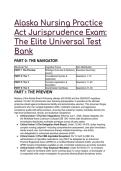
Alaska Nursing Practice
Act Jurisprudence Exam:
The Elite Universal Test
Bank
PART 0: THE NAVIGATOR
Structural Tier Cognitive Focus Item Distribution
PART I: The Preview Strategic Overview & Statutory Executive Summary
Axioms
PART II: Tier 1 Foundational Syntax & Questions 1–10
Application
PART II: Tier 2 Complex Application & Questions 11–20
Simulation
PART II: Tier 3 Grandmaster Synthesis Questions 21–30
PART I: THE PREVIEW
Mastery of the Alaska Board of Nursing statutes (AS 08.68) and the 2026/2027 regulatory
updates (12 AAC 44) transcends mere licensing prerequisites; it operates as the ultimate
protective shield against professional liability and administrative sanction. This document forges
practitioners who can navigate legislative shifts, multistate compacts, and aggressive
compliance audits with lethal precision, ensuring that academic mastery translates directly into
high-level professional, clinical, and analytical competence.
● Critical Axiom 1 (The NLC Integration): Effective July 1, 2026, Alaska integrates into
the Multistate Nurse Licensure Compact (SB 124). Home state disciplinary action
immediately deactivates multistate privileges across all party states.
● Critical Axiom 2 (The Delegation Hard-Stops): Under 12 AAC 44.970, duties requiring
complex nursing judgment—including comprehensive assessment, care plan formulation,
sterile wound care, and intravenous therapy initiation/monitoring—are strictly
non-delegatable to unlicensed assistive personnel (UAP).
● Critical Axiom 3 (The CMA Injectable Exception): Per 12 AAC 44.966, the
administration of injectable medications may ONLY be delegated by an Advanced
Practice Registered Nurse (APRN) to a Certified Medical Assistant (CMA), provided the
APRN remains immediately available on-site. Controlled substances are strictly excluded.
● Critical Axiom 4 (The 7-Day Employer Mandate): Under AS 08.68.277, an employer
MUST report to the Board within seven working days if a nurse resigns, is discharged, or
is suspended while under investigation for grounds allowing Board disciplinary action.
, ● Critical Axiom 5 (The Alternative to Discipline Program): Under 12 AAC 44.725, the
Board offers a voluntary, non-public Alternative to Discipline Program (ADP) for substance
use disorders, bypassing traditional punitive action while strictly maintaining participant
confidentiality.
PART II: THE ELITE TEST BANK
Tier 1 - Foundational Syntax & Application
The foundational tier evaluates the practitioner's syntax regarding the hard-deck rules of the
Alaska Nursing Practice Act. These scenarios strip away the ambiguity of clinical practice to test
the raw legal boundaries of licensure, delegation, and reporting mandates.
Q1: Effective July 1, 2026, Alaska enacts the Multistate Nurse Licensure Compact (NLC) under
SB 124. If a nurse holding an Alaska multistate license is placed under a disciplinary order by
the Alaska Board of Nursing, which action represents the IMMEDIATE statutory consequence
under the Compact rules? A) The nurse may continue practicing in remote party states until
those specific states complete independent investigations. B) The nurse’s multistate licensure
privilege is converted to a probationary multistate privilege across all jurisdictions. C) The
nurse’s multistate licensure privilege is deactivated in all party states during the pendency of the
order. D) The nurse must manually surrender their license credentials to the National Council of
State Boards of Nursing within seven days.
● The Answer: C (The nurse’s multistate licensure privilege is deactivated in all party states
during the pendency of the order.)
● Distractor Analysis:
○ A is incorrect: The NLC does not permit continued remote practice once the home
state issues a disciplinary order; the deactivation is instantaneous across the
network.
○ B is incorrect: There is no functional "probationary multistate privilege" under the
uniform rules. Discipline defaults the license to a single-state restriction, nullifying
cross-border mobility.
○ D is incorrect: The deactivation is an administrative, systems-level action executed
by the home state board via coordinated NLC database tracking; manual surrender
of physical credentials is an outdated legacy concept.
The Mentor's Analysis: The fundamental architecture of the NLC relies on the supreme
authority of the home state to dictate the status of the unified credential. When facing a
disciplinary action, the immediate priority is protecting the public across all jurisdictions
simultaneously. By utilizing the coordinated licensure information system, the regulatory body
bypasses the common trap of assuming jurisdictional delays or fragmented enforcement.
Professional/Academic Intuition: Home state discipline instantly severs the multistate
operational umbilical cord.
Q2: Under 12 AAC 44.600, a registered nurse preparing for biennial license renewal must meet
the continuing competency requirements. Assuming the nurse does not use alternative methods
(such as a refresher course or NCLEX), which combination MOST ACCURATELY fulfills the
Board's baseline mandate? A) Completion of 30 hours of continuing education and 15 hours of
uncompensated professional activities. B) Completion of 60 hours of continuing education
exclusively. C) Completion of two of the following: 30 CE hours, 30 hours of uncompensated
professional activities, or 320 hours of nursing employment. D) Completion of 320 hours of
, nursing employment and a board-approved competency examination.
● The Answer: C (Completion of two of the following: 30 CE hours, 30 hours of
uncompensated professional activities, or 320 hours of nursing employment.)
● Distractor Analysis:
○ A is incorrect: The professional activities requirement under 12 AAC 44.620
specifically demands 30 hours, not 15.
○ B is incorrect: While 60 hours of education is commendable, the statute strictly
mandates the completion of two distinct methods from the approved list of three,
rendering a single method insufficient.
○ D is incorrect: An examination (NCLEX) is an alternative method under 12 AAC
44.640, which stands alone and is not paired with employment hours under the
standard 12 AAC 44.600 framework.
The Mentor's Analysis: Regulatory compliance in Alaska is modular but rigid. When facing
license renewal, the immediate priority is satisfying the "Two-of-Three" combinatorial rule
established by 12 AAC 44.600. By utilizing the competency matrix, the practitioner bypasses the
common novice error of over-indexing on a single continuous education vector.
Professional/Academic Intuition: Competency is demonstrated through clinical and
academic diversity; single-vector compliance results in audit failure.
Q3: Under the 12 AAC 44.970 parameters outlining non-delegatable nursing duties, which task
is a registered nurse strictly FORBIDDEN from delegating to Unlicensed Assistive Personnel
(UAP)? A) Obtaining routine blood glucose levels on a stable patient. B) Suctioning the oral
pharynx of an established, stable patient. C) Providing and assessing sterile wound care. D)
Placing electrodes and leads for telemetry monitoring.
● The Answer: C (Providing and assessing sterile wound care.)
● Distractor Analysis:
○ A is incorrect: 12 AAC 44.960 explicitly lists obtaining blood glucose levels as a
delegatable specialized nursing duty.
○ B is incorrect: Suctioning of the oral pharynx is explicitly listed as a delegatable
specialized duty, whereas oral tracheal suction is strictly prohibited.
○ D is incorrect: Placing telemetry leads is a permissible specialized nursing task
under 12 AAC 44.960(b)(8).
The Mentor's Analysis: Delegation hinges on the presence of nursing judgment and systemic
anatomical risk. When facing delegation decisions, the immediate priority is identifying tasks
requiring complex clinical synthesis or the breach of a sterile physiological barrier. By utilizing
the sterile boundary rule, the practitioner bypasses the trap of conflating routine surface hygiene
with complex tissue assessment. Professional/Academic Intuition: If the procedure
breaches a sterile physiological barrier or requires the formulation of an evaluative
clinical judgment, it cannot be delegated.
Q4: An employer discharges a nurse following an internal investigation that revealed the nurse
was charting medication administrations for patients assigned to other staff members. According
to AS 08.68.277, what is the employer's FIRST legally mandated action regarding the Alaska
Board of Nursing? A) Report the nurse's name, address, and the reason for the action to the
Board within seven working days. B) Submit a formal grievance to the National Practitioner Data
Bank within 30 days. C) Advise the nurse to self-report to the Alternative to Discipline Program
within 48 hours. D) Withhold reporting until criminal charges are formally filed by the local
jurisdiction.
● The Answer: A (Report the nurse's name, address, and the reason for the action to the
Board within seven working days.)
Act Jurisprudence Exam:
The Elite Universal Test
Bank
PART 0: THE NAVIGATOR
Structural Tier Cognitive Focus Item Distribution
PART I: The Preview Strategic Overview & Statutory Executive Summary
Axioms
PART II: Tier 1 Foundational Syntax & Questions 1–10
Application
PART II: Tier 2 Complex Application & Questions 11–20
Simulation
PART II: Tier 3 Grandmaster Synthesis Questions 21–30
PART I: THE PREVIEW
Mastery of the Alaska Board of Nursing statutes (AS 08.68) and the 2026/2027 regulatory
updates (12 AAC 44) transcends mere licensing prerequisites; it operates as the ultimate
protective shield against professional liability and administrative sanction. This document forges
practitioners who can navigate legislative shifts, multistate compacts, and aggressive
compliance audits with lethal precision, ensuring that academic mastery translates directly into
high-level professional, clinical, and analytical competence.
● Critical Axiom 1 (The NLC Integration): Effective July 1, 2026, Alaska integrates into
the Multistate Nurse Licensure Compact (SB 124). Home state disciplinary action
immediately deactivates multistate privileges across all party states.
● Critical Axiom 2 (The Delegation Hard-Stops): Under 12 AAC 44.970, duties requiring
complex nursing judgment—including comprehensive assessment, care plan formulation,
sterile wound care, and intravenous therapy initiation/monitoring—are strictly
non-delegatable to unlicensed assistive personnel (UAP).
● Critical Axiom 3 (The CMA Injectable Exception): Per 12 AAC 44.966, the
administration of injectable medications may ONLY be delegated by an Advanced
Practice Registered Nurse (APRN) to a Certified Medical Assistant (CMA), provided the
APRN remains immediately available on-site. Controlled substances are strictly excluded.
● Critical Axiom 4 (The 7-Day Employer Mandate): Under AS 08.68.277, an employer
MUST report to the Board within seven working days if a nurse resigns, is discharged, or
is suspended while under investigation for grounds allowing Board disciplinary action.
, ● Critical Axiom 5 (The Alternative to Discipline Program): Under 12 AAC 44.725, the
Board offers a voluntary, non-public Alternative to Discipline Program (ADP) for substance
use disorders, bypassing traditional punitive action while strictly maintaining participant
confidentiality.
PART II: THE ELITE TEST BANK
Tier 1 - Foundational Syntax & Application
The foundational tier evaluates the practitioner's syntax regarding the hard-deck rules of the
Alaska Nursing Practice Act. These scenarios strip away the ambiguity of clinical practice to test
the raw legal boundaries of licensure, delegation, and reporting mandates.
Q1: Effective July 1, 2026, Alaska enacts the Multistate Nurse Licensure Compact (NLC) under
SB 124. If a nurse holding an Alaska multistate license is placed under a disciplinary order by
the Alaska Board of Nursing, which action represents the IMMEDIATE statutory consequence
under the Compact rules? A) The nurse may continue practicing in remote party states until
those specific states complete independent investigations. B) The nurse’s multistate licensure
privilege is converted to a probationary multistate privilege across all jurisdictions. C) The
nurse’s multistate licensure privilege is deactivated in all party states during the pendency of the
order. D) The nurse must manually surrender their license credentials to the National Council of
State Boards of Nursing within seven days.
● The Answer: C (The nurse’s multistate licensure privilege is deactivated in all party states
during the pendency of the order.)
● Distractor Analysis:
○ A is incorrect: The NLC does not permit continued remote practice once the home
state issues a disciplinary order; the deactivation is instantaneous across the
network.
○ B is incorrect: There is no functional "probationary multistate privilege" under the
uniform rules. Discipline defaults the license to a single-state restriction, nullifying
cross-border mobility.
○ D is incorrect: The deactivation is an administrative, systems-level action executed
by the home state board via coordinated NLC database tracking; manual surrender
of physical credentials is an outdated legacy concept.
The Mentor's Analysis: The fundamental architecture of the NLC relies on the supreme
authority of the home state to dictate the status of the unified credential. When facing a
disciplinary action, the immediate priority is protecting the public across all jurisdictions
simultaneously. By utilizing the coordinated licensure information system, the regulatory body
bypasses the common trap of assuming jurisdictional delays or fragmented enforcement.
Professional/Academic Intuition: Home state discipline instantly severs the multistate
operational umbilical cord.
Q2: Under 12 AAC 44.600, a registered nurse preparing for biennial license renewal must meet
the continuing competency requirements. Assuming the nurse does not use alternative methods
(such as a refresher course or NCLEX), which combination MOST ACCURATELY fulfills the
Board's baseline mandate? A) Completion of 30 hours of continuing education and 15 hours of
uncompensated professional activities. B) Completion of 60 hours of continuing education
exclusively. C) Completion of two of the following: 30 CE hours, 30 hours of uncompensated
professional activities, or 320 hours of nursing employment. D) Completion of 320 hours of
, nursing employment and a board-approved competency examination.
● The Answer: C (Completion of two of the following: 30 CE hours, 30 hours of
uncompensated professional activities, or 320 hours of nursing employment.)
● Distractor Analysis:
○ A is incorrect: The professional activities requirement under 12 AAC 44.620
specifically demands 30 hours, not 15.
○ B is incorrect: While 60 hours of education is commendable, the statute strictly
mandates the completion of two distinct methods from the approved list of three,
rendering a single method insufficient.
○ D is incorrect: An examination (NCLEX) is an alternative method under 12 AAC
44.640, which stands alone and is not paired with employment hours under the
standard 12 AAC 44.600 framework.
The Mentor's Analysis: Regulatory compliance in Alaska is modular but rigid. When facing
license renewal, the immediate priority is satisfying the "Two-of-Three" combinatorial rule
established by 12 AAC 44.600. By utilizing the competency matrix, the practitioner bypasses the
common novice error of over-indexing on a single continuous education vector.
Professional/Academic Intuition: Competency is demonstrated through clinical and
academic diversity; single-vector compliance results in audit failure.
Q3: Under the 12 AAC 44.970 parameters outlining non-delegatable nursing duties, which task
is a registered nurse strictly FORBIDDEN from delegating to Unlicensed Assistive Personnel
(UAP)? A) Obtaining routine blood glucose levels on a stable patient. B) Suctioning the oral
pharynx of an established, stable patient. C) Providing and assessing sterile wound care. D)
Placing electrodes and leads for telemetry monitoring.
● The Answer: C (Providing and assessing sterile wound care.)
● Distractor Analysis:
○ A is incorrect: 12 AAC 44.960 explicitly lists obtaining blood glucose levels as a
delegatable specialized nursing duty.
○ B is incorrect: Suctioning of the oral pharynx is explicitly listed as a delegatable
specialized duty, whereas oral tracheal suction is strictly prohibited.
○ D is incorrect: Placing telemetry leads is a permissible specialized nursing task
under 12 AAC 44.960(b)(8).
The Mentor's Analysis: Delegation hinges on the presence of nursing judgment and systemic
anatomical risk. When facing delegation decisions, the immediate priority is identifying tasks
requiring complex clinical synthesis or the breach of a sterile physiological barrier. By utilizing
the sterile boundary rule, the practitioner bypasses the trap of conflating routine surface hygiene
with complex tissue assessment. Professional/Academic Intuition: If the procedure
breaches a sterile physiological barrier or requires the formulation of an evaluative
clinical judgment, it cannot be delegated.
Q4: An employer discharges a nurse following an internal investigation that revealed the nurse
was charting medication administrations for patients assigned to other staff members. According
to AS 08.68.277, what is the employer's FIRST legally mandated action regarding the Alaska
Board of Nursing? A) Report the nurse's name, address, and the reason for the action to the
Board within seven working days. B) Submit a formal grievance to the National Practitioner Data
Bank within 30 days. C) Advise the nurse to self-report to the Alternative to Discipline Program
within 48 hours. D) Withhold reporting until criminal charges are formally filed by the local
jurisdiction.
● The Answer: A (Report the nurse's name, address, and the reason for the action to the
Board within seven working days.)


