

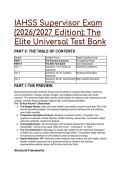
IAHSS Supervisor Exam
(2026/2027 Edition): The
Elite Universal Test Bank
PART 0: THE TABLE OF CONTENTS
Section Content Focus Target Cognitive Level
PART I The Preview & Axioms Foundational Rules
PART II The Elite Test Bank Core Assessment
Tier 1 Questions 1–15: Syntax & Hard-Deck Definitions
Application
Tier 2 Questions 16–35: Complex Situational Simulation
Application
Tier 3 Questions 36–60: Grandmaster Multi-Variable Scenarios
Synthesis
PART I: THE PREVIEW
Mastering this test bank translates directly into the ability to navigate high-stakes healthcare
security operations, manage complex budgets, and mitigate enterprise-wide risks under
pressure. The document forges elite security administrators by replacing rote memorization with
surgical, scenario-based application aligned with current global standards.
The "Critical Axioms" Cheat Sheet:
● The Budget Reality: Labor and labor-related costs strictly consume more than 93% of all
security operating budgets. Zero-based budgeting requires starting at $0 and justifying
every dollar annually.
● Progressive Discipline Protocol: Discipline is behavior-driven, not punitive. The
sequence is absolute: Verbal Warning, Written Warning, Suspension, Termination. Steps
cannot be arbitrarily repeated or skipped.
● Training Mechanics: All training begins with a Needs Assessment. Objectives must be
measurable—strictly avoid vague verbs like "know," "understand," or "learn".
● The Core Distinctions: Managers do things right; leaders do the right thing. Delegation
is defined as a way to multiply effectiveness through others. The greatest single indicator
of supervisory performance is the ability to create constructive change.
● Hazard Absolutes: MRI machines render magnetic data useless and pull metallic objects
lethally; radiation exposure risk is governed strictly by duration and intensity;
uncooperative patients expose staff to blood and body fluids.
Structural Frameworks
,Table 1.1: Kirkpatrick's Training Evaluation Model
Level Metric Measured Operational Application
Level 1: Reaction Participant Perception End-of-course satisfaction
surveys.
Level 2: Learning Knowledge Acquisition Written tests or practical
demonstrations during class.
Level 3: Behavior Field Application Observational audits of officers
on duty.
Level 4: Results Organizational Impact Reduction in liabilities, injuries,
or costs.
PART II: THE ELITE TEST BANK
Tier 1: Foundational Syntax & Application
Q1: According to the established frameworks for healthcare security supervision, what is the
single greatest indicator of a supervisor's performance? A) Maintaining a perfectly balanced
zero-based budget across fiscal quarters B) The ability to create constructive change within the
department C) Reducing officer turnover to absolute zero through developmental appraisals D)
Establishing an unbroken line of formal authority
● The Answer: B (The ability to create constructive change within the department)
● Distractor Analysis:
○ A is incorrect: While zero-based budgeting is a critical administrative standard,
financial maintenance is a management task, not the ultimate indicator of
leadership performance.
○ C is incorrect: Zero turnover is a statistical impossibility in healthcare security;
attrition is sometimes a necessary cost-control measure.
○ D is incorrect: Formal authority relies entirely on the organizational chart; true
leadership requires influence and the ability to enact change, not just structural
command.
The Mentor's Analysis: A supervisor’s ultimate value lies not in preserving the status quo, but
in identifying systemic weaknesses and systematically improving them. Constructive change
proves the transition from a task-manager to a transdisciplinary leader. Professional/Academic
Intuition: Management sustains the operation; leadership elevates it. The ultimate metric
of a leader is constructive change.
Q2: When calculating the annual operating budget for a healthcare security department, a
supervisor must account for the heaviest financial burden. Based on industry standards, what
percentage of the security operating budget is allocated specifically to labor and labor-related
costs? A) Approximately 50% B) Exactly 75% C) More than 93% D) Variable dependent entirely
on the FTE count
● The Answer: C (More than 93%)
● Distractor Analysis:
○ A is incorrect: 50% drastically underestimates the human-capital intensity of 24/7
healthcare security operations.
○ B is incorrect: 75% represents a generalized corporate benchmark, not specific to
the personnel-heavy nature of healthcare environments.
○ D is incorrect: While Full-Time Equivalent (FTE) counts dictate the specific dollar
amount, the overall proportion of the budget remains overwhelmingly above 93%
, regardless of the exact count.
The Mentor's Analysis: Healthcare security is an intensely service-based, human-driven
operation. Because technology and capital expenses are often amortized across other facility
budgets, the security operational budget is almost entirely consumed by payroll, benefits, and
overtime. Professional/Academic Intuition: Labor dictates the budget. Protect the 93% by
aggressively managing overtime and staff retention.
Q3: The primary goal of managed care systems within the healthcare industry directly impacts
security resource allocation. What is this primary organizational goal? A) To maximize patient
throughput and bed turnover B) To control costs C) To increase the ROI of advanced medical
technologies D) To decentralize patient care
● The Answer: B (To control costs)
● Distractor Analysis:
○ A is incorrect: Patient throughput is an operational metric for emergency
departments, not the overarching financial objective of the managed care system.
○ C is incorrect: Return on Investment (ROI) is a localized financial evaluation tool,
not the structural objective of managed care entities.
○ D is incorrect: Decentralization is an architectural or clinical staffing model,
unrelated to the core ethos of managed care providers.
The Mentor's Analysis: Managed care systems exist fundamentally to rein in the spiraling
costs of healthcare delivery. Security administrators must understand this mandate because
every budget request will be scrutinized against the enterprise-wide directive to reduce financial
waste. Professional/Academic Intuition: In a managed care environment, every security
initiative must ultimately justify its existence through cost control or liability reduction.
Q4: A security supervisor is drafting a performance improvement plan for an underperforming
officer. Which of the following principles is strictly NOT consistent with the progressive discipline
model? A) Punitive action B) Behavior-driven metrics C) Immediacy of the discipline D) Known
consequences
● The Answer: A (Punitive action)
● Distractor Analysis:
○ B is incorrect: Progressive discipline must strictly target the specific behavior, not
the individual's personality.
○ C is incorrect: Immediacy is a core tenet; delaying feedback degrades the
effectiveness and legality of the correction.
○ D is incorrect: Consequences must be known and transparent to ensure fairness
and legal defensibility.
The Mentor's Analysis: Progressive discipline is corrective, not retributive. The objective is to
modify behavior and salvage the employee, returning them to standard operational compliance.
Punitive mindsets invite grievances and civil liability. Professional/Academic Intuition:
Discipline modifies behavior; it does not exact revenge.
Q5: An instructor is developing a new curriculum for physical intervention training. According to
the five stages of training development, what is the absolute first step before drafting any lesson
plans or scheduling officers? A) Developing the evaluation format B) Securing the training
budget C) Conducting a needs assessment D) Writing performance objectives
● The Answer: C (Conducting a needs assessment)
● Distractor Analysis:
○ A is incorrect: Evaluation parameters cannot be established before identifying the
performance gaps the program is intended to close.
○ B is incorrect: Budgeting follows the identification of the need; funds cannot be
(2026/2027 Edition): The
Elite Universal Test Bank
PART 0: THE TABLE OF CONTENTS
Section Content Focus Target Cognitive Level
PART I The Preview & Axioms Foundational Rules
PART II The Elite Test Bank Core Assessment
Tier 1 Questions 1–15: Syntax & Hard-Deck Definitions
Application
Tier 2 Questions 16–35: Complex Situational Simulation
Application
Tier 3 Questions 36–60: Grandmaster Multi-Variable Scenarios
Synthesis
PART I: THE PREVIEW
Mastering this test bank translates directly into the ability to navigate high-stakes healthcare
security operations, manage complex budgets, and mitigate enterprise-wide risks under
pressure. The document forges elite security administrators by replacing rote memorization with
surgical, scenario-based application aligned with current global standards.
The "Critical Axioms" Cheat Sheet:
● The Budget Reality: Labor and labor-related costs strictly consume more than 93% of all
security operating budgets. Zero-based budgeting requires starting at $0 and justifying
every dollar annually.
● Progressive Discipline Protocol: Discipline is behavior-driven, not punitive. The
sequence is absolute: Verbal Warning, Written Warning, Suspension, Termination. Steps
cannot be arbitrarily repeated or skipped.
● Training Mechanics: All training begins with a Needs Assessment. Objectives must be
measurable—strictly avoid vague verbs like "know," "understand," or "learn".
● The Core Distinctions: Managers do things right; leaders do the right thing. Delegation
is defined as a way to multiply effectiveness through others. The greatest single indicator
of supervisory performance is the ability to create constructive change.
● Hazard Absolutes: MRI machines render magnetic data useless and pull metallic objects
lethally; radiation exposure risk is governed strictly by duration and intensity;
uncooperative patients expose staff to blood and body fluids.
Structural Frameworks
,Table 1.1: Kirkpatrick's Training Evaluation Model
Level Metric Measured Operational Application
Level 1: Reaction Participant Perception End-of-course satisfaction
surveys.
Level 2: Learning Knowledge Acquisition Written tests or practical
demonstrations during class.
Level 3: Behavior Field Application Observational audits of officers
on duty.
Level 4: Results Organizational Impact Reduction in liabilities, injuries,
or costs.
PART II: THE ELITE TEST BANK
Tier 1: Foundational Syntax & Application
Q1: According to the established frameworks for healthcare security supervision, what is the
single greatest indicator of a supervisor's performance? A) Maintaining a perfectly balanced
zero-based budget across fiscal quarters B) The ability to create constructive change within the
department C) Reducing officer turnover to absolute zero through developmental appraisals D)
Establishing an unbroken line of formal authority
● The Answer: B (The ability to create constructive change within the department)
● Distractor Analysis:
○ A is incorrect: While zero-based budgeting is a critical administrative standard,
financial maintenance is a management task, not the ultimate indicator of
leadership performance.
○ C is incorrect: Zero turnover is a statistical impossibility in healthcare security;
attrition is sometimes a necessary cost-control measure.
○ D is incorrect: Formal authority relies entirely on the organizational chart; true
leadership requires influence and the ability to enact change, not just structural
command.
The Mentor's Analysis: A supervisor’s ultimate value lies not in preserving the status quo, but
in identifying systemic weaknesses and systematically improving them. Constructive change
proves the transition from a task-manager to a transdisciplinary leader. Professional/Academic
Intuition: Management sustains the operation; leadership elevates it. The ultimate metric
of a leader is constructive change.
Q2: When calculating the annual operating budget for a healthcare security department, a
supervisor must account for the heaviest financial burden. Based on industry standards, what
percentage of the security operating budget is allocated specifically to labor and labor-related
costs? A) Approximately 50% B) Exactly 75% C) More than 93% D) Variable dependent entirely
on the FTE count
● The Answer: C (More than 93%)
● Distractor Analysis:
○ A is incorrect: 50% drastically underestimates the human-capital intensity of 24/7
healthcare security operations.
○ B is incorrect: 75% represents a generalized corporate benchmark, not specific to
the personnel-heavy nature of healthcare environments.
○ D is incorrect: While Full-Time Equivalent (FTE) counts dictate the specific dollar
amount, the overall proportion of the budget remains overwhelmingly above 93%
, regardless of the exact count.
The Mentor's Analysis: Healthcare security is an intensely service-based, human-driven
operation. Because technology and capital expenses are often amortized across other facility
budgets, the security operational budget is almost entirely consumed by payroll, benefits, and
overtime. Professional/Academic Intuition: Labor dictates the budget. Protect the 93% by
aggressively managing overtime and staff retention.
Q3: The primary goal of managed care systems within the healthcare industry directly impacts
security resource allocation. What is this primary organizational goal? A) To maximize patient
throughput and bed turnover B) To control costs C) To increase the ROI of advanced medical
technologies D) To decentralize patient care
● The Answer: B (To control costs)
● Distractor Analysis:
○ A is incorrect: Patient throughput is an operational metric for emergency
departments, not the overarching financial objective of the managed care system.
○ C is incorrect: Return on Investment (ROI) is a localized financial evaluation tool,
not the structural objective of managed care entities.
○ D is incorrect: Decentralization is an architectural or clinical staffing model,
unrelated to the core ethos of managed care providers.
The Mentor's Analysis: Managed care systems exist fundamentally to rein in the spiraling
costs of healthcare delivery. Security administrators must understand this mandate because
every budget request will be scrutinized against the enterprise-wide directive to reduce financial
waste. Professional/Academic Intuition: In a managed care environment, every security
initiative must ultimately justify its existence through cost control or liability reduction.
Q4: A security supervisor is drafting a performance improvement plan for an underperforming
officer. Which of the following principles is strictly NOT consistent with the progressive discipline
model? A) Punitive action B) Behavior-driven metrics C) Immediacy of the discipline D) Known
consequences
● The Answer: A (Punitive action)
● Distractor Analysis:
○ B is incorrect: Progressive discipline must strictly target the specific behavior, not
the individual's personality.
○ C is incorrect: Immediacy is a core tenet; delaying feedback degrades the
effectiveness and legality of the correction.
○ D is incorrect: Consequences must be known and transparent to ensure fairness
and legal defensibility.
The Mentor's Analysis: Progressive discipline is corrective, not retributive. The objective is to
modify behavior and salvage the employee, returning them to standard operational compliance.
Punitive mindsets invite grievances and civil liability. Professional/Academic Intuition:
Discipline modifies behavior; it does not exact revenge.
Q5: An instructor is developing a new curriculum for physical intervention training. According to
the five stages of training development, what is the absolute first step before drafting any lesson
plans or scheduling officers? A) Developing the evaluation format B) Securing the training
budget C) Conducting a needs assessment D) Writing performance objectives
● The Answer: C (Conducting a needs assessment)
● Distractor Analysis:
○ A is incorrect: Evaluation parameters cannot be established before identifying the
performance gaps the program is intended to close.
○ B is incorrect: Budgeting follows the identification of the need; funds cannot be


