

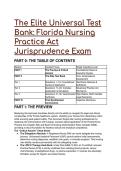
The Elite Universal Test
Bank: Florida Nursing
Practice Act
Jurisprudence Exam
PART 0: THE TABLE OF CONTENTS
Section Content Focus Target Cognitive Level
PART I The Preview & Critical Foundational Rules &
Axioms Execution Syntax
PART II The Elite Test Bank Core Jurisprudence
Assessment
Tier 1 Questions 1–10: Foundational Hard-Deck Statutes &
Syntax & Application Definitions
Tier 2 Questions 11–20: Complex Situational Practice Act
Application & Simulation Mechanics
Tier 3 Questions 21–30: Grandmaster High-Stakes, Multi-Variable
Synthesis Legal Scenarios
PART III Final Synthesized Capstone Directives
Conclusions
PART I: THE PREVIEW
Mastering this test bank translates directly into the ability to navigate the legal and ethical
complexities of the Florida healthcare system, shielding your license from disciplinary action
while ensuring peak patient safety. This document forges elite nursing professionals by
replacing rote memorization with surgical, scenario-based application of the Florida Nurse
Practice Act (Chapter 464) and Board of Nursing Administrative Rules (Chapter 64B9),
providing a robust foundation for flawless clinical and analytical competence.
The "Critical Axioms" Cheat Sheet:
● The Delegation Absolute: A Registered Nurse (RN) can never delegate the nursing
process. Unlicensed Assistive Personnel (UAP) cannot perform initial assessments,
determine nursing diagnoses, establish care goals, or evaluate progress. Total nursing
care liability remains permanently with the delegating nurse.
● The LPN IV Therapy Hard-Deck: Under Rule 64B9-12.003, an IV-certified Licensed
Practical Nurse (LPN) is strictly prohibited from initiating blood products, cancer
chemotherapy, investigational drugs, or plasma expanders. IV pushes are absolutely
forbidden except for heparin and saline flushes.
, ● The Mandatory Reporting Imperative: Under Section 456.076, failing to report a
colleague's inability to practice with reasonable skill and safety is a direct violation of the
Nurse Practice Act. Immediate referral to the Intervention Project for Nurses (IPN)
preempts formal Department of Health disciplinary action.
● Autonomous APRN Metrics: Section 464.0123 mandates that registration for
autonomous practice requires 3,000 clinical practice hours under physician supervision
within the past 5 years, plus 3 graduate-level semester hours in differential diagnosis and
3 in pharmacology.
● The Controlled Substance Ceiling: Advanced Practice Registered Nurses (APRNs)
prescribing Schedule II controlled substances for acute pain are strictly limited to a 7-day
supply, unless the prescription explicitly denotes a statutory exception. Psychiatric APRNs
hold explicit exemptions for psychiatric medications, including treating patients under 18
years old.
PART II: THE ELITE TEST BANK
Tier 1: Foundational Syntax & Application
Q1: An RN in a Florida acute care facility delegates the administration of a prefilled insulin pen
to an experienced Unlicensed Assistive Personnel (UAP). Based on the principles of the Florida
Nurse Practice Act regarding delegation, which conclusion is the MOST ACCURATE? A) The
delegation is prohibited because UAPs are never permitted to administer subcutaneous
medications under any circumstances. B) The delegation is acceptable only if the RN remains in
the patient's room to directly observe the UAP administer the medication. C) The delegation is
legally permissible because Florida statutes explicitly allow RNs to delegate the administration
of manufacturer-prefilled insulin pens to qualified UAPs. D) The delegation is prohibited
because insulin is a high-alert medication that requires continuous nursing judgment and
evaluation.
● The Answer: C (The delegation is legally permissible because Florida statutes explicitly
allow RNs to delegate the administration of manufacturer-prefilled insulin pens to qualified
UAPs.)
● Distractor Analysis:
○ A is incorrect: While UAPs generally cannot administer medications, Section
464.0156(1)(c) provides a specific, explicit legislative carve-out for prefilled insulin
syringes and pens.
○ B is incorrect: Direct, in-room supervision is not statutorily mandated for this
specific, exempted delegation, provided the UAP is properly trained and
competency is formally verified.
○ D is incorrect: This is a highly plausible distractor rooted in standard nursing safety
protocols (insulin is a high-alert drug), but Florida jurisprudence legally permits this
specific exception to facilitate routine diabetes management in long-term and home
settings.
The Mentor's Analysis: Statutory exceptions override general clinical principles in a court of
law. While insulin administration requires profound vigilance, Florida legislators specifically
carved out prefilled insulin pens to streamline chronic care delegation and optimize nursing
workflows. By utilizing Section 464.0156, you bypass the common trap of applying blanket
medication administration prohibitions to UAPs. Professional/Academic Intuition: Statutory
, exemptions are absolute; always isolate the legal carve-out before applying general
clinical safety rules.
Q2: A nurse initially licensed by examination in Florida is approaching their first biennial license
renewal. They have completed 2 hours of Medical Errors, 2 hours of Florida Laws and Rules,
and 1 hour of HIV/AIDS education. Which additional action is IMMEDIATELY required to fulfill
Florida Board of Nursing requirements? A) Complete an additional 19 hours of general
continuing education to meet the 24-hour minimum. B) Complete 2 hours of Recognizing
Impairment in the Workplace and 2 hours of Human Trafficking. C) Complete a 2-hour Domestic
Violence course, as it is required every biennium. D) Complete an additional 2-hour HIV/AIDS
course, as the minimum requirement is 3 hours.
● The Answer: B (Complete 2 hours of Recognizing Impairment in the Workplace and 2
hours of Human Trafficking.)
● Distractor Analysis:
○ A is incorrect: Nurses renewing for the first time following initial licensure by
examination are entirely exempt from the general 16-hour continuing education
requirement.
○ C is incorrect: Domestic Violence is required every third biennium, not every
biennium.
○ D is incorrect: The HIV/AIDS requirement is strictly a 1-hour, one-time requirement
prior to the first renewal.
The Mentor's Analysis: First-time license renewals carry a highly specific, restricted matrix of
requirements. The state prioritizes foundational legal and safety frameworks over general
clinical updates for new licensees, ensuring they comprehend the severe regulatory boundaries
of their new profession. By utilizing Rule 64B9-5.002, you bypass the common trap of
over-accumulating unnecessary general CE hours during the first cycle.
Professional/Academic Intuition: First-biennium renewals demand mandatory specialty
courses (Medical Errors, Laws, Impairment, Trafficking, HIV) but grant a complete, legal
exemption from general clinical hours.
Q3: An IV-certified Licensed Practical Nurse (LPN) receives an order to administer a dose of
intravenous morphine push for severe pain. Based on the principles of Florida Administrative
Code 64B9-12, which action is the MOST ACCURATE? A) Administer the medication slowly
over 2-3 minutes, as the LPN is IV-certified. B) Refuse the assignment, as IV-certified LPNs are
prohibited from performing any IV pushes except heparin and saline flushes. C) Administer the
medication only if a Registered Nurse is physically present in the room during the push. D)
Request the pharmacy to mix the morphine into a 50mL piggyback bag, allowing the LPN to
administer it safely.
● The Answer: B (Refuse the assignment, as IV-certified LPNs are prohibited from
performing any IV pushes except heparin and saline flushes.)
● Distractor Analysis:
○ A is incorrect: IV certification does not grant blanket authority for IV pushes; doing
so is a severe scope-of-practice violation that bypasses the patient's physiological
defense mechanisms.
○ C is incorrect: Direct supervision does not override the hard-deck rule that LPNs
cannot push IV medications.
○ D is incorrect: This is a plausible clinical workaround, but LPNs are also strictly
prohibited from mixing IV solutions under Florida Administrative Code
64B9-12.003(1)(e).
The Mentor's Analysis: The scope of practice for an IV-certified LPN is heavily regulated to
Bank: Florida Nursing
Practice Act
Jurisprudence Exam
PART 0: THE TABLE OF CONTENTS
Section Content Focus Target Cognitive Level
PART I The Preview & Critical Foundational Rules &
Axioms Execution Syntax
PART II The Elite Test Bank Core Jurisprudence
Assessment
Tier 1 Questions 1–10: Foundational Hard-Deck Statutes &
Syntax & Application Definitions
Tier 2 Questions 11–20: Complex Situational Practice Act
Application & Simulation Mechanics
Tier 3 Questions 21–30: Grandmaster High-Stakes, Multi-Variable
Synthesis Legal Scenarios
PART III Final Synthesized Capstone Directives
Conclusions
PART I: THE PREVIEW
Mastering this test bank translates directly into the ability to navigate the legal and ethical
complexities of the Florida healthcare system, shielding your license from disciplinary action
while ensuring peak patient safety. This document forges elite nursing professionals by
replacing rote memorization with surgical, scenario-based application of the Florida Nurse
Practice Act (Chapter 464) and Board of Nursing Administrative Rules (Chapter 64B9),
providing a robust foundation for flawless clinical and analytical competence.
The "Critical Axioms" Cheat Sheet:
● The Delegation Absolute: A Registered Nurse (RN) can never delegate the nursing
process. Unlicensed Assistive Personnel (UAP) cannot perform initial assessments,
determine nursing diagnoses, establish care goals, or evaluate progress. Total nursing
care liability remains permanently with the delegating nurse.
● The LPN IV Therapy Hard-Deck: Under Rule 64B9-12.003, an IV-certified Licensed
Practical Nurse (LPN) is strictly prohibited from initiating blood products, cancer
chemotherapy, investigational drugs, or plasma expanders. IV pushes are absolutely
forbidden except for heparin and saline flushes.
, ● The Mandatory Reporting Imperative: Under Section 456.076, failing to report a
colleague's inability to practice with reasonable skill and safety is a direct violation of the
Nurse Practice Act. Immediate referral to the Intervention Project for Nurses (IPN)
preempts formal Department of Health disciplinary action.
● Autonomous APRN Metrics: Section 464.0123 mandates that registration for
autonomous practice requires 3,000 clinical practice hours under physician supervision
within the past 5 years, plus 3 graduate-level semester hours in differential diagnosis and
3 in pharmacology.
● The Controlled Substance Ceiling: Advanced Practice Registered Nurses (APRNs)
prescribing Schedule II controlled substances for acute pain are strictly limited to a 7-day
supply, unless the prescription explicitly denotes a statutory exception. Psychiatric APRNs
hold explicit exemptions for psychiatric medications, including treating patients under 18
years old.
PART II: THE ELITE TEST BANK
Tier 1: Foundational Syntax & Application
Q1: An RN in a Florida acute care facility delegates the administration of a prefilled insulin pen
to an experienced Unlicensed Assistive Personnel (UAP). Based on the principles of the Florida
Nurse Practice Act regarding delegation, which conclusion is the MOST ACCURATE? A) The
delegation is prohibited because UAPs are never permitted to administer subcutaneous
medications under any circumstances. B) The delegation is acceptable only if the RN remains in
the patient's room to directly observe the UAP administer the medication. C) The delegation is
legally permissible because Florida statutes explicitly allow RNs to delegate the administration
of manufacturer-prefilled insulin pens to qualified UAPs. D) The delegation is prohibited
because insulin is a high-alert medication that requires continuous nursing judgment and
evaluation.
● The Answer: C (The delegation is legally permissible because Florida statutes explicitly
allow RNs to delegate the administration of manufacturer-prefilled insulin pens to qualified
UAPs.)
● Distractor Analysis:
○ A is incorrect: While UAPs generally cannot administer medications, Section
464.0156(1)(c) provides a specific, explicit legislative carve-out for prefilled insulin
syringes and pens.
○ B is incorrect: Direct, in-room supervision is not statutorily mandated for this
specific, exempted delegation, provided the UAP is properly trained and
competency is formally verified.
○ D is incorrect: This is a highly plausible distractor rooted in standard nursing safety
protocols (insulin is a high-alert drug), but Florida jurisprudence legally permits this
specific exception to facilitate routine diabetes management in long-term and home
settings.
The Mentor's Analysis: Statutory exceptions override general clinical principles in a court of
law. While insulin administration requires profound vigilance, Florida legislators specifically
carved out prefilled insulin pens to streamline chronic care delegation and optimize nursing
workflows. By utilizing Section 464.0156, you bypass the common trap of applying blanket
medication administration prohibitions to UAPs. Professional/Academic Intuition: Statutory
, exemptions are absolute; always isolate the legal carve-out before applying general
clinical safety rules.
Q2: A nurse initially licensed by examination in Florida is approaching their first biennial license
renewal. They have completed 2 hours of Medical Errors, 2 hours of Florida Laws and Rules,
and 1 hour of HIV/AIDS education. Which additional action is IMMEDIATELY required to fulfill
Florida Board of Nursing requirements? A) Complete an additional 19 hours of general
continuing education to meet the 24-hour minimum. B) Complete 2 hours of Recognizing
Impairment in the Workplace and 2 hours of Human Trafficking. C) Complete a 2-hour Domestic
Violence course, as it is required every biennium. D) Complete an additional 2-hour HIV/AIDS
course, as the minimum requirement is 3 hours.
● The Answer: B (Complete 2 hours of Recognizing Impairment in the Workplace and 2
hours of Human Trafficking.)
● Distractor Analysis:
○ A is incorrect: Nurses renewing for the first time following initial licensure by
examination are entirely exempt from the general 16-hour continuing education
requirement.
○ C is incorrect: Domestic Violence is required every third biennium, not every
biennium.
○ D is incorrect: The HIV/AIDS requirement is strictly a 1-hour, one-time requirement
prior to the first renewal.
The Mentor's Analysis: First-time license renewals carry a highly specific, restricted matrix of
requirements. The state prioritizes foundational legal and safety frameworks over general
clinical updates for new licensees, ensuring they comprehend the severe regulatory boundaries
of their new profession. By utilizing Rule 64B9-5.002, you bypass the common trap of
over-accumulating unnecessary general CE hours during the first cycle.
Professional/Academic Intuition: First-biennium renewals demand mandatory specialty
courses (Medical Errors, Laws, Impairment, Trafficking, HIV) but grant a complete, legal
exemption from general clinical hours.
Q3: An IV-certified Licensed Practical Nurse (LPN) receives an order to administer a dose of
intravenous morphine push for severe pain. Based on the principles of Florida Administrative
Code 64B9-12, which action is the MOST ACCURATE? A) Administer the medication slowly
over 2-3 minutes, as the LPN is IV-certified. B) Refuse the assignment, as IV-certified LPNs are
prohibited from performing any IV pushes except heparin and saline flushes. C) Administer the
medication only if a Registered Nurse is physically present in the room during the push. D)
Request the pharmacy to mix the morphine into a 50mL piggyback bag, allowing the LPN to
administer it safely.
● The Answer: B (Refuse the assignment, as IV-certified LPNs are prohibited from
performing any IV pushes except heparin and saline flushes.)
● Distractor Analysis:
○ A is incorrect: IV certification does not grant blanket authority for IV pushes; doing
so is a severe scope-of-practice violation that bypasses the patient's physiological
defense mechanisms.
○ C is incorrect: Direct supervision does not override the hard-deck rule that LPNs
cannot push IV medications.
○ D is incorrect: This is a plausible clinical workaround, but LPNs are also strictly
prohibited from mixing IV solutions under Florida Administrative Code
64B9-12.003(1)(e).
The Mentor's Analysis: The scope of practice for an IV-certified LPN is heavily regulated to


