

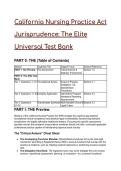
California Nursing Practice Act
Jurisprudence: The Elite
Universal Test Bank
PART 0: THE (Table of Contents)
Section Cognitive Tier Subject Focus Section Reference
PART I: The Preview Pre-Assessment Critical Axioms & Section 1.0
Statutory Frameworks
PART II: The Elite Test
Bank
Tier 1: Questions 1–10 Foundational Syntax Scope of Practice, Section 2.1
Delegation, CE,
Standardized
Procedures
Tier 2: Questions 11–20 Complex Application Intervention Program, Section 2.2
Mandatory Reporting,
Abandonment
Tier 3: Questions Grandmaster Synthesis Multi-Variable Clinical & Section 2.3
21–30 Legal Crises
PART I: THE Preview
Mastery of the California Nursing Practice Act (NPA) bridges the cognitive gap between
foundational clinical competence and absolute legal invulnerability, transforming standard
practitioners into legally defensible healthcare leaders. Executing this specific assessment
gauntlet ensures that academic jurisprudence translates directly into elite, universally applicable
professional practice capable of withstanding rigorous board scrutiny.
The "Critical Axioms" Cheat Sheet
● The Overlapping Functions Mandate: Standardized procedures act as the sole legal
mechanism permitting a Registered Nurse (RN) to execute functions that overlap with the
practice of medicine, such as initiating medical treatments or performing invasive surgical
acts.
● The Delegation Hard-Deck: The registered nurse may never delegate the core nursing
process—specifically assessment, planning, or evaluation—to a Licensed Vocational
, Nurse (LVN) or Unlicensed Assistive Personnel (UAP). Subordinate licenses perform
basic data collection; the RN synthesizes and evaluates.
● The Abandonment Axiom: Patient abandonment mandates the formal assumption of
patient care followed by the active severing of that relationship without adequate
handover. Refusing mandatory overtime strictly due to extreme fatigue constitutes a
protected labor dispute, not clinical abandonment.
● The First-Renewal Exemption: Newly licensed RNs are statutorily exempt from the
standard 30-hour Continuing Education (CE) requirement for their initial renewal cycle,
with one uncompromising exception: the mandatory completion of a 1-hour
Board-approved implicit bias course.
● The Intervention Sanctuary: The Board of Registered Nursing (BRN) Intervention
Program serves as a confidential alternative to public disciplinary action for nurses facing
substance use or mental health disorders, provided enrollment occurs voluntarily prior to
the execution of formal board discipline.
PART II: THE ELITE TEST BANK
Tier 1: Foundational Syntax & Application
Q1: A newly licensed registered nurse is approaching their first license renewal cycle in the
state of California. Based on the provisions of the California Nursing Practice Act regarding
continuing education requirements, which action is the MOST ACCURATE? A) The registered
nurse must complete 30 contact hours of continuing education, including 1 hour of implicit bias
training. B) The registered nurse is entirely exempt from all continuing education requirements
for the first renewal cycle due to recent graduation. C) The registered nurse is exempt from the
standard 30-hour requirement but must complete a 1-hour direct participation course in implicit
bias. D) The registered nurse must complete exactly 15 contact hours of continuing education
focused exclusively on California jurisprudence.
● The Answer: C (The registered nurse is exempt from the standard 30-hour requirement
but must complete a 1-hour direct participation course in implicit bias.)
● Distractor Analysis:
○ A is incorrect: This option represents a common novice misconception regarding
the onset of educational mandates. The full 30-hour requirement strictly applies to
subsequent biennial renewals, not the very first renewal following initial licensure.
○ B is incorrect: While this absolute exemption was technically accurate under legacy
regulations, Assembly Bill 1407 strictly mandates the 1-hour implicit bias
requirement even during the initial post-licensure exemption period.
○ D is incorrect: There is absolutely no legal provision or statutory mechanism in the
California Code of Regulations permitting a prorated 15-hour continuing education
requirement for new graduates.
The Mentor's Analysis: Regulatory updates aggressively target contemporary clinical and
social issues. The state board requires immediate baseline competency in equitable care over
generalized continuing education for new practitioners. By utilizing the first-renewal statutory
exemption rules, the practitioner bypasses the common trap of unnecessary financial and
educational expenditure while remaining legally compliant. Professional/Academic Intuition:
Always isolate the exceptions; generalized regulatory rules rarely govern initial licensure
parameters.
, Q2: A facility utilizes Unlicensed Assistive Personnel (UAP) within a high-acuity medical-surgical
unit. Under the strict parameters of the California Code of Regulations, which specific task can
the registered nurse MOST APPROPRIATELY delegate to the UAP? A) Administering a bolus
tube feeding via an established percutaneous endoscopic gastrostomy (PEG) tube. B)
Educating the patient's family on standard post-discharge mobility precautions to prevent deep
vein thrombosis. C) Documenting basic intake, output, and routine vital signs on a
hemodynamically stable patient. D) Performing a focused neurological assessment on a patient
who has just returned from an invasive surgical procedure.
● The Answer: C (Documenting basic intake, output, and routine vital signs on a
hemodynamically stable patient.)
● Distractor Analysis:
○ A is incorrect: California Business and Professions Code Section 2725.3 explicitly
forbids UAPs from performing invasive procedures, which statutorily includes
parenteral or enteral tube feedings.
○ B is incorrect: Educating patients and their families concerning health care
problems or post-discharge care requires a substantial amount of scientific
knowledge and is expressly non-delegable to unlicensed personnel.
○ D is incorrect: The assessment of a patient's condition is a core registered nursing
function involving critical clinical judgment and cannot be delegated to unlicensed or
subordinate licensed personnel.
The Mentor's Analysis: Delegation is not a mechanism for task shedding; it is a profound
exercise in legal risk management. Unlicensed Assistive Personnel are statutorily restricted to
routine, non-invasive, and non-evaluative tasks. By utilizing the delegation hard-deck
framework, the clinician bypasses the severe trap of conflating task simplicity with legal
authorization. Professional/Academic Intuition: Never delegate the core components of
the nursing process: Assessment, Planning, Evaluation, or Scientific Education.
Q3: A registered nurse operates in an outpatient clinic and frequently implements medical
treatment regimens for patients based on specific, written guidelines. To legally perform these
functions that overlap with the practice of medicine, which element is an ABSOLUTE
REQUIREMENT of the standardized procedure? A) The procedure must be verbally authorized
by the clinical medical director prior to the start of each operational shift. B) The procedure must
contain a formal, written method for the initial and continuing evaluation of the registered nurse's
clinical competence. C) The procedure must allow the registered nurse to independently
prescribe Schedule II controlled substances without physician oversight. D) The procedure must
be submitted to and formally approved by the California Board of Registered Nursing prior to
institutional implementation.
● The Answer: B (The procedure must contain a formal, written method for the initial and
continuing evaluation of the registered nurse's clinical competence.)
● Distractor Analysis:
○ A is incorrect: Standardized procedures must be in writing, dated, and signed by
authorized personnel; verbal authorization is legally void and provides no defensive
shield.
○ C is incorrect: While Advanced Practice nurses possess specific furnishing
protocols, standard registered nurse standardized procedures do not grant
independent Schedule II prescribing authority.
○ D is incorrect: This represents a massive legacy trap. Standardized procedures are
developed collaboratively at the institutional level and are expressly not subject to
prior approval by the regulatory boards.
Jurisprudence: The Elite
Universal Test Bank
PART 0: THE (Table of Contents)
Section Cognitive Tier Subject Focus Section Reference
PART I: The Preview Pre-Assessment Critical Axioms & Section 1.0
Statutory Frameworks
PART II: The Elite Test
Bank
Tier 1: Questions 1–10 Foundational Syntax Scope of Practice, Section 2.1
Delegation, CE,
Standardized
Procedures
Tier 2: Questions 11–20 Complex Application Intervention Program, Section 2.2
Mandatory Reporting,
Abandonment
Tier 3: Questions Grandmaster Synthesis Multi-Variable Clinical & Section 2.3
21–30 Legal Crises
PART I: THE Preview
Mastery of the California Nursing Practice Act (NPA) bridges the cognitive gap between
foundational clinical competence and absolute legal invulnerability, transforming standard
practitioners into legally defensible healthcare leaders. Executing this specific assessment
gauntlet ensures that academic jurisprudence translates directly into elite, universally applicable
professional practice capable of withstanding rigorous board scrutiny.
The "Critical Axioms" Cheat Sheet
● The Overlapping Functions Mandate: Standardized procedures act as the sole legal
mechanism permitting a Registered Nurse (RN) to execute functions that overlap with the
practice of medicine, such as initiating medical treatments or performing invasive surgical
acts.
● The Delegation Hard-Deck: The registered nurse may never delegate the core nursing
process—specifically assessment, planning, or evaluation—to a Licensed Vocational
, Nurse (LVN) or Unlicensed Assistive Personnel (UAP). Subordinate licenses perform
basic data collection; the RN synthesizes and evaluates.
● The Abandonment Axiom: Patient abandonment mandates the formal assumption of
patient care followed by the active severing of that relationship without adequate
handover. Refusing mandatory overtime strictly due to extreme fatigue constitutes a
protected labor dispute, not clinical abandonment.
● The First-Renewal Exemption: Newly licensed RNs are statutorily exempt from the
standard 30-hour Continuing Education (CE) requirement for their initial renewal cycle,
with one uncompromising exception: the mandatory completion of a 1-hour
Board-approved implicit bias course.
● The Intervention Sanctuary: The Board of Registered Nursing (BRN) Intervention
Program serves as a confidential alternative to public disciplinary action for nurses facing
substance use or mental health disorders, provided enrollment occurs voluntarily prior to
the execution of formal board discipline.
PART II: THE ELITE TEST BANK
Tier 1: Foundational Syntax & Application
Q1: A newly licensed registered nurse is approaching their first license renewal cycle in the
state of California. Based on the provisions of the California Nursing Practice Act regarding
continuing education requirements, which action is the MOST ACCURATE? A) The registered
nurse must complete 30 contact hours of continuing education, including 1 hour of implicit bias
training. B) The registered nurse is entirely exempt from all continuing education requirements
for the first renewal cycle due to recent graduation. C) The registered nurse is exempt from the
standard 30-hour requirement but must complete a 1-hour direct participation course in implicit
bias. D) The registered nurse must complete exactly 15 contact hours of continuing education
focused exclusively on California jurisprudence.
● The Answer: C (The registered nurse is exempt from the standard 30-hour requirement
but must complete a 1-hour direct participation course in implicit bias.)
● Distractor Analysis:
○ A is incorrect: This option represents a common novice misconception regarding
the onset of educational mandates. The full 30-hour requirement strictly applies to
subsequent biennial renewals, not the very first renewal following initial licensure.
○ B is incorrect: While this absolute exemption was technically accurate under legacy
regulations, Assembly Bill 1407 strictly mandates the 1-hour implicit bias
requirement even during the initial post-licensure exemption period.
○ D is incorrect: There is absolutely no legal provision or statutory mechanism in the
California Code of Regulations permitting a prorated 15-hour continuing education
requirement for new graduates.
The Mentor's Analysis: Regulatory updates aggressively target contemporary clinical and
social issues. The state board requires immediate baseline competency in equitable care over
generalized continuing education for new practitioners. By utilizing the first-renewal statutory
exemption rules, the practitioner bypasses the common trap of unnecessary financial and
educational expenditure while remaining legally compliant. Professional/Academic Intuition:
Always isolate the exceptions; generalized regulatory rules rarely govern initial licensure
parameters.
, Q2: A facility utilizes Unlicensed Assistive Personnel (UAP) within a high-acuity medical-surgical
unit. Under the strict parameters of the California Code of Regulations, which specific task can
the registered nurse MOST APPROPRIATELY delegate to the UAP? A) Administering a bolus
tube feeding via an established percutaneous endoscopic gastrostomy (PEG) tube. B)
Educating the patient's family on standard post-discharge mobility precautions to prevent deep
vein thrombosis. C) Documenting basic intake, output, and routine vital signs on a
hemodynamically stable patient. D) Performing a focused neurological assessment on a patient
who has just returned from an invasive surgical procedure.
● The Answer: C (Documenting basic intake, output, and routine vital signs on a
hemodynamically stable patient.)
● Distractor Analysis:
○ A is incorrect: California Business and Professions Code Section 2725.3 explicitly
forbids UAPs from performing invasive procedures, which statutorily includes
parenteral or enteral tube feedings.
○ B is incorrect: Educating patients and their families concerning health care
problems or post-discharge care requires a substantial amount of scientific
knowledge and is expressly non-delegable to unlicensed personnel.
○ D is incorrect: The assessment of a patient's condition is a core registered nursing
function involving critical clinical judgment and cannot be delegated to unlicensed or
subordinate licensed personnel.
The Mentor's Analysis: Delegation is not a mechanism for task shedding; it is a profound
exercise in legal risk management. Unlicensed Assistive Personnel are statutorily restricted to
routine, non-invasive, and non-evaluative tasks. By utilizing the delegation hard-deck
framework, the clinician bypasses the severe trap of conflating task simplicity with legal
authorization. Professional/Academic Intuition: Never delegate the core components of
the nursing process: Assessment, Planning, Evaluation, or Scientific Education.
Q3: A registered nurse operates in an outpatient clinic and frequently implements medical
treatment regimens for patients based on specific, written guidelines. To legally perform these
functions that overlap with the practice of medicine, which element is an ABSOLUTE
REQUIREMENT of the standardized procedure? A) The procedure must be verbally authorized
by the clinical medical director prior to the start of each operational shift. B) The procedure must
contain a formal, written method for the initial and continuing evaluation of the registered nurse's
clinical competence. C) The procedure must allow the registered nurse to independently
prescribe Schedule II controlled substances without physician oversight. D) The procedure must
be submitted to and formally approved by the California Board of Registered Nursing prior to
institutional implementation.
● The Answer: B (The procedure must contain a formal, written method for the initial and
continuing evaluation of the registered nurse's clinical competence.)
● Distractor Analysis:
○ A is incorrect: Standardized procedures must be in writing, dated, and signed by
authorized personnel; verbal authorization is legally void and provides no defensive
shield.
○ C is incorrect: While Advanced Practice nurses possess specific furnishing
protocols, standard registered nurse standardized procedures do not grant
independent Schedule II prescribing authority.
○ D is incorrect: This represents a massive legacy trap. Standardized procedures are
developed collaboratively at the institutional level and are expressly not subject to
prior approval by the regulatory boards.


