

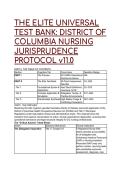
THE ELITE UNIVERSAL
TEST BANK: DISTRICT OF
COLUMBIA NURSING
JURISPRUDENCE
PROTOCOL v11.0
PART 0: THE TABLE OF CONTENTS
Section Cognitive Tier Focus Area Question Range
PART I The Preview DC HORA Operational N/A
Doctrine & Axioms
PART II The Elite Test Bank 30-Point Assessment Q1–Q30
Gauntlet
- Tier 1 Foundational Syntax & Hard Deck Definitions, Q1–Q10
Application Licensure, & CE
- Tier 2 Complex Application & Delegation, Scope, & Q11–Q20
Simulation Practice Environments
- Tier 3 Grandmaster Synthesis High-Stakes Triage & Q21–Q30
Conflicting Precedents
PART I: THE PREVIEW
Mastering this elite cognitive gauntlet translates directly to flawless real-world application of the
District of Columbia Health Occupations Revision Act (HORA) and Title 17 Municipal
Regulations under high-stakes clinical and administrative stress. This material forces the
transition from passive memorization to active, clinical jurisprudence diagnostics, ensuring total
operational dominance and legal structural integrity for DC nursing professionals.
The "Critical Axioms" Cheat Sheet:
Axiom Statutory Mechanism Clinical Implication
The Delegation Imperative Title 17 Chapter 54 A Registered Nurse (RN)
retains absolute accountability
for all delegated acts.
Unlicensed Assistive Personnel
(UAP) or Nursing Assistive
Personnel (NAP) may only
perform routine, recurring tasks
with predictable outcomes.
Assessment, diagnosis, care
,Axiom Statutory Mechanism Clinical Implication
planning, and evaluation are
strictly non-delegable.
Full Practice Authority (FPA) DC Code § 3-1205.03 DC Advanced Practice
Registered Nurses (APRNs)
operate with full, independent
practice authority. No formal
collaborative practice
agreement (CPA) or physician
supervision is required for
diagnosis, treatment, or
prescriptive authority.
The 90-Day Pending Window Title 17 § 5400.3 Applications incomplete for 90
days are legally abandoned.
Graduate nurses possess a
strict 90-day window to practice
under a "Letter of Supervised
Practice," strictly barring them
from correctional and dialysis
facilities.
Mandatory Reporting DC Code § 22-3020.52 Child abuse requires
IMMEDIATE reporting to police
or the Child and Family
Services Agency. Adult
Protective Services (APS)
requires reporting within 24
hours for immediate
life-threatening risks, and 10
days for standard risks.
The Licensure Chronology Title 17 § 5401.1 All DC nursing licenses expire
precisely at 12:00 midnight on
June 30 of even-numbered
years. Continuing Education
(CE) requires 24 hours for
RNs/APRNs and 18 hours for
LPNs, mandating specific
allocations for LGBTQ cultural
awareness and public health
priorities.
PART II: THE ELITE TEST BANK
Q1: A Registered Nurse licensed in the District of Columbia is preparing for their first licensure
renewal following the initial grant of their license by examination. Based on the principles of Title
17 Chapter 54 of the District of Columbia Municipal Regulations, which action is the MOST
ACCURATE regarding Continuing Education (CE) requirements? A) The nurse must complete
24 contact hours, prioritizing 2 hours of LGBTQ cultural awareness and 3 hours of HIV/AIDS or
Director's topics. B) The nurse must complete a prorated amount of 12 contact hours since they
have been licensed for less than a full two-year cycle. C) The nurse is entirely exempt from all
, continuing education requirements for this specific renewal cycle. D) The nurse must submit an
audit verification form signed by a supervisor to waive the 24-hour CE requirement.
● The Answer: C (The nurse is entirely exempt from all continuing education requirements
for this specific renewal cycle.)
● Distractor Analysis:
○ A is incorrect: While 24 hours (including LGBTQ and public health topics) is the
standard requirement for subsequent RN renewals, it does not apply to the first
renewal after the initial grant of a license.
○ B is incorrect: The District of Columbia Board of Nursing does not prorate CE hours
based on the length of the initial licensure period; the exemption is absolute for the
first renewal.
○ D is incorrect: Audit verifications are utilized to prove compliance during random
selection processes, not to request waivers. The exemption is automatic based on
statutory licensure status.
The Mentor's Analysis: The regulatory framework acknowledges that recent graduates have
just completed rigorous academic training, rendering immediate CE redundant. When facing the
initial renewal phase, the immediate priority is understanding statutory exemptions. By utilizing
the First-Renewal Exemption, you bypass the common trap of unnecessarily accumulating and
reporting CE credits. Professional/Academic Intuition: An initial license grant shields the
practitioner from CE requirements until the second renewal cycle.
Q2: An Advanced Practice Registered Nurse (APRN) relocating from a state with restricted
practice authority applies for licensure by endorsement in the District of Columbia. The APRN
intends to open an independent primary care clinic. Based on the principles of the District of
Columbia Health Occupations Revision Act (HORA), which conclusion is the MOST
ACCURATE? A) The APRN must secure a formal Collaborative Practice Agreement (CPA) with
a DC-licensed physician before opening the clinic. B) The APRN may open the clinic
independently and evaluate, diagnose, and treat patients without physician supervision. C) The
APRN may practice independently but must have a physician co-sign all Schedule II controlled
substance prescriptions. D) The APRN must complete a 3,600-hour transition-to-practice period
under physician supervision before achieving Full Practice Authority.
● The Answer: B (The APRN may open the clinic independently and evaluate, diagnose,
and treat patients without physician supervision.)
● Distractor Analysis:
○ A is incorrect: The District of Columbia grants Full Practice Authority; CPAs and
physician supervision mandates are legally nonexistent for APRNs in this
jurisdiction.
○ C is incorrect: An APRN in DC has full prescriptive authority, including Schedule II-V
controlled substances, provided they hold a DEA number and a DC Controlled
Substances Registration (CSR), without co-signature requirements.
○ D is incorrect: Unlike states that require a supervised transition period (e.g.,
Pennsylvania or Virginia), DC law grants Full Practice Authority immediately upon
licensure.
The Mentor's Analysis: The District of Columbia is a Full Practice Authority jurisdiction,
meaning the APRN functions as an independent primary care provider. When facing
jurisdictional transitions, the immediate priority is shedding legacy restrictions. By utilizing
Independent Practice Authority, you bypass the common trap of artificially restricting clinic
operations due to outdated, out-of-state regulatory mindsets. Professional/Academic
Intuition: APRN practice in the District of Columbia is governed exclusively by the Board
TEST BANK: DISTRICT OF
COLUMBIA NURSING
JURISPRUDENCE
PROTOCOL v11.0
PART 0: THE TABLE OF CONTENTS
Section Cognitive Tier Focus Area Question Range
PART I The Preview DC HORA Operational N/A
Doctrine & Axioms
PART II The Elite Test Bank 30-Point Assessment Q1–Q30
Gauntlet
- Tier 1 Foundational Syntax & Hard Deck Definitions, Q1–Q10
Application Licensure, & CE
- Tier 2 Complex Application & Delegation, Scope, & Q11–Q20
Simulation Practice Environments
- Tier 3 Grandmaster Synthesis High-Stakes Triage & Q21–Q30
Conflicting Precedents
PART I: THE PREVIEW
Mastering this elite cognitive gauntlet translates directly to flawless real-world application of the
District of Columbia Health Occupations Revision Act (HORA) and Title 17 Municipal
Regulations under high-stakes clinical and administrative stress. This material forces the
transition from passive memorization to active, clinical jurisprudence diagnostics, ensuring total
operational dominance and legal structural integrity for DC nursing professionals.
The "Critical Axioms" Cheat Sheet:
Axiom Statutory Mechanism Clinical Implication
The Delegation Imperative Title 17 Chapter 54 A Registered Nurse (RN)
retains absolute accountability
for all delegated acts.
Unlicensed Assistive Personnel
(UAP) or Nursing Assistive
Personnel (NAP) may only
perform routine, recurring tasks
with predictable outcomes.
Assessment, diagnosis, care
,Axiom Statutory Mechanism Clinical Implication
planning, and evaluation are
strictly non-delegable.
Full Practice Authority (FPA) DC Code § 3-1205.03 DC Advanced Practice
Registered Nurses (APRNs)
operate with full, independent
practice authority. No formal
collaborative practice
agreement (CPA) or physician
supervision is required for
diagnosis, treatment, or
prescriptive authority.
The 90-Day Pending Window Title 17 § 5400.3 Applications incomplete for 90
days are legally abandoned.
Graduate nurses possess a
strict 90-day window to practice
under a "Letter of Supervised
Practice," strictly barring them
from correctional and dialysis
facilities.
Mandatory Reporting DC Code § 22-3020.52 Child abuse requires
IMMEDIATE reporting to police
or the Child and Family
Services Agency. Adult
Protective Services (APS)
requires reporting within 24
hours for immediate
life-threatening risks, and 10
days for standard risks.
The Licensure Chronology Title 17 § 5401.1 All DC nursing licenses expire
precisely at 12:00 midnight on
June 30 of even-numbered
years. Continuing Education
(CE) requires 24 hours for
RNs/APRNs and 18 hours for
LPNs, mandating specific
allocations for LGBTQ cultural
awareness and public health
priorities.
PART II: THE ELITE TEST BANK
Q1: A Registered Nurse licensed in the District of Columbia is preparing for their first licensure
renewal following the initial grant of their license by examination. Based on the principles of Title
17 Chapter 54 of the District of Columbia Municipal Regulations, which action is the MOST
ACCURATE regarding Continuing Education (CE) requirements? A) The nurse must complete
24 contact hours, prioritizing 2 hours of LGBTQ cultural awareness and 3 hours of HIV/AIDS or
Director's topics. B) The nurse must complete a prorated amount of 12 contact hours since they
have been licensed for less than a full two-year cycle. C) The nurse is entirely exempt from all
, continuing education requirements for this specific renewal cycle. D) The nurse must submit an
audit verification form signed by a supervisor to waive the 24-hour CE requirement.
● The Answer: C (The nurse is entirely exempt from all continuing education requirements
for this specific renewal cycle.)
● Distractor Analysis:
○ A is incorrect: While 24 hours (including LGBTQ and public health topics) is the
standard requirement for subsequent RN renewals, it does not apply to the first
renewal after the initial grant of a license.
○ B is incorrect: The District of Columbia Board of Nursing does not prorate CE hours
based on the length of the initial licensure period; the exemption is absolute for the
first renewal.
○ D is incorrect: Audit verifications are utilized to prove compliance during random
selection processes, not to request waivers. The exemption is automatic based on
statutory licensure status.
The Mentor's Analysis: The regulatory framework acknowledges that recent graduates have
just completed rigorous academic training, rendering immediate CE redundant. When facing the
initial renewal phase, the immediate priority is understanding statutory exemptions. By utilizing
the First-Renewal Exemption, you bypass the common trap of unnecessarily accumulating and
reporting CE credits. Professional/Academic Intuition: An initial license grant shields the
practitioner from CE requirements until the second renewal cycle.
Q2: An Advanced Practice Registered Nurse (APRN) relocating from a state with restricted
practice authority applies for licensure by endorsement in the District of Columbia. The APRN
intends to open an independent primary care clinic. Based on the principles of the District of
Columbia Health Occupations Revision Act (HORA), which conclusion is the MOST
ACCURATE? A) The APRN must secure a formal Collaborative Practice Agreement (CPA) with
a DC-licensed physician before opening the clinic. B) The APRN may open the clinic
independently and evaluate, diagnose, and treat patients without physician supervision. C) The
APRN may practice independently but must have a physician co-sign all Schedule II controlled
substance prescriptions. D) The APRN must complete a 3,600-hour transition-to-practice period
under physician supervision before achieving Full Practice Authority.
● The Answer: B (The APRN may open the clinic independently and evaluate, diagnose,
and treat patients without physician supervision.)
● Distractor Analysis:
○ A is incorrect: The District of Columbia grants Full Practice Authority; CPAs and
physician supervision mandates are legally nonexistent for APRNs in this
jurisdiction.
○ C is incorrect: An APRN in DC has full prescriptive authority, including Schedule II-V
controlled substances, provided they hold a DEA number and a DC Controlled
Substances Registration (CSR), without co-signature requirements.
○ D is incorrect: Unlike states that require a supervised transition period (e.g.,
Pennsylvania or Virginia), DC law grants Full Practice Authority immediately upon
licensure.
The Mentor's Analysis: The District of Columbia is a Full Practice Authority jurisdiction,
meaning the APRN functions as an independent primary care provider. When facing
jurisdictional transitions, the immediate priority is shedding legacy restrictions. By utilizing
Independent Practice Authority, you bypass the common trap of artificially restricting clinic
operations due to outdated, out-of-state regulatory mindsets. Professional/Academic
Intuition: APRN practice in the District of Columbia is governed exclusively by the Board


