

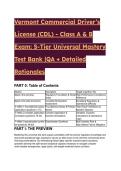
Vermont Commercial Driver’s
License (CDL) - Class A & B
Exam: S-Tier Universal Mastery
Test Bank |QA + Detailed
Rationales
PART 0: Table of Contents
Section Description Target Cognitive Tier
(#part-i-the-preview) Regulatory Foundation & Cheat High-Performance Compliance
Sheet Reference
(#part-ii-the-elite-test-bank) Complete 60-Question Escalating Regulatory &
Assessment Operational Difficulty
├─(#tier-1-foundational-syntax- Foundational Syntax & Primary "Hard Deck" Definitions &
-application-questions-1-15) Metrics Baseline Statutes
├─(#tier-2-complex-application- Complex Application & Variables, Dynamic
-simulation-questions-16-35) Dynamic Simulations Calculations & Operational
Logic
└─(#tier-3-grandmaster-synthe Grandmaster Synthesis Multi-Variable Risk &
sis-questions-36-60) High-Stakes Failure Mitigation
PART I: THE PREVIEW
Mastering this universal test bank equips candidates with the precise regulatory knowledge and
real-world operational logic required to secure an elite score on the Vermont commercial driver
licensing examinations. By internalizing these highly specific scenario-based questions,
operators develop the split-second analytical capacity necessary to navigate complex
multi-variable emergencies, legal audits, and weight-restricted transit corridors.
,The Critical Axioms Cheat Sheet
● The Air Brake Operational Baseline: The low-pressure warning must activate at or
above 60\text{ PSI} , emergency spring brakes must automatically deploy between
20\text{ PSI} and 40\text{ PSI} , and the air compressor governor must regulate system
pressure between 110\text{ PSI} and 130\text{ PSI}.
● The Vermont Dimensional Limits: Standard commercial vehicles are limited to a
maximum height of 13\text{ feet } 6\text{ inches} , a maximum width of 8\text{ feet } 6\text{
inches} , a single-vehicle length of 46\text{ feet} , and combination vehicle lengths up to
75\text{ feet}.
● The Zero-Tolerance Thresholds: The legal limit for blood alcohol concentration in a
commercial motor vehicle is strictly 0.04\% , with any off-duty chemical test refusal or
conviction of 0.08\% in a personal vehicle triggering a mandatory 1-year CDL
disqualification.
● The Idling Restrictions: Under 23 V.S.A. § 1110, stationary engines are limited to 5\text{
minutes} of idling in any 60-minute period , with strict zero-tolerance rules applied to
school buses on school grounds.
● The Weight Tolerances: Tandem axles are limited to 34,000\text{ lbs} on Interstate
highways and 36,000\text{ lbs} on non-Interstate highways , subject to a 10\% scale
tolerance on non-Interstate state roads.
Table 1: Vermont Statutory Dimensional Limits
Dimension Standard Highway Limit (No Legal Authority
Permit)
Maximum Width 8\text{ feet, } 6\text{ inches } 23 V.S.A. § 1431
(102\text{ inches})
Maximum Height 13\text{ feet, } 6\text{ 23 V.S.A. § 1431
inche[span_40](start_span)[spa
n_40](end_span)[span_54](star
t_span)[span_54](end_span)s}
Single Vehicle Length 46\text{ feet} 23 V.S.A. § 1432
Combination Length 75\text{ feet} 23 V.S.A. § 1432
Table 2: Air Brake Leakage Rate Thresholds (Maximum Allowable
Loss)
Vehicle Class State of Brakes Maximum Allowable Air Loss
per Minute
Class B (Single Vehicle) Brakes Released (Static) 2\text{ PSI}
Class B (Single Vehicle) Brakes Fully Applied 3\text{ PSI}
Class A (Combination) Brakes Released (Static) 3\text{ PSI}
Class A (Combination) Brakes Fully Applied 4\text{ PSI}
PART II: THE ELITE TEST BANK
Tier 1: Foundational Syntax & Application (Questions 1–15)
, Q1: According to standard vehicle height restrictions enforced across all public highways in
Vermont, what is the MAXIMUM legal height permitted for a commercial motor vehicle without
an over-dimension permit? A) 13\text{ feet, } 0\text{ inches} B) 13\text{ feet, } 6\text{ inches} C)
14\text{ feet, } 0\text{ inches} D) 14\text{ feet, } 6\text{ inches}
● The Answer: B (13\text{ feet, } 6\text{ inches})
● Distractor Analysis:
○ A is incorrect: This is a standard bridge clearance baseline in several old urban
centers but is more restrictive than the statutory limit.
○ C is incorrect: This height exceeds the standard legal limit and requires a VTrans
over-dimension permit.
○ D is incorrect: This is a standard limit in western states but is completely illegal in
Vermont without a route-specific permit.
The Mentor's Analysis: Standard vertical clearances are structurally fixed to protect bridge
infrastructure and overhead utility lines. When verifying route viability, the immediate priority is
ensuring the physical vehicle height remains below the standard legal envelope. By maintaining
a height of exactly 13\text{ feet, } 6\text{ inches} or less, the operator avoids the catastrophic
risk of bridge strikes and structural collisions. Professional/Academic Intuition: Always
assume posted clearance signs on older bridge structures are inaccurate if the roadway has
been recently repaved without being milled down.
Q2: Under Vermont statutes, what is the MAXIMUM legal width permitted for a commercial
motor vehicle operating on any public highway without an escort or over-dimension permit? A)
8\text{ feet, } 0\text{ inches} B) 8\text{ feet, } 6\text{ inches} C) 9\text{ feet, } 0\text{ inches} D)
10\text{ feet, } 2\text{ inches}
● The Answer: B (8\text{ feet, } 6\text{ inches})
● Distractor Analysis:
○ A is incorrect: This was the standard limit prior to the Surface Transportation
Assistance Act but is now obsolete for modern commercial lanes.
○ C is incorrect: This width exceeds the legal standard of 102\text{
inc[span_69](start_span)[span_69](end_span)hes} and would require a VTrans
permit.
○ D is incorrect: This is a common width for heavy agricultural equipment under
specific exemptions, but is illegal for standard commercial motor vehicles.
The Mentor's Analysis: Lateral lane spacing is calculated based on standard trailer widths.
When operating a vehicle at the absolute legal limit of 8\text{ feet, } 6\text{ inches}, the
immediate priority is maintaining strict center-lane tracking. By utilizing this exact statutory limit,
the operator bypasses the risk of lateral collisions with stationary roadside objects or oncoming
traffic. Professional/Academic Intuition: Commercial vehicle width measurements must
exclude mirrors and safety devices, provided they do not extend beyond the standard clearance
allowances.
Q3: Under the provisions of the Vermont Commercial Driver's License manual, what is the
MAXIMUM statutory length permitted for a single motor vehicle operating on any public
highway? A) 40\text{ feet} B) 45\text{ feet} C) 46\text{ feet} D) 50\text{ feet}
● The Answer: C (46\text{ feet})
● Distractor Analysis:
○ A is incorrect: This is the standard length limit for single passenger buses in some
jurisdictions, but is more restrictive than the Vermont straight truck limit.
○ B is incorrect: This is a common standard for motor coaches but is not the precise
statutory maximum for single commercial freight vehicles.
License (CDL) - Class A & B
Exam: S-Tier Universal Mastery
Test Bank |QA + Detailed
Rationales
PART 0: Table of Contents
Section Description Target Cognitive Tier
(#part-i-the-preview) Regulatory Foundation & Cheat High-Performance Compliance
Sheet Reference
(#part-ii-the-elite-test-bank) Complete 60-Question Escalating Regulatory &
Assessment Operational Difficulty
├─(#tier-1-foundational-syntax- Foundational Syntax & Primary "Hard Deck" Definitions &
-application-questions-1-15) Metrics Baseline Statutes
├─(#tier-2-complex-application- Complex Application & Variables, Dynamic
-simulation-questions-16-35) Dynamic Simulations Calculations & Operational
Logic
└─(#tier-3-grandmaster-synthe Grandmaster Synthesis Multi-Variable Risk &
sis-questions-36-60) High-Stakes Failure Mitigation
PART I: THE PREVIEW
Mastering this universal test bank equips candidates with the precise regulatory knowledge and
real-world operational logic required to secure an elite score on the Vermont commercial driver
licensing examinations. By internalizing these highly specific scenario-based questions,
operators develop the split-second analytical capacity necessary to navigate complex
multi-variable emergencies, legal audits, and weight-restricted transit corridors.
,The Critical Axioms Cheat Sheet
● The Air Brake Operational Baseline: The low-pressure warning must activate at or
above 60\text{ PSI} , emergency spring brakes must automatically deploy between
20\text{ PSI} and 40\text{ PSI} , and the air compressor governor must regulate system
pressure between 110\text{ PSI} and 130\text{ PSI}.
● The Vermont Dimensional Limits: Standard commercial vehicles are limited to a
maximum height of 13\text{ feet } 6\text{ inches} , a maximum width of 8\text{ feet } 6\text{
inches} , a single-vehicle length of 46\text{ feet} , and combination vehicle lengths up to
75\text{ feet}.
● The Zero-Tolerance Thresholds: The legal limit for blood alcohol concentration in a
commercial motor vehicle is strictly 0.04\% , with any off-duty chemical test refusal or
conviction of 0.08\% in a personal vehicle triggering a mandatory 1-year CDL
disqualification.
● The Idling Restrictions: Under 23 V.S.A. § 1110, stationary engines are limited to 5\text{
minutes} of idling in any 60-minute period , with strict zero-tolerance rules applied to
school buses on school grounds.
● The Weight Tolerances: Tandem axles are limited to 34,000\text{ lbs} on Interstate
highways and 36,000\text{ lbs} on non-Interstate highways , subject to a 10\% scale
tolerance on non-Interstate state roads.
Table 1: Vermont Statutory Dimensional Limits
Dimension Standard Highway Limit (No Legal Authority
Permit)
Maximum Width 8\text{ feet, } 6\text{ inches } 23 V.S.A. § 1431
(102\text{ inches})
Maximum Height 13\text{ feet, } 6\text{ 23 V.S.A. § 1431
inche[span_40](start_span)[spa
n_40](end_span)[span_54](star
t_span)[span_54](end_span)s}
Single Vehicle Length 46\text{ feet} 23 V.S.A. § 1432
Combination Length 75\text{ feet} 23 V.S.A. § 1432
Table 2: Air Brake Leakage Rate Thresholds (Maximum Allowable
Loss)
Vehicle Class State of Brakes Maximum Allowable Air Loss
per Minute
Class B (Single Vehicle) Brakes Released (Static) 2\text{ PSI}
Class B (Single Vehicle) Brakes Fully Applied 3\text{ PSI}
Class A (Combination) Brakes Released (Static) 3\text{ PSI}
Class A (Combination) Brakes Fully Applied 4\text{ PSI}
PART II: THE ELITE TEST BANK
Tier 1: Foundational Syntax & Application (Questions 1–15)
, Q1: According to standard vehicle height restrictions enforced across all public highways in
Vermont, what is the MAXIMUM legal height permitted for a commercial motor vehicle without
an over-dimension permit? A) 13\text{ feet, } 0\text{ inches} B) 13\text{ feet, } 6\text{ inches} C)
14\text{ feet, } 0\text{ inches} D) 14\text{ feet, } 6\text{ inches}
● The Answer: B (13\text{ feet, } 6\text{ inches})
● Distractor Analysis:
○ A is incorrect: This is a standard bridge clearance baseline in several old urban
centers but is more restrictive than the statutory limit.
○ C is incorrect: This height exceeds the standard legal limit and requires a VTrans
over-dimension permit.
○ D is incorrect: This is a standard limit in western states but is completely illegal in
Vermont without a route-specific permit.
The Mentor's Analysis: Standard vertical clearances are structurally fixed to protect bridge
infrastructure and overhead utility lines. When verifying route viability, the immediate priority is
ensuring the physical vehicle height remains below the standard legal envelope. By maintaining
a height of exactly 13\text{ feet, } 6\text{ inches} or less, the operator avoids the catastrophic
risk of bridge strikes and structural collisions. Professional/Academic Intuition: Always
assume posted clearance signs on older bridge structures are inaccurate if the roadway has
been recently repaved without being milled down.
Q2: Under Vermont statutes, what is the MAXIMUM legal width permitted for a commercial
motor vehicle operating on any public highway without an escort or over-dimension permit? A)
8\text{ feet, } 0\text{ inches} B) 8\text{ feet, } 6\text{ inches} C) 9\text{ feet, } 0\text{ inches} D)
10\text{ feet, } 2\text{ inches}
● The Answer: B (8\text{ feet, } 6\text{ inches})
● Distractor Analysis:
○ A is incorrect: This was the standard limit prior to the Surface Transportation
Assistance Act but is now obsolete for modern commercial lanes.
○ C is incorrect: This width exceeds the legal standard of 102\text{
inc[span_69](start_span)[span_69](end_span)hes} and would require a VTrans
permit.
○ D is incorrect: This is a common width for heavy agricultural equipment under
specific exemptions, but is illegal for standard commercial motor vehicles.
The Mentor's Analysis: Lateral lane spacing is calculated based on standard trailer widths.
When operating a vehicle at the absolute legal limit of 8\text{ feet, } 6\text{ inches}, the
immediate priority is maintaining strict center-lane tracking. By utilizing this exact statutory limit,
the operator bypasses the risk of lateral collisions with stationary roadside objects or oncoming
traffic. Professional/Academic Intuition: Commercial vehicle width measurements must
exclude mirrors and safety devices, provided they do not extend beyond the standard clearance
allowances.
Q3: Under the provisions of the Vermont Commercial Driver's License manual, what is the
MAXIMUM statutory length permitted for a single motor vehicle operating on any public
highway? A) 40\text{ feet} B) 45\text{ feet} C) 46\text{ feet} D) 50\text{ feet}
● The Answer: C (46\text{ feet})
● Distractor Analysis:
○ A is incorrect: This is the standard length limit for single passenger buses in some
jurisdictions, but is more restrictive than the Vermont straight truck limit.
○ B is incorrect: This is a common standard for motor coaches but is not the precise
statutory maximum for single commercial freight vehicles.


