

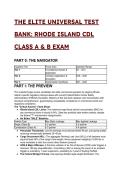
THE ELITE UNIVERSAL TEST
BANK: RHODE ISLAND CDL
CLASS A & B EXAM
PART 0: THE NAVIGATOR
Cognitive Tier Focus Area Question Range
Tier 1 Foundational Syntax & Q1 – Q15
Application
Tier 2 Complex Application & Q16 – Q30
Simulation
Tier 3 Grandmaster Synthesis Q31 – Q45
PART I: THE PREVIEW
This material forges novice candidates into elite commercial operators by aligning Rhode
Island’s specific regulatory idiosyncrasies with current Federal Motor Carrier Safety
Administration (FMCSA) mandates. Mastery of this test bank replaces rote memorization with
structural comprehension, guaranteeing unassailable competence in commercial transit and
regulatory compliance.
The "Critical Axioms" Cheat Sheet:
● Rhode Island CDL Limits: The maximum legal blood alcohol concentration (BAC) for
any commercial driver is strictly 0.04%. State law prohibits triple trailers entirely, despite
the federal "T" endorsement categorization.
● Air Brake "SALE" Baseline:
Vehicle Type Max Static Leakage Max Applied Leakage
Single (Class B) < 2 psi/min < 3 psi/min
Combination (Class A) < 3 psi/min < 4 psi/min
● Pneumatic Thresholds: Low-air warnings must activate before 60 psi, and spring brakes
must pop mechanically between 20–45 psi.
● Cargo Securement WLL: The aggregate Working Load Limit (WLL) of all tiedowns must
equal at least 50% of the cargo’s total weight. Heavy equipment weighing 10,000 lbs or
more mandates a strict four-corner direct tiedown protocol.
● OOS & Major Offenses: A first-time violation of an Out-of-Service (OOS) order triggers a
minimum 180-day disqualification. Committing a DUI or leaving the scene of an accident
triggers a mandatory 1-year suspension, escalating to 3 years if hauling HazMat.
● The Federal Bridge Formula: Axle spacing dictates legal weight distribution. The
, standard maximum gross vehicle weight is 80,000 lbs, with a maximum of 20,000 lbs on a
single axle and 34,000 lbs on a tandem axle.
PART II: THE ELITE TEST BANK
Tier 1: Foundational Syntax & Application
Q1: A driver is conducting the mandatory Applied Pressure Test (Leak Test) on a Class A
combination vehicle. The engine is off, the wheels are chocked, the parking brakes are
released, and the foot brake is fully applied. Under Rhode Island and FMCSA standards, what is
the MAXIMUM allowable air pressure loss in one minute after initial stabilization? A) 2 psi B) 3
psi C) 4 psi D) 5 psi
● The Answer: C (4 psi)
● Distractor Analysis:
○ A is incorrect: 2 psi is the maximum static (unapplied) leakage rate for a single
(Class B) vehicle.
○ B is incorrect: 3 psi is the applied leakage rate for a single vehicle, or the static rate
for a combination vehicle.
○ D is incorrect: 5 psi exceeds all legal FMCSA tolerances for air brake systems and
warrants an immediate Out-of-Service declaration.
The Mentor's Analysis: Air systems are the lifeblood of commercial vehicle safety. When
calculating combination vehicle tolerances, the immediate priority is accounting for the
expanded volumetric capacity of the trailer's air lines. By recognizing the 4 psi threshold, you
bypass the common trap of applying single-vehicle standards to articulated rigs.
Professional/Academic Intuition: Combination vehicles may lose no more than 4 psi in one
minute during an applied brake test; exceeding this mathematically guarantees a critical system
leak.
Q2: A Rhode Island commercial driver is subjected to a random roadside breathalyzer test while
operating a straight truck. Under strictly enforced state statutes, at what precise Blood Alcohol
Concentration (BAC) is the operator legally defined as Driving Under the Influence (DUI)? A)
0.02% B) 0.04% C) 0.06% D) 0.08%
● The Answer: B (0.04%)
● Distractor Analysis:
○ A is incorrect: 0.02% is the threshold for a Driving While Impaired (DWI) charge for
a standard operator under the age of 21, not the CDL standard.
○ C is incorrect: This is an arbitrary figure with no statutory basis in Rhode Island CDL
law.
○ D is incorrect: 0.08% is the standard limit for non-commercial passenger vehicles,
representing a fatal misconception for commercial operators.
The Mentor's Analysis: Commercial operation demands absolute physiological sobriety. When
managing driver fitness, the immediate priority is understanding the bifurcated legal limits
between passenger and commercial operation. By utilizing the 0.04% threshold, fleets bypass
the catastrophic liability of assuming standard civil limits apply to heavy machinery.
Professional/Academic Intuition: A BAC of 0.04% or greater automatically triggers a DUI
conviction and license disqualification for any active commercial motor vehicle operator.
Q3: An applicant wishes to secure an endorsement to haul multiple trailing units. They arrive at
the Rhode Island DMV to take the knowledge test. Based on specific state transport regulations,
, which operational statement is MOST ACCURATE regarding this endorsement? A) The "T"
endorsement allows for statewide operation of both double and triple trailers without restriction.
B) Triple trailers are strictly prohibited statewide in Rhode Island, despite the federal
endorsement being titled "Double/Triple Trailers." C) The endorsement requires both a written
test and a specialized skills test executed in a double-trailer rig. D) Double trailers are permitted
on all urban and rural roads provided the driver holds the endorsement.
● The Answer: B (Triple trailers are strictly prohibited statewide in Rhode Island, despite
the federal endorsement being titled "Double/Triple Trailers.")
● Distractor Analysis:
○ A is incorrect: Rhode Island outlaws triple combinations entirely due to localized
infrastructure and urban density constraints.
○ C is incorrect: The "T" endorsement strictly requires only a knowledge test; there is
no secondary road skills test required for doubles/triples.
○ D is incorrect: Double trailers are explicitly prohibited in many urban zones and face
strict bridge weight regulations, particularly on I-95 and I-195.
The Mentor's Analysis: State sovereignty frequently restricts federal allowances based on
local infrastructure limits. When advising logistics routing, the immediate priority is respecting
localized prohibitions. By understanding Rhode Island’s outright ban on triple trailers, fleet
managers bypass catastrophic routing fines and vehicle impoundment. Professional/Academic
Intuition: The federal CDL "T" endorsement is universally categorized as "Double/Triple," but
Rhode Island law strictly forbids the physical operation of triple trailers within state lines.
Q4: A driver is performing a pre-trip inspection on an air-braked vehicle. They begin fanning the
foot brake to bleed off pressure and test the low air warning devices. According to the Rhode
Island CDL manual, at what pressure point MUST the warning buzzer and light activate? A) At
precisely 45 psi B) Before the pressure drops below 60 psi C) Exactly at 90 psi D) Between 20
and 40 psi
● The Answer: B (Before the pressure drops below 60 psi)
● Distractor Analysis:
○ A is incorrect: 45 psi is the upper threshold for when the mechanical emergency
spring brakes begin to deploy, not the initial electronic warning system.
○ C is incorrect: 90 psi is generally the threshold where the air governor cuts in to
begin rebuilding pressure, completely unrelated to emergency warnings.
○ D is incorrect: This is the critical range for the tractor protection valve and parking
brake valve to pop out, physically locking the wheels.
The Mentor's Analysis: Early detection of pneumatic failure is critical to avert a total loss of
dynamic control. When auditing air systems, the immediate priority is confirming the driver has a
sufficient safety margin to decelerate and park safely. By verifying activation before 60 psi, you
bypass the deadly scenario of spring brakes deploying at highway speeds without prior
cognitive warning. Professional/Academic Intuition: The primary low air warning system must
visually and audibly activate before tank pressure drops below 60 psi.
Q5: An inspector evaluates a flatbed hauling a single, solid article of cargo that is 11 feet in
length and weighs 900 pounds. The cargo is not blocked by a forward headerboard. Based on
FMCSA length and weight tiedown rules, what is the MINIMUM number of tiedowns legally
required? A) 1 B) 2 C) 3 D) 4
● The Answer: C (3)
● Distractor Analysis:
○ A is incorrect: One tiedown is only legal if the cargo is 5 feet or less in length AND
weighs 1,100 lbs or less.
BANK: RHODE ISLAND CDL
CLASS A & B EXAM
PART 0: THE NAVIGATOR
Cognitive Tier Focus Area Question Range
Tier 1 Foundational Syntax & Q1 – Q15
Application
Tier 2 Complex Application & Q16 – Q30
Simulation
Tier 3 Grandmaster Synthesis Q31 – Q45
PART I: THE PREVIEW
This material forges novice candidates into elite commercial operators by aligning Rhode
Island’s specific regulatory idiosyncrasies with current Federal Motor Carrier Safety
Administration (FMCSA) mandates. Mastery of this test bank replaces rote memorization with
structural comprehension, guaranteeing unassailable competence in commercial transit and
regulatory compliance.
The "Critical Axioms" Cheat Sheet:
● Rhode Island CDL Limits: The maximum legal blood alcohol concentration (BAC) for
any commercial driver is strictly 0.04%. State law prohibits triple trailers entirely, despite
the federal "T" endorsement categorization.
● Air Brake "SALE" Baseline:
Vehicle Type Max Static Leakage Max Applied Leakage
Single (Class B) < 2 psi/min < 3 psi/min
Combination (Class A) < 3 psi/min < 4 psi/min
● Pneumatic Thresholds: Low-air warnings must activate before 60 psi, and spring brakes
must pop mechanically between 20–45 psi.
● Cargo Securement WLL: The aggregate Working Load Limit (WLL) of all tiedowns must
equal at least 50% of the cargo’s total weight. Heavy equipment weighing 10,000 lbs or
more mandates a strict four-corner direct tiedown protocol.
● OOS & Major Offenses: A first-time violation of an Out-of-Service (OOS) order triggers a
minimum 180-day disqualification. Committing a DUI or leaving the scene of an accident
triggers a mandatory 1-year suspension, escalating to 3 years if hauling HazMat.
● The Federal Bridge Formula: Axle spacing dictates legal weight distribution. The
, standard maximum gross vehicle weight is 80,000 lbs, with a maximum of 20,000 lbs on a
single axle and 34,000 lbs on a tandem axle.
PART II: THE ELITE TEST BANK
Tier 1: Foundational Syntax & Application
Q1: A driver is conducting the mandatory Applied Pressure Test (Leak Test) on a Class A
combination vehicle. The engine is off, the wheels are chocked, the parking brakes are
released, and the foot brake is fully applied. Under Rhode Island and FMCSA standards, what is
the MAXIMUM allowable air pressure loss in one minute after initial stabilization? A) 2 psi B) 3
psi C) 4 psi D) 5 psi
● The Answer: C (4 psi)
● Distractor Analysis:
○ A is incorrect: 2 psi is the maximum static (unapplied) leakage rate for a single
(Class B) vehicle.
○ B is incorrect: 3 psi is the applied leakage rate for a single vehicle, or the static rate
for a combination vehicle.
○ D is incorrect: 5 psi exceeds all legal FMCSA tolerances for air brake systems and
warrants an immediate Out-of-Service declaration.
The Mentor's Analysis: Air systems are the lifeblood of commercial vehicle safety. When
calculating combination vehicle tolerances, the immediate priority is accounting for the
expanded volumetric capacity of the trailer's air lines. By recognizing the 4 psi threshold, you
bypass the common trap of applying single-vehicle standards to articulated rigs.
Professional/Academic Intuition: Combination vehicles may lose no more than 4 psi in one
minute during an applied brake test; exceeding this mathematically guarantees a critical system
leak.
Q2: A Rhode Island commercial driver is subjected to a random roadside breathalyzer test while
operating a straight truck. Under strictly enforced state statutes, at what precise Blood Alcohol
Concentration (BAC) is the operator legally defined as Driving Under the Influence (DUI)? A)
0.02% B) 0.04% C) 0.06% D) 0.08%
● The Answer: B (0.04%)
● Distractor Analysis:
○ A is incorrect: 0.02% is the threshold for a Driving While Impaired (DWI) charge for
a standard operator under the age of 21, not the CDL standard.
○ C is incorrect: This is an arbitrary figure with no statutory basis in Rhode Island CDL
law.
○ D is incorrect: 0.08% is the standard limit for non-commercial passenger vehicles,
representing a fatal misconception for commercial operators.
The Mentor's Analysis: Commercial operation demands absolute physiological sobriety. When
managing driver fitness, the immediate priority is understanding the bifurcated legal limits
between passenger and commercial operation. By utilizing the 0.04% threshold, fleets bypass
the catastrophic liability of assuming standard civil limits apply to heavy machinery.
Professional/Academic Intuition: A BAC of 0.04% or greater automatically triggers a DUI
conviction and license disqualification for any active commercial motor vehicle operator.
Q3: An applicant wishes to secure an endorsement to haul multiple trailing units. They arrive at
the Rhode Island DMV to take the knowledge test. Based on specific state transport regulations,
, which operational statement is MOST ACCURATE regarding this endorsement? A) The "T"
endorsement allows for statewide operation of both double and triple trailers without restriction.
B) Triple trailers are strictly prohibited statewide in Rhode Island, despite the federal
endorsement being titled "Double/Triple Trailers." C) The endorsement requires both a written
test and a specialized skills test executed in a double-trailer rig. D) Double trailers are permitted
on all urban and rural roads provided the driver holds the endorsement.
● The Answer: B (Triple trailers are strictly prohibited statewide in Rhode Island, despite
the federal endorsement being titled "Double/Triple Trailers.")
● Distractor Analysis:
○ A is incorrect: Rhode Island outlaws triple combinations entirely due to localized
infrastructure and urban density constraints.
○ C is incorrect: The "T" endorsement strictly requires only a knowledge test; there is
no secondary road skills test required for doubles/triples.
○ D is incorrect: Double trailers are explicitly prohibited in many urban zones and face
strict bridge weight regulations, particularly on I-95 and I-195.
The Mentor's Analysis: State sovereignty frequently restricts federal allowances based on
local infrastructure limits. When advising logistics routing, the immediate priority is respecting
localized prohibitions. By understanding Rhode Island’s outright ban on triple trailers, fleet
managers bypass catastrophic routing fines and vehicle impoundment. Professional/Academic
Intuition: The federal CDL "T" endorsement is universally categorized as "Double/Triple," but
Rhode Island law strictly forbids the physical operation of triple trailers within state lines.
Q4: A driver is performing a pre-trip inspection on an air-braked vehicle. They begin fanning the
foot brake to bleed off pressure and test the low air warning devices. According to the Rhode
Island CDL manual, at what pressure point MUST the warning buzzer and light activate? A) At
precisely 45 psi B) Before the pressure drops below 60 psi C) Exactly at 90 psi D) Between 20
and 40 psi
● The Answer: B (Before the pressure drops below 60 psi)
● Distractor Analysis:
○ A is incorrect: 45 psi is the upper threshold for when the mechanical emergency
spring brakes begin to deploy, not the initial electronic warning system.
○ C is incorrect: 90 psi is generally the threshold where the air governor cuts in to
begin rebuilding pressure, completely unrelated to emergency warnings.
○ D is incorrect: This is the critical range for the tractor protection valve and parking
brake valve to pop out, physically locking the wheels.
The Mentor's Analysis: Early detection of pneumatic failure is critical to avert a total loss of
dynamic control. When auditing air systems, the immediate priority is confirming the driver has a
sufficient safety margin to decelerate and park safely. By verifying activation before 60 psi, you
bypass the deadly scenario of spring brakes deploying at highway speeds without prior
cognitive warning. Professional/Academic Intuition: The primary low air warning system must
visually and audibly activate before tank pressure drops below 60 psi.
Q5: An inspector evaluates a flatbed hauling a single, solid article of cargo that is 11 feet in
length and weighs 900 pounds. The cargo is not blocked by a forward headerboard. Based on
FMCSA length and weight tiedown rules, what is the MINIMUM number of tiedowns legally
required? A) 1 B) 2 C) 3 D) 4
● The Answer: C (3)
● Distractor Analysis:
○ A is incorrect: One tiedown is only legal if the cargo is 5 feet or less in length AND
weighs 1,100 lbs or less.


