

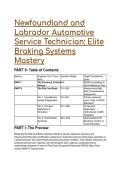
Newfoundland and
Labrador Automotive
Service Technician: Elite
Braking Systems
Mastery
PART 0: Table of Contents
Section Cognitive Tier / Focus Question Range Target Competence
Area Level
PART I The Preview & Critical N/A RSOS Foundations &
Axioms Quick-Reference Data
PART II The Elite Test Bank Q1–Q30 Interprovincial Red
Seal Comprehensive
Assessment
Tier 1: Foundational Q1–Q10 Primary Hydraulic
Syntax & Application Laws, Tools, & RSOS
Standards
Tier 2: Complex Q11–Q20 Component
Application & Diagnostics,
Simulation Hydro-Boost, & ABS
Integration
Tier 3: Grandmaster Q21–Q30 Multi-Variable NVH,
Synthesis Electronic Control, &
Code Resolution
PART I: The Preview
Mastering this Elite Test Bank translates directly to top-tier diagnostic precision and
Interprovincial Red Seal certification readiness for Automotive Service Technicians operating at
a global standard. By systematically deconstructing these complex, multi-variable scenarios, the
professional technician replaces rote memorization with a rigorous, analytically driven
methodology designed to meet the Red Seal Occupational Standard (RSOS) Major Work
Activity (MWA) F requirements.
,Critical Axioms Cheat Sheet
● RSOS Diagnostic Sequencing (Task F-18): Diagnosis must always precede repair.
Establish a baseline by verifying the customer concern, performing a comprehensive
visual inspection, and pulling all chassis/ABS diagnostic trouble codes (DTCs) before
altering any mechanical variables.
● Hydro-Boost Accumulator Depletion: Before opening any hydraulic lines on a
hydro-boost system, the accumulator pressure must be depleted. With the engine off, the
brake pedal must be pumped 4 to 5 times until the pedal becomes completely hard and
pushes back against the foot.
● Rotor Runout Limits: Lateral rotor runout must be measured using a rigid-mounted dial
indicator with the rotor firmly secured by conical washers or reversed lug nuts. Excessive
runout directly causes brake pedal pulsation and thermal judder.
● Flare Syntax: A metric ISO Bubble Flare and an SAE Double Flare are structurally and
dynamically incompatible. Intermixing these profiles on a brake hydraulic circuit will
guarantee catastrophic high-pressure fluid failure.
● Square-Cut Seal Dynamics: In a disc brake caliper, the square-cut piston seal is the sole
component responsible for retracting the piston when hydraulic pressure is released. If
this seal hardens or is contaminated, the pad will drag heavily.
PART II: THE ELITE TEST BANK
Tier 1: Foundational Syntax & Application
Q1: An Automotive Service Technician in a busy repair facility is preparing to overhaul a
severely scored disc brake rotor on a bench lathe. The vehicle has suffered from extreme pad
degradation due to aggressive usage. To prevent severe noise, vibration, and harshness (NVH)
issues post-installation, the final pass on the lathe must achieve a highly specific surface finish.
Based on standard machining principles and RSOS tolerances, which finishing specification is
the MOST ACCURATE? A) 150 to 200 micro-inches measured laterally across the braking
surface to ensure aggressive pad bite B) 15 to 30 micro-inches circumferentially, achieved via a
slow, continuous final feed rate C) 0.030 inches of maximum material removal using a negative
rake carbide insert for the final polish D) 500 microns absolute to ensure rapid pad bed-in during
the initial road test
● The Answer: B (15 to 30 micro-inches circumferentially, achieved via a slow, continuous
final feed rate)
● Distractor Analysis:
○ A is incorrect: A 150-200 micro-inch finish is far too rough, resembling a
phonograph record, which will cause immediate, severe pad squeal and rapid
friction material destruction upon delivery.
○ C is incorrect: While 0.030 inches might be a typical maximum cut depth for certain
heavily damaged drums or primary rotor cuts , it describes depth of cut, not the
required micro-finish surface syntax for a rotor.
○ D is incorrect: Microns are a unit of metric measurement, not standard surface
finish micro-inches, and 500 microns is an excessively coarse profile that would ruin
the braking dynamic.
The Mentor's Analysis: Rotational friction demands an incredibly smooth, non-directional
, surface to prevent acoustic resonance. When machining a rotor, the immediate priority is
achieving a mirror-like structural profile. By utilizing a slow, continuous feed rate to achieve a 15
to 30 micro-inch finish, the technician bypasses the common trap of inducing severe brake
squeal upon delivery. Professional/Academic Intuition: A fast cut ruins the rotor; a slow cut
seats the pad. Always finish slow to achieve the required micro-inch specification.
Q2: During a routine provincial safety inspection, a technician must measure a rear brake drum
to ensure it has not exceeded its maximum discard diameter. Which precision measuring
instrument is the MOST APPROPRIATE to determine the accurate internal geometry and detect
out-of-round conditions within the drum? A) A standard flexible steel tape measure calibrated in
millimeters B) An outside micrometer utilizing an extended anvil for reach C) A specialized brake
drum micrometer gauge taking measurements at 90-degree intervals D) A dial indicator
mounted directly to the vehicle's rear steering knuckle
● The Answer: C (A specialized brake drum micrometer gauge taking measurements at
90-degree intervals)
● Distractor Analysis:
○ A is incorrect: A tape measure lacks the microscopic precision required for
automotive safety tolerances and cannot reliably detect the slight out-of-round
conditions that cause severe vibrations.
○ B is incorrect: An outside micrometer measures external diameters (like an engine
piston or bearing journal), not internal bores like a brake drum friction surface.
○ D is incorrect: A dial indicator measures lateral runout and end-play, not the
absolute internal diameter of a cylinder.
The Mentor's Analysis: Brake drums distort into oval shapes under extreme thermal stress
and mechanical load. When evaluating drum integrity, the immediate priority is verifying both
absolute diameter and geometric concentricity. By utilizing a drum micrometer and measuring
across multiple axes, the technician bypasses the common trap of approving an out-of-round
drum that will cause low-speed pedal pulsation. Professional/Academic Intuition: Measure
the drum in an "X" pattern; if the measurements differ, the drum is out-of-round and must be
machined or discarded.
Q3: An apprentice is fabricating a replacement steel hydraulic brake line for a late-model
domestic vehicle utilizing metric fittings. The RSOS curriculum strictly dictates the proper use of
flaring types to maintain system integrity. Which action is strictly prohibited when assembling
this high-pressure hydraulic circuit? A) Utilizing copper-nickel alloy tubing to prevent winter salt
corrosion B) Utilizing an ISO bubble flare on a circuit designed for an SAE double flare C)
Utilizing a specialized flaring bar and yoke to cold-form the tube end D) Utilizing a tubing cutter
with a reaming blade to remove internal burrs
● The Answer: B (Utilizing an ISO bubble flare on a circuit designed for an SAE double
flare)
● Distractor Analysis:
○ A is incorrect: Copper-nickel tubing (NiCopp) is highly recommended and perfectly
legal for brake line fabrication due to its burst strength, flexibility, and extreme
corrosion resistance.
○ C is incorrect: A flaring bar and yoke are the exact mandated tools required to
create the precise angles of the flare.
○ D is incorrect: Reaming the internal burr is a mandatory step; failing to do so
restricts fluid flow and causes the flare to crack during the compression stage.
The Mentor's Analysis: Hydraulic sealing relies entirely on the precise physical mating of the
flare angle and the internal seat of the fitting. When replacing brake lines, the immediate priority
Labrador Automotive
Service Technician: Elite
Braking Systems
Mastery
PART 0: Table of Contents
Section Cognitive Tier / Focus Question Range Target Competence
Area Level
PART I The Preview & Critical N/A RSOS Foundations &
Axioms Quick-Reference Data
PART II The Elite Test Bank Q1–Q30 Interprovincial Red
Seal Comprehensive
Assessment
Tier 1: Foundational Q1–Q10 Primary Hydraulic
Syntax & Application Laws, Tools, & RSOS
Standards
Tier 2: Complex Q11–Q20 Component
Application & Diagnostics,
Simulation Hydro-Boost, & ABS
Integration
Tier 3: Grandmaster Q21–Q30 Multi-Variable NVH,
Synthesis Electronic Control, &
Code Resolution
PART I: The Preview
Mastering this Elite Test Bank translates directly to top-tier diagnostic precision and
Interprovincial Red Seal certification readiness for Automotive Service Technicians operating at
a global standard. By systematically deconstructing these complex, multi-variable scenarios, the
professional technician replaces rote memorization with a rigorous, analytically driven
methodology designed to meet the Red Seal Occupational Standard (RSOS) Major Work
Activity (MWA) F requirements.
,Critical Axioms Cheat Sheet
● RSOS Diagnostic Sequencing (Task F-18): Diagnosis must always precede repair.
Establish a baseline by verifying the customer concern, performing a comprehensive
visual inspection, and pulling all chassis/ABS diagnostic trouble codes (DTCs) before
altering any mechanical variables.
● Hydro-Boost Accumulator Depletion: Before opening any hydraulic lines on a
hydro-boost system, the accumulator pressure must be depleted. With the engine off, the
brake pedal must be pumped 4 to 5 times until the pedal becomes completely hard and
pushes back against the foot.
● Rotor Runout Limits: Lateral rotor runout must be measured using a rigid-mounted dial
indicator with the rotor firmly secured by conical washers or reversed lug nuts. Excessive
runout directly causes brake pedal pulsation and thermal judder.
● Flare Syntax: A metric ISO Bubble Flare and an SAE Double Flare are structurally and
dynamically incompatible. Intermixing these profiles on a brake hydraulic circuit will
guarantee catastrophic high-pressure fluid failure.
● Square-Cut Seal Dynamics: In a disc brake caliper, the square-cut piston seal is the sole
component responsible for retracting the piston when hydraulic pressure is released. If
this seal hardens or is contaminated, the pad will drag heavily.
PART II: THE ELITE TEST BANK
Tier 1: Foundational Syntax & Application
Q1: An Automotive Service Technician in a busy repair facility is preparing to overhaul a
severely scored disc brake rotor on a bench lathe. The vehicle has suffered from extreme pad
degradation due to aggressive usage. To prevent severe noise, vibration, and harshness (NVH)
issues post-installation, the final pass on the lathe must achieve a highly specific surface finish.
Based on standard machining principles and RSOS tolerances, which finishing specification is
the MOST ACCURATE? A) 150 to 200 micro-inches measured laterally across the braking
surface to ensure aggressive pad bite B) 15 to 30 micro-inches circumferentially, achieved via a
slow, continuous final feed rate C) 0.030 inches of maximum material removal using a negative
rake carbide insert for the final polish D) 500 microns absolute to ensure rapid pad bed-in during
the initial road test
● The Answer: B (15 to 30 micro-inches circumferentially, achieved via a slow, continuous
final feed rate)
● Distractor Analysis:
○ A is incorrect: A 150-200 micro-inch finish is far too rough, resembling a
phonograph record, which will cause immediate, severe pad squeal and rapid
friction material destruction upon delivery.
○ C is incorrect: While 0.030 inches might be a typical maximum cut depth for certain
heavily damaged drums or primary rotor cuts , it describes depth of cut, not the
required micro-finish surface syntax for a rotor.
○ D is incorrect: Microns are a unit of metric measurement, not standard surface
finish micro-inches, and 500 microns is an excessively coarse profile that would ruin
the braking dynamic.
The Mentor's Analysis: Rotational friction demands an incredibly smooth, non-directional
, surface to prevent acoustic resonance. When machining a rotor, the immediate priority is
achieving a mirror-like structural profile. By utilizing a slow, continuous feed rate to achieve a 15
to 30 micro-inch finish, the technician bypasses the common trap of inducing severe brake
squeal upon delivery. Professional/Academic Intuition: A fast cut ruins the rotor; a slow cut
seats the pad. Always finish slow to achieve the required micro-inch specification.
Q2: During a routine provincial safety inspection, a technician must measure a rear brake drum
to ensure it has not exceeded its maximum discard diameter. Which precision measuring
instrument is the MOST APPROPRIATE to determine the accurate internal geometry and detect
out-of-round conditions within the drum? A) A standard flexible steel tape measure calibrated in
millimeters B) An outside micrometer utilizing an extended anvil for reach C) A specialized brake
drum micrometer gauge taking measurements at 90-degree intervals D) A dial indicator
mounted directly to the vehicle's rear steering knuckle
● The Answer: C (A specialized brake drum micrometer gauge taking measurements at
90-degree intervals)
● Distractor Analysis:
○ A is incorrect: A tape measure lacks the microscopic precision required for
automotive safety tolerances and cannot reliably detect the slight out-of-round
conditions that cause severe vibrations.
○ B is incorrect: An outside micrometer measures external diameters (like an engine
piston or bearing journal), not internal bores like a brake drum friction surface.
○ D is incorrect: A dial indicator measures lateral runout and end-play, not the
absolute internal diameter of a cylinder.
The Mentor's Analysis: Brake drums distort into oval shapes under extreme thermal stress
and mechanical load. When evaluating drum integrity, the immediate priority is verifying both
absolute diameter and geometric concentricity. By utilizing a drum micrometer and measuring
across multiple axes, the technician bypasses the common trap of approving an out-of-round
drum that will cause low-speed pedal pulsation. Professional/Academic Intuition: Measure
the drum in an "X" pattern; if the measurements differ, the drum is out-of-round and must be
machined or discarded.
Q3: An apprentice is fabricating a replacement steel hydraulic brake line for a late-model
domestic vehicle utilizing metric fittings. The RSOS curriculum strictly dictates the proper use of
flaring types to maintain system integrity. Which action is strictly prohibited when assembling
this high-pressure hydraulic circuit? A) Utilizing copper-nickel alloy tubing to prevent winter salt
corrosion B) Utilizing an ISO bubble flare on a circuit designed for an SAE double flare C)
Utilizing a specialized flaring bar and yoke to cold-form the tube end D) Utilizing a tubing cutter
with a reaming blade to remove internal burrs
● The Answer: B (Utilizing an ISO bubble flare on a circuit designed for an SAE double
flare)
● Distractor Analysis:
○ A is incorrect: Copper-nickel tubing (NiCopp) is highly recommended and perfectly
legal for brake line fabrication due to its burst strength, flexibility, and extreme
corrosion resistance.
○ C is incorrect: A flaring bar and yoke are the exact mandated tools required to
create the precise angles of the flare.
○ D is incorrect: Reaming the internal burr is a mandatory step; failing to do so
restricts fluid flow and causes the flare to crack during the compression stage.
The Mentor's Analysis: Hydraulic sealing relies entirely on the precise physical mating of the
flare angle and the internal seat of the fitting. When replacing brake lines, the immediate priority


