

Elite Universal Test Bank: Quebec CPA
Automotive Mechanic (Brakes) Mastery
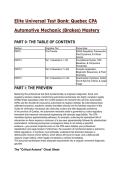
PART 0: THE TABLE OF CONTENTS
Section Cognitive Tier Focus Area
PART I The Preview SAAQ Regulatory Frameworks,
Fluid Dynamics, & Critical
Axioms
PART II Tier 1 (Questions 1–10) Foundational Syntax, CPA
Baselines, & Component
Thresholds
PART II Tier 2 (Questions 11–20) Complex Application,
Diagnostic Sequences, & Fluid
Chemistry
PART II Tier 3 (Questions 21–30) Grandmaster Synthesis, SAAQ
Out-of-Service Criteria, & Legal
Triage
PART I: THE PREVIEW
Mastering this professional test bank fundamentally re-engineers diagnostic, fiscal, and
regulatory decision-making, transforming automotive technicians into highly compliant, legally
fortified brake specialists under the Comité paritaire de l'industrie des services automobiles
(CPA) and the Société de l'assurance automobile du Québec (SAAQ). By internalizing these
calibrated scenarios, academic mastery translates directly into the flawless execution of the
Guide de vérification mécanique des véhicules routiers and elite diagnostic proficiency.
In the province of Quebec, the automotive mechanic trade is governed by a strict regulatory
framework that intersects mechanical engineering with absolute legal liability. The CPA
mandates rigorous apprenticeship pathways; for example, achieving the specialized title of
mécanicien en freins requires a minimum of a two-year apprenticeship followed by standardized
examinations. Achieving journeyman (compagnon) status is not merely a pass/fail
endeavor—your precise empirical score on the CPA exam dictates your professional
classification and wage bracket. Furthermore, the execution of mechanical duties is policed by
SAAQ regulations. A mechanic must intimately understand the distinction between a
défectuosité mineure (minor defect), which allows 48 hours for repair, and a défectuosité
majeure (major defect), which legally immobilizes a vehicle immediately.
This document synthesizes these disparate requirements into a singular, immersive diagnostic
gauntlet.
The "Critical Axioms" Cheat Sheet
,Axiom 1: The SAAQ Defect Doctrine A défectuosité majeure immediately prohibits the vehicle
from circulating; it presents an imminent danger to public safety. A défectuosité mineure
mandates repair within precisely 48 hours of declaration. Failure to comply shifts legal and
financial liability entirely onto the mechanic, the mandated inspection facility, and the vehicle
operator.
Axiom 2: The SAAQ Brake Thickness Hard Deck Brake friction material limits are absolute
legal thresholds, not preventative guidelines. Measurements must always be taken at the
thinnest point of the material, excluding any chamfered edges.
Vehicle/Axle Type Material Type Minimum Legal Thickness
Light Vehicle (Promenade) Bonded (Collée) 1.6 mm (1/16 in)
Heavy Vehicle - Steering Axle Riveted (Rivetée) 4.8 mm (3/16 in) or 1 mm
above rivets
Heavy Vehicle - Non-Steering Riveted (Rivetée) 8.0 mm (5/16 in) or 1 mm
Axle above rivets
Axiom 3: The CPA
Certification Matrix
The Comité paritaire issues
competency cards based on
strict scoring tiers from the
qualification exams. For
specialized mechanical trades,
your percentage directly maps
to your class rank.
CPA Exam Score Range Journeyman Certification Classification
80.0% to 100% Class "A" Journeyman (Compagnon A)
70.0% to 79.9% Class "B" Journeyman (Compagnon B)
60.0% to 69.9% Class "C" Journeyman (Compagnon C)
Axiom 4: Fluid Chemistry and Boiling Point Degradation Brake fluid operates in an extreme
thermal environment. Glycol-based fluids are highly hygroscopic, absorbing water directly from
the atmosphere, which critically lowers the boiling point. Silicone-based fluids are
non-hygroscopic but fundamentally incompatible with glycol systems.
Fluid Designation Chemical Base Min. Dry Boiling Point Min. Wet Boiling Point
(3.7% H2O)
DOT 3 Polyethylene Glycol 205 °C 140 °C
DOT 4 Polyethylene Glycol / 230 °C 155 °C
Borate Esters
DOT 5.1 Polyethylene Glycol / 260 °C 180 °C
Borate Esters
DOT 5 Silicone (Purple Dye) 260 °C 180 °C (Non-miscible)
Axiom 5: Pneumatic Air Loss Parameters During mandatory SAAQ inspections and daily
rondes de sécurité, air leaks are evaluated under service brake application. The maximum
allowable pressure drop dictates the defect severity.
Vehicle Configuration Minor Defect Threshold Major Defect Threshold
Single Unit > 20 kPa (3 psi) / minute > 40 kPa (6 psi) / minute
, Vehicle Configuration Minor Defect Threshold Major Defect Threshold
Two Units (e.g., Tractor-Trailer) > 28 kPa (4 psi) / minute > 48 kPa (7 psi) / minute
Three Units > 35 kPa (5 psi) / minute > 62 kPa (9 psi) / minute
PART II: THE ELITE TEST BANK
TIER 1: Foundational Syntax & Application (Questions 1–10)
This cognitive tier bridges fundamental mechanical definitions, core hydraulic/pneumatic
principles, and strict SAAQ regulatory baselines. At the journeyman level, a brake mechanic
must instinctively recognize the exact parameters that differentiate a legally compliant vehicle
from a grounded one. The Guide de vérification mécanique leaves no room for interpretation;
measurements must be surgically precise, and material classifications must be absolute.
Q1: A technician is inspecting the front disc brakes of a 2019 light passenger vehicle (véhicule
de promenade). The brake pads feature bonded friction material (garniture collée). According to
the SAAQ Guide de vérification mécanique, which measurement represents the absolute
minimum allowable pad thickness before the component is deemed legally non-compliant? A)
1.0 mm (1/32 in) measured at the chamfered edge to account for taper wear. B) 2.0 mm (5/64
in) measured at the thickest point of the pad to ensure preventative safety. C) 1.6 mm (1/16 in)
measured at the thinnest point, strictly excluding the chamfer. D) 4.8 mm (3/16 in) measured at
the center of the friction material surface.
● The Answer: C (1.6 mm (1/16 in) measured at the thinnest point, strictly excluding the
chamfer.)
● Distractor Analysis:
○ A is incorrect: 1.0 mm is the clearance tolerance for a rivet head on a riveted lining ,
not the base thickness limit for a bonded lining. Furthermore, SAAQ explicitly
demands measurements exclude the chamfer.
○ B is incorrect: 2.0 mm is often an OEM or dealership suggested replacement point
for preventative maintenance, but it is not the SAAQ minimum legal threshold.
○ D is incorrect: 4.8 mm (3/16 in) is the minimum legal thickness for a riveted lining
situated on the steering axle of a heavy vehicle , not a light passenger vehicle with
bonded linings.
The Mentor's Analysis: Regulatory thresholds do not adapt to dealership maintenance
packages; they are absolute legal limits protecting the public. When inspecting bonded brake
pads on a light vehicle, the immediate priority is locating the most compromised friction point. By
utilizing the 1.6 mm minimum rule , you bypass the common trap of prematurely failing a vehicle
based on subjective wear opinions rather than codified SAAQ law. Professional/Academic
Intuition: The legal limit for bonded linings is uniformly 1.6 mm (1/16 in) at the thinnest
non-chamfered point; anything above this legally passes a SAAQ inspection.
Q2: An apprentice mechanic has completed the required two years of specialized training and
sits for the mécanique automobile qualification exam administered by the CPA of Montreal. To
be classified specifically as a Class "B" Journeyman (Compagnon B), which exact grading
threshold must the candidate achieve? A) Between 60.0% and 69.9% B) Between 70.0% and
79.9% C) Between 71.5% and 74.9% D) Between 80.0% and 100%
● The Answer: B (Between 70.0% and 79.9%)
● Distractor Analysis:
○ A is incorrect: Achieving a score between 60.0% and 69.9% grants the candidate a
Class "C" certification , the entry-level journeyman tier.
Automotive Mechanic (Brakes) Mastery
PART 0: THE TABLE OF CONTENTS
Section Cognitive Tier Focus Area
PART I The Preview SAAQ Regulatory Frameworks,
Fluid Dynamics, & Critical
Axioms
PART II Tier 1 (Questions 1–10) Foundational Syntax, CPA
Baselines, & Component
Thresholds
PART II Tier 2 (Questions 11–20) Complex Application,
Diagnostic Sequences, & Fluid
Chemistry
PART II Tier 3 (Questions 21–30) Grandmaster Synthesis, SAAQ
Out-of-Service Criteria, & Legal
Triage
PART I: THE PREVIEW
Mastering this professional test bank fundamentally re-engineers diagnostic, fiscal, and
regulatory decision-making, transforming automotive technicians into highly compliant, legally
fortified brake specialists under the Comité paritaire de l'industrie des services automobiles
(CPA) and the Société de l'assurance automobile du Québec (SAAQ). By internalizing these
calibrated scenarios, academic mastery translates directly into the flawless execution of the
Guide de vérification mécanique des véhicules routiers and elite diagnostic proficiency.
In the province of Quebec, the automotive mechanic trade is governed by a strict regulatory
framework that intersects mechanical engineering with absolute legal liability. The CPA
mandates rigorous apprenticeship pathways; for example, achieving the specialized title of
mécanicien en freins requires a minimum of a two-year apprenticeship followed by standardized
examinations. Achieving journeyman (compagnon) status is not merely a pass/fail
endeavor—your precise empirical score on the CPA exam dictates your professional
classification and wage bracket. Furthermore, the execution of mechanical duties is policed by
SAAQ regulations. A mechanic must intimately understand the distinction between a
défectuosité mineure (minor defect), which allows 48 hours for repair, and a défectuosité
majeure (major defect), which legally immobilizes a vehicle immediately.
This document synthesizes these disparate requirements into a singular, immersive diagnostic
gauntlet.
The "Critical Axioms" Cheat Sheet
,Axiom 1: The SAAQ Defect Doctrine A défectuosité majeure immediately prohibits the vehicle
from circulating; it presents an imminent danger to public safety. A défectuosité mineure
mandates repair within precisely 48 hours of declaration. Failure to comply shifts legal and
financial liability entirely onto the mechanic, the mandated inspection facility, and the vehicle
operator.
Axiom 2: The SAAQ Brake Thickness Hard Deck Brake friction material limits are absolute
legal thresholds, not preventative guidelines. Measurements must always be taken at the
thinnest point of the material, excluding any chamfered edges.
Vehicle/Axle Type Material Type Minimum Legal Thickness
Light Vehicle (Promenade) Bonded (Collée) 1.6 mm (1/16 in)
Heavy Vehicle - Steering Axle Riveted (Rivetée) 4.8 mm (3/16 in) or 1 mm
above rivets
Heavy Vehicle - Non-Steering Riveted (Rivetée) 8.0 mm (5/16 in) or 1 mm
Axle above rivets
Axiom 3: The CPA
Certification Matrix
The Comité paritaire issues
competency cards based on
strict scoring tiers from the
qualification exams. For
specialized mechanical trades,
your percentage directly maps
to your class rank.
CPA Exam Score Range Journeyman Certification Classification
80.0% to 100% Class "A" Journeyman (Compagnon A)
70.0% to 79.9% Class "B" Journeyman (Compagnon B)
60.0% to 69.9% Class "C" Journeyman (Compagnon C)
Axiom 4: Fluid Chemistry and Boiling Point Degradation Brake fluid operates in an extreme
thermal environment. Glycol-based fluids are highly hygroscopic, absorbing water directly from
the atmosphere, which critically lowers the boiling point. Silicone-based fluids are
non-hygroscopic but fundamentally incompatible with glycol systems.
Fluid Designation Chemical Base Min. Dry Boiling Point Min. Wet Boiling Point
(3.7% H2O)
DOT 3 Polyethylene Glycol 205 °C 140 °C
DOT 4 Polyethylene Glycol / 230 °C 155 °C
Borate Esters
DOT 5.1 Polyethylene Glycol / 260 °C 180 °C
Borate Esters
DOT 5 Silicone (Purple Dye) 260 °C 180 °C (Non-miscible)
Axiom 5: Pneumatic Air Loss Parameters During mandatory SAAQ inspections and daily
rondes de sécurité, air leaks are evaluated under service brake application. The maximum
allowable pressure drop dictates the defect severity.
Vehicle Configuration Minor Defect Threshold Major Defect Threshold
Single Unit > 20 kPa (3 psi) / minute > 40 kPa (6 psi) / minute
, Vehicle Configuration Minor Defect Threshold Major Defect Threshold
Two Units (e.g., Tractor-Trailer) > 28 kPa (4 psi) / minute > 48 kPa (7 psi) / minute
Three Units > 35 kPa (5 psi) / minute > 62 kPa (9 psi) / minute
PART II: THE ELITE TEST BANK
TIER 1: Foundational Syntax & Application (Questions 1–10)
This cognitive tier bridges fundamental mechanical definitions, core hydraulic/pneumatic
principles, and strict SAAQ regulatory baselines. At the journeyman level, a brake mechanic
must instinctively recognize the exact parameters that differentiate a legally compliant vehicle
from a grounded one. The Guide de vérification mécanique leaves no room for interpretation;
measurements must be surgically precise, and material classifications must be absolute.
Q1: A technician is inspecting the front disc brakes of a 2019 light passenger vehicle (véhicule
de promenade). The brake pads feature bonded friction material (garniture collée). According to
the SAAQ Guide de vérification mécanique, which measurement represents the absolute
minimum allowable pad thickness before the component is deemed legally non-compliant? A)
1.0 mm (1/32 in) measured at the chamfered edge to account for taper wear. B) 2.0 mm (5/64
in) measured at the thickest point of the pad to ensure preventative safety. C) 1.6 mm (1/16 in)
measured at the thinnest point, strictly excluding the chamfer. D) 4.8 mm (3/16 in) measured at
the center of the friction material surface.
● The Answer: C (1.6 mm (1/16 in) measured at the thinnest point, strictly excluding the
chamfer.)
● Distractor Analysis:
○ A is incorrect: 1.0 mm is the clearance tolerance for a rivet head on a riveted lining ,
not the base thickness limit for a bonded lining. Furthermore, SAAQ explicitly
demands measurements exclude the chamfer.
○ B is incorrect: 2.0 mm is often an OEM or dealership suggested replacement point
for preventative maintenance, but it is not the SAAQ minimum legal threshold.
○ D is incorrect: 4.8 mm (3/16 in) is the minimum legal thickness for a riveted lining
situated on the steering axle of a heavy vehicle , not a light passenger vehicle with
bonded linings.
The Mentor's Analysis: Regulatory thresholds do not adapt to dealership maintenance
packages; they are absolute legal limits protecting the public. When inspecting bonded brake
pads on a light vehicle, the immediate priority is locating the most compromised friction point. By
utilizing the 1.6 mm minimum rule , you bypass the common trap of prematurely failing a vehicle
based on subjective wear opinions rather than codified SAAQ law. Professional/Academic
Intuition: The legal limit for bonded linings is uniformly 1.6 mm (1/16 in) at the thinnest
non-chamfered point; anything above this legally passes a SAAQ inspection.
Q2: An apprentice mechanic has completed the required two years of specialized training and
sits for the mécanique automobile qualification exam administered by the CPA of Montreal. To
be classified specifically as a Class "B" Journeyman (Compagnon B), which exact grading
threshold must the candidate achieve? A) Between 60.0% and 69.9% B) Between 70.0% and
79.9% C) Between 71.5% and 74.9% D) Between 80.0% and 100%
● The Answer: B (Between 70.0% and 79.9%)
● Distractor Analysis:
○ A is incorrect: Achieving a score between 60.0% and 69.9% grants the candidate a
Class "C" certification , the entry-level journeyman tier.


