

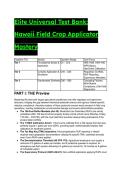
Elite Universal Test Bank:
Hawaii Field Crop Applicator
Mastery
Cognitive Tier Section Question Range Core Focus
Tier 1 Foundational Syntax & Q1 – Q15 HRS 149A, HAR 4-66,
Application WPS Basics,
Hard-Deck Calibration
Tier 2 Complex Application & Q16 – Q35 Regulatory Conflicts,
Simulation RUP Reporting,
Supervisory Mandates
Tier 3 Grandmaster Synthesis Q36 – Q60 Cascading Failures,
Multi-Statute
Compliance, Elite Field
Diagnostics
PART I: THE Preview
Mastering this test bank forges agricultural practitioners into elite regulatory and agronomic
tacticians, bridging the gap between theoretical pesticide science and rigorous Hawaii-specific
statutory compliance. Absolute mastery of these protocols ensures exact precision in field crop
operations, averting catastrophic environmental damage and severe administrative penalties.
● The 100-Foot Buffer Mandate (Act 45): Restricted Use Pesticides (RUPs) are strictly
prohibited within 100 feet of school property during normal school hours (Monday–Friday,
7:00 AM – 4:00 PM), with the most restrictive provision always taking precedence if the
product label conflicts.
● The 1/128th Calibration Axiom: 1 fluid ounce collected from a 340 square foot test area
perfectly equals 1 gallon per acre (GPA), providing rapid, mathematically flawless field
calibration for handheld systems.
● The Tax Map Key (TMK) Imperative: All post-application RUP reporting in Hawaii
requires exact geographic documentation utilizing the specific TMK, submitted annually
even if zero RUPs were applied.
● The Decontamination Threshold (40 CFR 170): Agricultural employers must supply a
minimum of 3 gallons of water per handler, and if protective eyewear is required, an
emergency eye-flush system delivering 0.4 gallons per minute for 15 minutes (or 6 gallons
of immediate water).
● The Supervisory Protocol (HAR 4-66-61): Non-certified applicators applying RUPs must
, be at least 18 years old, operate under direct supervision, and possess use-specific
written instructions provided by the certified applicator.
PART II: THE ELITE TEST BANK
Q1: A certified commercial applicator operating in Hawaii is preparing to apply a federally
registered pesticide that the Environmental Protection Agency (EPA) classifies as "General
Use." However, the Hawaii Department of Agriculture (HDOA) has independently designated
this specific active ingredient for restricted use within the state. Which regulatory framework
MOST ACCURATELY dictates the applicator's legal requirements? A) The applicator may apply
the product without a certified restricted-use license, as FIFRA supersedes state-level
classification on federally registered products. B) The applicator must possess a valid
commercial Category 1A certification and document the application as a Restricted Use
Pesticide (RUP) strictly in accordance with HAR 4-66. C) The applicator must apply for a
Section 18 Emergency Exemption before utilizing the product on field crops. D) The applicator is
only required to follow the EPA label, provided the state has not issued a Section 24(c) Special
Local Need label.
● The Answer: B (The applicator must possess a valid commercial Category 1A
certification and document the application as a Restricted Use Pesticide (RUP) strictly in
accordance with HAR 4-66.)
● Distractor Analysis:
○ A is incorrect: Under HRS 149A and HAR 4-66, the HDOA possesses statutory
authority to classify general-use federally registered products as State Restricted
Use pesticides.
○ C is incorrect: A Section 18 Exemption applies to unregistered uses during an
emergency, not to the routine application of a state-designated RUP.
○ D is incorrect: State law can enforce stricter regulations than federal law. Ignoring
state-specific restricted classifications is a direct violation of Hawaii Pesticides Law.
The Mentor's Analysis: Federal law provides the baseline; state law defines the ceiling. When
operating in Hawaii, the practitioner must cross-reference all active ingredients against the
HDOA State Restricted Use list. By utilizing State-Level Statutory Precedence, the practitioner
bypasses the catastrophic error of assuming EPA general-use classifications grant universal
application rights. Professional/Academic Intuition: The strictest sovereign regulation dictates
the application standard.
Q2: Under the Worker Protection Standard (WPS) mandated by 40 CFR 170, an agricultural
employer is establishing a decontamination site for three pesticide handlers mixing an
organophosphate. The product label mandates the use of protective eyewear. What is the
ABSOLUTE MINIMUM water supply requirement the employer must establish at the mixing
site? A) 1 gallon of water per handler, plus 1 pint of immediate eye-flush water per handler. B) 3
gallons of water per handler, plus a centralized eye-flush station capable of delivering 0.4
gallons per minute for 15 minutes. C) 9 gallons of total water, utilized for both routine washing
and emergency eye flushing combined. D) 10 gallons of total water for the site, regardless of the
number of handlers present.
● The Answer: B (3 gallons of water per handler, plus a centralized eye-flush station
capable of delivering 0.4 gallons per minute for 15 minutes.)
● Distractor Analysis:
○ A is incorrect: 1 gallon per worker applies to general field workers, not handlers.
, Handlers require 3 gallons each.
○ C is incorrect: The eye-flush requirement is distinct and mathematically additive.
Commingling routine wash water with emergency eye-flush water violates the
immediately available safety threshold.
○ D is incorrect: The 10-gallon metric is an outdated calculation or a misapplication of
early-entry worker rules, failing to account for the mandatory 3 gallons per handler
plus the 6-gallon (or 0.4 GPM) eye-flush mandate.
The Mentor's Analysis: Decontamination logistics separate administrative compliance from
biological survival. When protective eyewear is labeled, the immediate priority is segregating
routine wash water from emergency ocular flush systems. By utilizing Distinct Flow-Rate
Metrics, the practitioner bypasses the novice error of under-supplying critical emergency
infrastructure. Professional/Academic Intuition: Handlers demand 3 gallons for the body; the
label demands 0.4 GPM for the eyes.
Q3: A Hawaii field crop applicator is utilizing the 1/128th method to calibrate a handheld spray
gun. The applicator marks out a test area of exactly 340 square feet. Maintaining constant
pressure and walking speed, the applicator collects the water discharged over the test area and
measures 45 fluid ounces. Based on this methodology, what is the calibrated output? A) 45
gallons per acre (GPA) B) 90 gallons per acre (GPA) C) 4.5 gallons per minute (GPM) D) 0.35
gallons per acre (GPA)
● The Answer: A (45 gallons per acre (GPA))
● Distractor Analysis:
○ B is incorrect: Doubling the fluid ounces is an analytical error associated with
halving the test plot size (170 sq ft), which did not occur here.
○ C is incorrect: The 1/128th method calculates volume per area (GPA), not volume
per time (GPM).
○ D is incorrect: Dividing 45 by 128 is a fundamental misunderstanding of the 1/128th
mathematical ratio.
The Mentor's Analysis: Calibration translates mechanical output into agronomic efficacy.
Because there are 128 fluid ounces in a gallon and 340 square feet is 1/128th of an acre, the
ratio is a perfect 1:1. By utilizing the 1/128th Direct Conversion Principle, the practitioner
bypasses complex algebra and eliminates field calibration errors. Professional/Academic
Intuition: In a 340 square foot plot, fluid ounces collected perfectly equal gallons per acre.
Q4: A commercial applicator intends to apply a Restricted Use Pesticide (RUP) to a macadamia
nut orchard bordering a public middle school. The application is scheduled for 10:00 AM on a
Tuesday. The pesticide label establishes a 50-foot buffer zone from sensitive areas. According
to Hawaii Act 45 (HRS 149A-28), which action is MOST APPROPRIATE? A) The applicator
must adhere to the 50-foot buffer zone, as federal FIFRA label laws supersede state buffer
regulations. B) The applicator must halt the application entirely, as RUPs can only be applied on
weekends in Hawaii. C) The applicator must establish a 100-foot buffer zone from the school
property line, as it falls within normal school hours. D) The applicator may proceed up to the
property line if utilizing drift-reduction nozzles and maintaining a wind speed below 10 mph.
● The Answer: C (The applicator must establish a 100-foot buffer zone from the school
property line, as it falls within normal school hours.)
● Distractor Analysis:
○ A is incorrect: Act 45 explicitly states that if the state law conflicts with the label, the
more restrictive provision applies. The 100-foot state mandate overrides the 50-foot
label mandate.
○ B is incorrect: RUPs can be applied during the week, provided the statutory
, 100-foot buffer zone is strictly maintained around the school.
○ D is incorrect: Drift-reduction technology does not legally negate statutory
geographic buffer zones under any circumstances.
The Mentor's Analysis: Statutory buffer zones are absolute geographic barriers, devoid of
meteorological nuance. When encountering conflicting federal and state boundaries, the
immediate priority is identifying the most restrictive metric. By utilizing the Maximum Restriction
Doctrine, the practitioner bypasses the critical error of violating Hawaii's stringent school
protection laws. Professional/Academic Intuition: The most restrictive buffer—whether state
or federal—always owns the boundary line.
Q5: An agricultural employer holds a Private Category 1 certification in Hawaii. They assign an
uncertified, 19-year-old farmhand to apply a Restricted Use Pesticide (RUP). The certified
applicator provides verbal instructions, physical supervision from the edge of the field, and full
Personal Protective Equipment (PPE). Has the certified applicator achieved full compliance with
HAR 4-66-61? A) Yes, because physical supervision and proper PPE satisfy all federal and
state mandates for non-certified applicators. B) Yes, provided the uncertified applicator has
completed standard Worker Protection Standard (WPS) handler training. C) No, because
uncertified applicators in Hawaii must be at least 21 years of age to handle RUPs. D) No,
because the certified applicator failed to provide use-specific written instructions to the
non-certified applicator.
● The Answer: D (No, because the certified applicator failed to provide use-specific written
instructions to the non-certified applicator.)
● Distractor Analysis:
○ A is incorrect: Verbal instruction is statutorily insufficient in Hawaii. The law
mandates documented, written guidance.
○ B is incorrect: While WPS handler training is required, it does not exempt the
supervising certified applicator from their duty to provide use-specific written
instructions under HAR 4-66.
○ C is incorrect: The minimum legal age for a non-certified applicator handling an
RUP under supervision is 18, not 21.
The Mentor's Analysis: Supervision in elite agronomy is a documented, legal transfer of
authority. When delegating RUP applications, the immediate priority is establishing a verifiable
paper trail of exact methodologies and hazards. By utilizing the Written Instruction Mandate, the
practitioner bypasses the catastrophic liability of undocumented supervision.
Professional/Academic Intuition: Verbal instructions evaporate; written instructions protect the
license.
Q6: Under the Hawaii Pesticides Law (Chapter 149A), what specific geographic identifier MUST
be included in the annual post-application reporting of all Restricted Use Pesticide (RUP)
applications? A) The GPS coordinates of the mixing and loading site. B) The specific Tax Map
Key (TMK) number of the application site. C) The zip code and watershed designation of the
treated field. D) The exact linear distance to the nearest potable water well.
● The Answer: B (The specific Tax Map Key (TMK) number of the application site.)
● Distractor Analysis:
○ A is incorrect: While GPS may be an internal farm metric, the statute explicitly
demands the TMK for state reporting, not mixing site coordinates.
○ C is incorrect: Zip codes and watersheds lack the granular property definition
required by HDOA reporting standards.
○ D is incorrect: Well setbacks are label requirements for application safety, not
statutory metrics for annual RUP geographic reporting.
Hawaii Field Crop Applicator
Mastery
Cognitive Tier Section Question Range Core Focus
Tier 1 Foundational Syntax & Q1 – Q15 HRS 149A, HAR 4-66,
Application WPS Basics,
Hard-Deck Calibration
Tier 2 Complex Application & Q16 – Q35 Regulatory Conflicts,
Simulation RUP Reporting,
Supervisory Mandates
Tier 3 Grandmaster Synthesis Q36 – Q60 Cascading Failures,
Multi-Statute
Compliance, Elite Field
Diagnostics
PART I: THE Preview
Mastering this test bank forges agricultural practitioners into elite regulatory and agronomic
tacticians, bridging the gap between theoretical pesticide science and rigorous Hawaii-specific
statutory compliance. Absolute mastery of these protocols ensures exact precision in field crop
operations, averting catastrophic environmental damage and severe administrative penalties.
● The 100-Foot Buffer Mandate (Act 45): Restricted Use Pesticides (RUPs) are strictly
prohibited within 100 feet of school property during normal school hours (Monday–Friday,
7:00 AM – 4:00 PM), with the most restrictive provision always taking precedence if the
product label conflicts.
● The 1/128th Calibration Axiom: 1 fluid ounce collected from a 340 square foot test area
perfectly equals 1 gallon per acre (GPA), providing rapid, mathematically flawless field
calibration for handheld systems.
● The Tax Map Key (TMK) Imperative: All post-application RUP reporting in Hawaii
requires exact geographic documentation utilizing the specific TMK, submitted annually
even if zero RUPs were applied.
● The Decontamination Threshold (40 CFR 170): Agricultural employers must supply a
minimum of 3 gallons of water per handler, and if protective eyewear is required, an
emergency eye-flush system delivering 0.4 gallons per minute for 15 minutes (or 6 gallons
of immediate water).
● The Supervisory Protocol (HAR 4-66-61): Non-certified applicators applying RUPs must
, be at least 18 years old, operate under direct supervision, and possess use-specific
written instructions provided by the certified applicator.
PART II: THE ELITE TEST BANK
Q1: A certified commercial applicator operating in Hawaii is preparing to apply a federally
registered pesticide that the Environmental Protection Agency (EPA) classifies as "General
Use." However, the Hawaii Department of Agriculture (HDOA) has independently designated
this specific active ingredient for restricted use within the state. Which regulatory framework
MOST ACCURATELY dictates the applicator's legal requirements? A) The applicator may apply
the product without a certified restricted-use license, as FIFRA supersedes state-level
classification on federally registered products. B) The applicator must possess a valid
commercial Category 1A certification and document the application as a Restricted Use
Pesticide (RUP) strictly in accordance with HAR 4-66. C) The applicator must apply for a
Section 18 Emergency Exemption before utilizing the product on field crops. D) The applicator is
only required to follow the EPA label, provided the state has not issued a Section 24(c) Special
Local Need label.
● The Answer: B (The applicator must possess a valid commercial Category 1A
certification and document the application as a Restricted Use Pesticide (RUP) strictly in
accordance with HAR 4-66.)
● Distractor Analysis:
○ A is incorrect: Under HRS 149A and HAR 4-66, the HDOA possesses statutory
authority to classify general-use federally registered products as State Restricted
Use pesticides.
○ C is incorrect: A Section 18 Exemption applies to unregistered uses during an
emergency, not to the routine application of a state-designated RUP.
○ D is incorrect: State law can enforce stricter regulations than federal law. Ignoring
state-specific restricted classifications is a direct violation of Hawaii Pesticides Law.
The Mentor's Analysis: Federal law provides the baseline; state law defines the ceiling. When
operating in Hawaii, the practitioner must cross-reference all active ingredients against the
HDOA State Restricted Use list. By utilizing State-Level Statutory Precedence, the practitioner
bypasses the catastrophic error of assuming EPA general-use classifications grant universal
application rights. Professional/Academic Intuition: The strictest sovereign regulation dictates
the application standard.
Q2: Under the Worker Protection Standard (WPS) mandated by 40 CFR 170, an agricultural
employer is establishing a decontamination site for three pesticide handlers mixing an
organophosphate. The product label mandates the use of protective eyewear. What is the
ABSOLUTE MINIMUM water supply requirement the employer must establish at the mixing
site? A) 1 gallon of water per handler, plus 1 pint of immediate eye-flush water per handler. B) 3
gallons of water per handler, plus a centralized eye-flush station capable of delivering 0.4
gallons per minute for 15 minutes. C) 9 gallons of total water, utilized for both routine washing
and emergency eye flushing combined. D) 10 gallons of total water for the site, regardless of the
number of handlers present.
● The Answer: B (3 gallons of water per handler, plus a centralized eye-flush station
capable of delivering 0.4 gallons per minute for 15 minutes.)
● Distractor Analysis:
○ A is incorrect: 1 gallon per worker applies to general field workers, not handlers.
, Handlers require 3 gallons each.
○ C is incorrect: The eye-flush requirement is distinct and mathematically additive.
Commingling routine wash water with emergency eye-flush water violates the
immediately available safety threshold.
○ D is incorrect: The 10-gallon metric is an outdated calculation or a misapplication of
early-entry worker rules, failing to account for the mandatory 3 gallons per handler
plus the 6-gallon (or 0.4 GPM) eye-flush mandate.
The Mentor's Analysis: Decontamination logistics separate administrative compliance from
biological survival. When protective eyewear is labeled, the immediate priority is segregating
routine wash water from emergency ocular flush systems. By utilizing Distinct Flow-Rate
Metrics, the practitioner bypasses the novice error of under-supplying critical emergency
infrastructure. Professional/Academic Intuition: Handlers demand 3 gallons for the body; the
label demands 0.4 GPM for the eyes.
Q3: A Hawaii field crop applicator is utilizing the 1/128th method to calibrate a handheld spray
gun. The applicator marks out a test area of exactly 340 square feet. Maintaining constant
pressure and walking speed, the applicator collects the water discharged over the test area and
measures 45 fluid ounces. Based on this methodology, what is the calibrated output? A) 45
gallons per acre (GPA) B) 90 gallons per acre (GPA) C) 4.5 gallons per minute (GPM) D) 0.35
gallons per acre (GPA)
● The Answer: A (45 gallons per acre (GPA))
● Distractor Analysis:
○ B is incorrect: Doubling the fluid ounces is an analytical error associated with
halving the test plot size (170 sq ft), which did not occur here.
○ C is incorrect: The 1/128th method calculates volume per area (GPA), not volume
per time (GPM).
○ D is incorrect: Dividing 45 by 128 is a fundamental misunderstanding of the 1/128th
mathematical ratio.
The Mentor's Analysis: Calibration translates mechanical output into agronomic efficacy.
Because there are 128 fluid ounces in a gallon and 340 square feet is 1/128th of an acre, the
ratio is a perfect 1:1. By utilizing the 1/128th Direct Conversion Principle, the practitioner
bypasses complex algebra and eliminates field calibration errors. Professional/Academic
Intuition: In a 340 square foot plot, fluid ounces collected perfectly equal gallons per acre.
Q4: A commercial applicator intends to apply a Restricted Use Pesticide (RUP) to a macadamia
nut orchard bordering a public middle school. The application is scheduled for 10:00 AM on a
Tuesday. The pesticide label establishes a 50-foot buffer zone from sensitive areas. According
to Hawaii Act 45 (HRS 149A-28), which action is MOST APPROPRIATE? A) The applicator
must adhere to the 50-foot buffer zone, as federal FIFRA label laws supersede state buffer
regulations. B) The applicator must halt the application entirely, as RUPs can only be applied on
weekends in Hawaii. C) The applicator must establish a 100-foot buffer zone from the school
property line, as it falls within normal school hours. D) The applicator may proceed up to the
property line if utilizing drift-reduction nozzles and maintaining a wind speed below 10 mph.
● The Answer: C (The applicator must establish a 100-foot buffer zone from the school
property line, as it falls within normal school hours.)
● Distractor Analysis:
○ A is incorrect: Act 45 explicitly states that if the state law conflicts with the label, the
more restrictive provision applies. The 100-foot state mandate overrides the 50-foot
label mandate.
○ B is incorrect: RUPs can be applied during the week, provided the statutory
, 100-foot buffer zone is strictly maintained around the school.
○ D is incorrect: Drift-reduction technology does not legally negate statutory
geographic buffer zones under any circumstances.
The Mentor's Analysis: Statutory buffer zones are absolute geographic barriers, devoid of
meteorological nuance. When encountering conflicting federal and state boundaries, the
immediate priority is identifying the most restrictive metric. By utilizing the Maximum Restriction
Doctrine, the practitioner bypasses the critical error of violating Hawaii's stringent school
protection laws. Professional/Academic Intuition: The most restrictive buffer—whether state
or federal—always owns the boundary line.
Q5: An agricultural employer holds a Private Category 1 certification in Hawaii. They assign an
uncertified, 19-year-old farmhand to apply a Restricted Use Pesticide (RUP). The certified
applicator provides verbal instructions, physical supervision from the edge of the field, and full
Personal Protective Equipment (PPE). Has the certified applicator achieved full compliance with
HAR 4-66-61? A) Yes, because physical supervision and proper PPE satisfy all federal and
state mandates for non-certified applicators. B) Yes, provided the uncertified applicator has
completed standard Worker Protection Standard (WPS) handler training. C) No, because
uncertified applicators in Hawaii must be at least 21 years of age to handle RUPs. D) No,
because the certified applicator failed to provide use-specific written instructions to the
non-certified applicator.
● The Answer: D (No, because the certified applicator failed to provide use-specific written
instructions to the non-certified applicator.)
● Distractor Analysis:
○ A is incorrect: Verbal instruction is statutorily insufficient in Hawaii. The law
mandates documented, written guidance.
○ B is incorrect: While WPS handler training is required, it does not exempt the
supervising certified applicator from their duty to provide use-specific written
instructions under HAR 4-66.
○ C is incorrect: The minimum legal age for a non-certified applicator handling an
RUP under supervision is 18, not 21.
The Mentor's Analysis: Supervision in elite agronomy is a documented, legal transfer of
authority. When delegating RUP applications, the immediate priority is establishing a verifiable
paper trail of exact methodologies and hazards. By utilizing the Written Instruction Mandate, the
practitioner bypasses the catastrophic liability of undocumented supervision.
Professional/Academic Intuition: Verbal instructions evaporate; written instructions protect the
license.
Q6: Under the Hawaii Pesticides Law (Chapter 149A), what specific geographic identifier MUST
be included in the annual post-application reporting of all Restricted Use Pesticide (RUP)
applications? A) The GPS coordinates of the mixing and loading site. B) The specific Tax Map
Key (TMK) number of the application site. C) The zip code and watershed designation of the
treated field. D) The exact linear distance to the nearest potable water well.
● The Answer: B (The specific Tax Map Key (TMK) number of the application site.)
● Distractor Analysis:
○ A is incorrect: While GPS may be an internal farm metric, the statute explicitly
demands the TMK for state reporting, not mixing site coordinates.
○ C is incorrect: Zip codes and watersheds lack the granular property definition
required by HDOA reporting standards.
○ D is incorrect: Well setbacks are label requirements for application safety, not
statutory metrics for annual RUP geographic reporting.


