

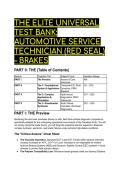
THE ELITE UNIVERSAL
TEST BANK:
AUTOMOTIVE SERVICE
TECHNICIAN (RED SEAL)
– BRAKES
PART 0: THE (Table of Contents)
Section Cognitive Tier Subject Focus Question Range
PART I The Preview Axioms & Core N/A
Directives
PART II Tier 1: Foundational Component ID, Fluid Q1 – Q10
Syntax & Application Dynamics, PMVI
Baseline
PART II Tier 2: Complex Hydro-boost, Q11 – Q20
Application & Diagnostics, PMVI
Simulation Tolerances
PART II Tier 3: Grandmaster Arctic Failure Q21 – Q30
Synthesis Cascades, Red Seal
Diagnostics
PART I: THE Preview
Mastering this test bank translates directly to elite, Red Seal-certified diagnostic competence,
specifically adapted for the unforgiving operational environment of the Canadian Arctic. You will
not simply memorize brake theory; you will forge the analytical stamina required to diagnose
complex hydraulic, electronic, and kinetic failures under extreme high-stakes conditions.
The "Critical Axioms" Cheat Sheet
● The Viscosity Imperative: Standard DOT 3 and DOT 4 fluids suffer extreme kinematic
viscosity increases at -40°C. DOT 4 LV (Low Viscosity) is non-negotiable for modern
Anti-lock Braking Systems (ABS) and Electronic Stability Control (ESC) systems in Arctic
climates to prevent fatal actuator delays.
● The Polymer Compatibility Law: Petroleum-based greases swell and destroy Ethylene
, Propylene Diene Monomer (EPDM) rubber boots and seals. Slide pins must exclusively
be serviced with extreme-temperature dimethyl silicone or fluorocarbon gels rated for
-40°C to 200°C.
● The PMVI Hard Deck: Under National Safety Code (NSC) Standard 11B, a commercial
hydraulic disc brake pad must never fall below 1.6 mm (1/16 inch). If it fails the
micrometer measurement, it fails the inspection.
● The Waveform Absolute: Passive (analog) wheel speed sensors generate an alternating
current (AC) sine wave whose amplitude and frequency drop with wheel speed. Active
(digital/Hall-effect) sensors generate a digital signal where the frequency drops, but
amplitude remains constant.
● The Hydro-Boost Baseline: A functional hydro-boost system relies on power steering
pressure. If the accumulator is depleted (engine off, pedal pumped), starting the engine
while holding the pedal MUST result in the pedal dropping slightly against your foot.
NSC 11B Component Discard Limit / Critical Corrective Action
Parameter Threshold
Hydraulic Disc Brake Pad < 1.6 mm (1/16 inch) Immediate Rejection / Replace
Drum Brake Shoe (Bonded) < 2.0 mm Immediate Rejection / Replace
Drum Brake Shoe (Riveted) < 3.0 mm Immediate Rejection / Replace
Rotor Heat Checks < 0.5 mm width and depth Acceptable Operational Wear
Drum/Rotor Structural Crack Extends to outer edge or vent Immediate Rejection / Replace
PART II: THE ELITE TEST BANK
Tier 1: Foundational Syntax & Application
Q1: A customer in Iqaluit, Nunavut, complains of a severely delayed brake pedal response and
an ABS malfunction light only when the ambient temperature drops below -30°C. The system
was recently flushed with conventional DOT 4 brake fluid. Based on fluid dynamic principles for
modern Electronic Stability Program (ESP) systems, which action is the MOST
APPROPRIATE? A) Replace the ABS hydraulic control unit due to internal valve body seizure.
B) Install a block heater adjacent to the master cylinder to maintain ambient fluid temperature.
C) Evacuate the system and flush entirely with DOT 4 LV (Low Viscosity) brake fluid. D)
Reprogram the ABS control module to lower the pressure threshold for cold-weather activation.
● The Answer: C (Evacuate the system and flush entirely with DOT 4 LV (Low Viscosity)
brake fluid.)
● Distractor Analysis:
○ A is incorrect: The ABS unit is not mechanically seized; the fluid is simply too
viscous to flow through the micro-valves. Replacing the unit without changing the
fluid type will not resolve the cold-weather delay.
○ B is incorrect: Modifying the vehicle with an unapproved localized heater is a fire
hazard and does not solve the fluid specification error throughout the exposed
chassis lines.
○ D is incorrect: You cannot alter Original Equipment Manufacturer (OEM) safety
parameters in an ABS module to compensate for incorrect hydraulic fluid.
The Mentor's Analysis: Modern ABS/ESC pumps utilize micro-valves that demand rapid fluid
transfer. At -40°C, conventional DOT 4 fluid thickens dramatically (exceeding 900 mm²/s),
preventing the ABS pump from cycling efficiently. By utilizing DOT 4 LV, you bypass the
common trap of misdiagnosing a simple fluid viscosity issue as a catastrophic hardware failure.
, Professional/Academic Intuition: Always match fluid viscosity to the operational climate;
an ABS module cannot pump cold molasses.
Q2: A technician is overhauling a floating disc brake caliper. They intend to lubricate the caliper
slide pins to ensure proper lateral movement. To prevent the premature degradation of the
EPDM rubber dust boots, which lubricant is the MOST ACCURATE choice? A) White lithium
grease. B) High-temperature copper anti-seize compound. C) Dimethyl silicone-based grease.
D) Heavy-duty petroleum-based chassis grease.
● The Answer: C (Dimethyl silicone-based grease.)
● Distractor Analysis:
○ A is incorrect: White lithium grease is petroleum-based and will cause EPDM rubber
to swell, leading to seized guide pins.
○ B is incorrect: Copper anti-seize is an assembly compound, not a dynamic
lubricant. It will dry out, harden, and seize the pins.
○ D is incorrect: Petroleum-based greases break down under high braking
temperatures and rapidly destroy natural and synthetic rubber seals.
The Mentor's Analysis: Floating calipers require frictionless pin movement to apply and
release clamping force evenly. When servicing guide pins, the immediate priority is seal
compatibility. By utilizing a dimethyl silicone-based grease (e.g., Fluorocarbon Gel 880) , you
bypass the novice error of using petroleum products that swell the boots and trap the caliper in
an applied position. Professional/Academic Intuition: If petroleum touches EPDM brake
rubber, the rubber dies. Silence the brakes with pure silicone.
Q3: A rear-wheel-drive vehicle equipped with front disc and rear drum brakes nose-dives
aggressively during light braking. The technician suspects a failure in the combination valve.
Which specific component within the valve is MOST LIKELY failing to perform its intended
function? A) The pressure differential switch. B) The quick take-up valve. C) The metering valve.
D) The proportioning valve.
● The Answer: C (The metering valve.)
● Distractor Analysis:
○ A is incorrect: The pressure differential switch only illuminates the dashboard
warning light in the event of a hydraulic leak; it does not control fluid timing.
○ B is incorrect: The quick take-up valve is located inside the master cylinder, not the
combination valve.
○ D is incorrect: The proportioning valve restricts pressure to the rear brakes during
heavy braking to prevent rear-wheel lockup, not front-end dive during light braking.
The Mentor's Analysis: Disc brakes apply instantly, while drum brakes must overcome heavy
return springs before the shoes contact the drum. The immediate priority of the metering valve is
to block pressure to the front discs (until roughly 75-125 psi) to allow the rear drums time to
catch up. By isolating the metering valve, you bypass the trap of replacing front suspension
components for a hydraulic timing issue. Professional/Academic Intuition: Metering
manages timing (front-to-rear coordination); Proportioning manages pressure
(preventing rear lockup).
Q4: According to National Safety Code (NSC) Standard 11B for Periodic Commercial Motor
Vehicle Inspections (PMVI), what is the absolute minimum allowable friction material thickness
for a hydraulic disc brake pad? A) 3.2 mm (1/8 inch). B) 2.0 mm. C) 1.6 mm (1/16 inch). D) 6.4
mm (1/4 inch).
● The Answer: C (1.6 mm (1/16 inch).)
● Distractor Analysis:
○ A is incorrect: 3.2 mm (1/8 inch) is the minimum thickness for a commercial air disc
TEST BANK:
AUTOMOTIVE SERVICE
TECHNICIAN (RED SEAL)
– BRAKES
PART 0: THE (Table of Contents)
Section Cognitive Tier Subject Focus Question Range
PART I The Preview Axioms & Core N/A
Directives
PART II Tier 1: Foundational Component ID, Fluid Q1 – Q10
Syntax & Application Dynamics, PMVI
Baseline
PART II Tier 2: Complex Hydro-boost, Q11 – Q20
Application & Diagnostics, PMVI
Simulation Tolerances
PART II Tier 3: Grandmaster Arctic Failure Q21 – Q30
Synthesis Cascades, Red Seal
Diagnostics
PART I: THE Preview
Mastering this test bank translates directly to elite, Red Seal-certified diagnostic competence,
specifically adapted for the unforgiving operational environment of the Canadian Arctic. You will
not simply memorize brake theory; you will forge the analytical stamina required to diagnose
complex hydraulic, electronic, and kinetic failures under extreme high-stakes conditions.
The "Critical Axioms" Cheat Sheet
● The Viscosity Imperative: Standard DOT 3 and DOT 4 fluids suffer extreme kinematic
viscosity increases at -40°C. DOT 4 LV (Low Viscosity) is non-negotiable for modern
Anti-lock Braking Systems (ABS) and Electronic Stability Control (ESC) systems in Arctic
climates to prevent fatal actuator delays.
● The Polymer Compatibility Law: Petroleum-based greases swell and destroy Ethylene
, Propylene Diene Monomer (EPDM) rubber boots and seals. Slide pins must exclusively
be serviced with extreme-temperature dimethyl silicone or fluorocarbon gels rated for
-40°C to 200°C.
● The PMVI Hard Deck: Under National Safety Code (NSC) Standard 11B, a commercial
hydraulic disc brake pad must never fall below 1.6 mm (1/16 inch). If it fails the
micrometer measurement, it fails the inspection.
● The Waveform Absolute: Passive (analog) wheel speed sensors generate an alternating
current (AC) sine wave whose amplitude and frequency drop with wheel speed. Active
(digital/Hall-effect) sensors generate a digital signal where the frequency drops, but
amplitude remains constant.
● The Hydro-Boost Baseline: A functional hydro-boost system relies on power steering
pressure. If the accumulator is depleted (engine off, pedal pumped), starting the engine
while holding the pedal MUST result in the pedal dropping slightly against your foot.
NSC 11B Component Discard Limit / Critical Corrective Action
Parameter Threshold
Hydraulic Disc Brake Pad < 1.6 mm (1/16 inch) Immediate Rejection / Replace
Drum Brake Shoe (Bonded) < 2.0 mm Immediate Rejection / Replace
Drum Brake Shoe (Riveted) < 3.0 mm Immediate Rejection / Replace
Rotor Heat Checks < 0.5 mm width and depth Acceptable Operational Wear
Drum/Rotor Structural Crack Extends to outer edge or vent Immediate Rejection / Replace
PART II: THE ELITE TEST BANK
Tier 1: Foundational Syntax & Application
Q1: A customer in Iqaluit, Nunavut, complains of a severely delayed brake pedal response and
an ABS malfunction light only when the ambient temperature drops below -30°C. The system
was recently flushed with conventional DOT 4 brake fluid. Based on fluid dynamic principles for
modern Electronic Stability Program (ESP) systems, which action is the MOST
APPROPRIATE? A) Replace the ABS hydraulic control unit due to internal valve body seizure.
B) Install a block heater adjacent to the master cylinder to maintain ambient fluid temperature.
C) Evacuate the system and flush entirely with DOT 4 LV (Low Viscosity) brake fluid. D)
Reprogram the ABS control module to lower the pressure threshold for cold-weather activation.
● The Answer: C (Evacuate the system and flush entirely with DOT 4 LV (Low Viscosity)
brake fluid.)
● Distractor Analysis:
○ A is incorrect: The ABS unit is not mechanically seized; the fluid is simply too
viscous to flow through the micro-valves. Replacing the unit without changing the
fluid type will not resolve the cold-weather delay.
○ B is incorrect: Modifying the vehicle with an unapproved localized heater is a fire
hazard and does not solve the fluid specification error throughout the exposed
chassis lines.
○ D is incorrect: You cannot alter Original Equipment Manufacturer (OEM) safety
parameters in an ABS module to compensate for incorrect hydraulic fluid.
The Mentor's Analysis: Modern ABS/ESC pumps utilize micro-valves that demand rapid fluid
transfer. At -40°C, conventional DOT 4 fluid thickens dramatically (exceeding 900 mm²/s),
preventing the ABS pump from cycling efficiently. By utilizing DOT 4 LV, you bypass the
common trap of misdiagnosing a simple fluid viscosity issue as a catastrophic hardware failure.
, Professional/Academic Intuition: Always match fluid viscosity to the operational climate;
an ABS module cannot pump cold molasses.
Q2: A technician is overhauling a floating disc brake caliper. They intend to lubricate the caliper
slide pins to ensure proper lateral movement. To prevent the premature degradation of the
EPDM rubber dust boots, which lubricant is the MOST ACCURATE choice? A) White lithium
grease. B) High-temperature copper anti-seize compound. C) Dimethyl silicone-based grease.
D) Heavy-duty petroleum-based chassis grease.
● The Answer: C (Dimethyl silicone-based grease.)
● Distractor Analysis:
○ A is incorrect: White lithium grease is petroleum-based and will cause EPDM rubber
to swell, leading to seized guide pins.
○ B is incorrect: Copper anti-seize is an assembly compound, not a dynamic
lubricant. It will dry out, harden, and seize the pins.
○ D is incorrect: Petroleum-based greases break down under high braking
temperatures and rapidly destroy natural and synthetic rubber seals.
The Mentor's Analysis: Floating calipers require frictionless pin movement to apply and
release clamping force evenly. When servicing guide pins, the immediate priority is seal
compatibility. By utilizing a dimethyl silicone-based grease (e.g., Fluorocarbon Gel 880) , you
bypass the novice error of using petroleum products that swell the boots and trap the caliper in
an applied position. Professional/Academic Intuition: If petroleum touches EPDM brake
rubber, the rubber dies. Silence the brakes with pure silicone.
Q3: A rear-wheel-drive vehicle equipped with front disc and rear drum brakes nose-dives
aggressively during light braking. The technician suspects a failure in the combination valve.
Which specific component within the valve is MOST LIKELY failing to perform its intended
function? A) The pressure differential switch. B) The quick take-up valve. C) The metering valve.
D) The proportioning valve.
● The Answer: C (The metering valve.)
● Distractor Analysis:
○ A is incorrect: The pressure differential switch only illuminates the dashboard
warning light in the event of a hydraulic leak; it does not control fluid timing.
○ B is incorrect: The quick take-up valve is located inside the master cylinder, not the
combination valve.
○ D is incorrect: The proportioning valve restricts pressure to the rear brakes during
heavy braking to prevent rear-wheel lockup, not front-end dive during light braking.
The Mentor's Analysis: Disc brakes apply instantly, while drum brakes must overcome heavy
return springs before the shoes contact the drum. The immediate priority of the metering valve is
to block pressure to the front discs (until roughly 75-125 psi) to allow the rear drums time to
catch up. By isolating the metering valve, you bypass the trap of replacing front suspension
components for a hydraulic timing issue. Professional/Academic Intuition: Metering
manages timing (front-to-rear coordination); Proportioning manages pressure
(preventing rear lockup).
Q4: According to National Safety Code (NSC) Standard 11B for Periodic Commercial Motor
Vehicle Inspections (PMVI), what is the absolute minimum allowable friction material thickness
for a hydraulic disc brake pad? A) 3.2 mm (1/8 inch). B) 2.0 mm. C) 1.6 mm (1/16 inch). D) 6.4
mm (1/4 inch).
● The Answer: C (1.6 mm (1/16 inch).)
● Distractor Analysis:
○ A is incorrect: 3.2 mm (1/8 inch) is the minimum thickness for a commercial air disc


