

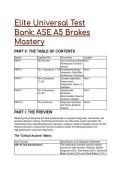
Elite Universal Test
Bank: ASE A5 Brakes
Mastery
PART 0: THE TABLE OF CONTENTS
Section Cognitive Tier Focus Area Location
PART I The Preview Core Automotive Brake Part I
Architecture & Critical
Axioms
PART II Tier 1 (Questions 1–10) Foundational Syntax: Part II
Hydraulics, Drum/Disc
Architecture, & Sensors
PART II Tier 2 (Questions Complex Application: Part II
11–20) Power Assist
Diagnostics, Valves, &
Validation
PART II Tier 3 (Questions Grandmaster Part II
21–30) Synthesis:
Multi-Variable Crises &
Hydraulic Collapse
PART III The Conclusion Diagnostic Synthesis Part III
and Future Systemic
Outlook
PART I: THE PREVIEW
Mastering this professional test bank fundamentally re-engineers diagnostic, mechanical, and
analytical decision-making, transforming technicians into elite brake system specialists. By
internalizing these calibrated diagnostic scenarios, academic mastery translates directly into the
flawless execution of Automotive Service Excellence (ASE) A5 testing parameters and
high-performance real-world diagnostics.
The "Critical Axioms" Matrix
Core Concept Operational Law & Diagnostic Parameter
ASE A5 Test Specifications The certification standard requires mastery
across four rigid domains: Hydraulic System
Diagnosis (43%), Disc Brakes (24%), Electronic
Brake Control (22%), and Drum Brakes (11%).
,Core Concept Operational Law & Diagnostic Parameter
The Quick Take-Up Constant Low-drag calipers require step-bore master
cylinders to supply high initial fluid volume. The
system utilizes a bypass valve that transitions
fluid from the large primary bore to the smaller
high-pressure bore once system pressure
exceeds exactly 100 psi.
The Valve Sequencing Protocol In disc/drum combination systems, the metering
valve holds back pressure to the front discs
(until 75-125 psi) to overcome rear drum spring
tension. The proportioning valve limits rear
drum hydraulic pressure beyond a specific knee
point to prevent premature rear lockup.
The Duo-Servo Geometry In a duo-servo drum system, the primary shoe
(shorter lining) faces the front. Its rotational
energy forces it against the star wheel adjuster,
violently driving the secondary shoe (longer
lining) upward into the anchor pin to generate
peak stopping force.
The Hydro-Boost Depletion Rule Before opening any hydraulic lines or removing
a master cylinder on a hydro-boost system, the
engine must be turned off and the brake pedal
pumped exactly 4 to 5 times to completely
deplete the internal accumulator's reserve
pressure.
The Signal Architecture (WSS) Passive wheel speed sensors generate an
alternating current (AC) sine wave. Active
wheel speed sensors utilize magneto-resistive
elements, outputting a precise digital direct
current (DC) square wave capable of reading
zero wheel speed.
PART II: THE ELITE TEST BANK
Tier 1: Foundational Syntax & Application
The foundational syntax of automotive braking systems relies on the absolute predictability of
fluid dynamics and thermodynamic energy conversion. Before manipulating advanced electronic
controls, a practitioner must demonstrate an unyielding command of base mechanical geometry,
Pascal's Law, and the chemical limitations of hydraulic fluids. Tier 1 establishes the baseline
structural parameters of brake actuation.
Q1: An automotive engineer is modifying a hydraulic brake system to alter pedal feel. If the
surface area of the master cylinder piston is doubled while the mechanical pedal force applied
by the driver remains mathematically constant, what is the MOST ACCURATE immediate effect
on the hydraulic pressure within the brake lines? A) The hydraulic pressure is doubled to
dramatically increase caliper clamping force. B) The hydraulic pressure remains fundamentally
unchanged due to the absolute incompressibility of standard DOT 3 brake fluid. C) The
hydraulic pressure is mathematically cut in half. D) The brake pedal travel distance decreases
, while pressure exponentially increases due to volumetric displacement.
● The Answer: C (The hydraulic pressure is mathematically cut in half.)
● Distractor Analysis:
○ A is incorrect: This is a fundamental inversion of Pascal’s Law. Increasing the piston
area spreads the applied force over a much larger surface, actively reducing the
resulting pressure, not increasing it.
○ B is incorrect: While brake fluid is indeed incompressible, hydraulic pressure (P =
F/A) dictates that altering the piston area directly and inversely alters the resulting
system pressure.
○ D is incorrect: A larger piston will move more fluid volume and therefore decrease
the required pedal travel, but it will physically decrease line pressure, eliminating
any exponential increase.
The Mentor's Analysis: Hydraulic pressure is defined entirely by mechanical force divided by
surface area. Originating from the fundamental laws of fluid dynamics, when facing a
modification in master cylinder bore sizing, the immediate priority is understanding the inverse
relationship between fluid volume and hydraulic pressure. By utilizing Pascal’s Law, you bypass
the common novice trap of assuming bigger master cylinders automatically create stronger
brakes. Professional/Academic Intuition: A larger master cylinder bore yields a harder,
shorter pedal with significantly less stopping power; a smaller bore yields a softer, longer pedal
with massive hydraulic stopping power.
Q2: A technician is inspecting an older drum brake system and notes that the forward brake
shoe has a significantly shorter friction lining than the rearward brake shoe. Based on the
mechanical principles of drum brake design, which operational framework is MOST ACCURATE
for this specific configuration? A) A leading-trailing drum brake system utilizing a lower anchor
pin to divide applied force equally. B) A duo-servo drum brake system where the front shoe
actively energizes the rear shoe. C) A non-servo drum brake system experiencing advanced
uneven wear from a seized trailing wheel cylinder piston. D) A synchronous brake system
designed specifically to mitigate the thermal effects of mechanical brake fade.
● The Answer: B (A duo-servo drum brake system where the front shoe actively energizes
the rear shoe.)
● Distractor Analysis:
○ A is incorrect: Leading-trailing (non-servo) systems typically utilize shoes with
identical lining lengths and anchor firmly at the bottom, neutralizing any transfer of
kinetic energy between the shoes.
○ C is incorrect: This lining disparity is a deliberate, factory-engineered design
feature, not a symptom of uneven wear or a localized hydraulic mechanical failure.
○ D is incorrect: Mechanical brake fade is combated by metallurgy, ribbed heat
dissipation designs, and advanced friction material formulation, not by shortening
the primary shoe lining.
The Mentor's Analysis: Friction material surface area dictates kinetic energy absorption and
mechanical advantage. Originating in heavy-duty applications requiring maximum stopping force
from minimal hydraulic input, when facing an asymmetrical shoe lining setup, the immediate
priority is recognizing the self-energizing geometry of the brake assembly. By utilizing the
duo-servo identification matrix, you bypass the catastrophic trap of installing the shoes
backward, which destroys braking efficiency. Professional/Academic Intuition: In a duo-servo
system, the short shoe always faces the front; it serves as the kinetic trigger to smash the large
secondary shoe into the drum against the anchor pin.
Q3: A modern vehicle equipped with low-drag disc brake calipers requires a master cylinder
Bank: ASE A5 Brakes
Mastery
PART 0: THE TABLE OF CONTENTS
Section Cognitive Tier Focus Area Location
PART I The Preview Core Automotive Brake Part I
Architecture & Critical
Axioms
PART II Tier 1 (Questions 1–10) Foundational Syntax: Part II
Hydraulics, Drum/Disc
Architecture, & Sensors
PART II Tier 2 (Questions Complex Application: Part II
11–20) Power Assist
Diagnostics, Valves, &
Validation
PART II Tier 3 (Questions Grandmaster Part II
21–30) Synthesis:
Multi-Variable Crises &
Hydraulic Collapse
PART III The Conclusion Diagnostic Synthesis Part III
and Future Systemic
Outlook
PART I: THE PREVIEW
Mastering this professional test bank fundamentally re-engineers diagnostic, mechanical, and
analytical decision-making, transforming technicians into elite brake system specialists. By
internalizing these calibrated diagnostic scenarios, academic mastery translates directly into the
flawless execution of Automotive Service Excellence (ASE) A5 testing parameters and
high-performance real-world diagnostics.
The "Critical Axioms" Matrix
Core Concept Operational Law & Diagnostic Parameter
ASE A5 Test Specifications The certification standard requires mastery
across four rigid domains: Hydraulic System
Diagnosis (43%), Disc Brakes (24%), Electronic
Brake Control (22%), and Drum Brakes (11%).
,Core Concept Operational Law & Diagnostic Parameter
The Quick Take-Up Constant Low-drag calipers require step-bore master
cylinders to supply high initial fluid volume. The
system utilizes a bypass valve that transitions
fluid from the large primary bore to the smaller
high-pressure bore once system pressure
exceeds exactly 100 psi.
The Valve Sequencing Protocol In disc/drum combination systems, the metering
valve holds back pressure to the front discs
(until 75-125 psi) to overcome rear drum spring
tension. The proportioning valve limits rear
drum hydraulic pressure beyond a specific knee
point to prevent premature rear lockup.
The Duo-Servo Geometry In a duo-servo drum system, the primary shoe
(shorter lining) faces the front. Its rotational
energy forces it against the star wheel adjuster,
violently driving the secondary shoe (longer
lining) upward into the anchor pin to generate
peak stopping force.
The Hydro-Boost Depletion Rule Before opening any hydraulic lines or removing
a master cylinder on a hydro-boost system, the
engine must be turned off and the brake pedal
pumped exactly 4 to 5 times to completely
deplete the internal accumulator's reserve
pressure.
The Signal Architecture (WSS) Passive wheel speed sensors generate an
alternating current (AC) sine wave. Active
wheel speed sensors utilize magneto-resistive
elements, outputting a precise digital direct
current (DC) square wave capable of reading
zero wheel speed.
PART II: THE ELITE TEST BANK
Tier 1: Foundational Syntax & Application
The foundational syntax of automotive braking systems relies on the absolute predictability of
fluid dynamics and thermodynamic energy conversion. Before manipulating advanced electronic
controls, a practitioner must demonstrate an unyielding command of base mechanical geometry,
Pascal's Law, and the chemical limitations of hydraulic fluids. Tier 1 establishes the baseline
structural parameters of brake actuation.
Q1: An automotive engineer is modifying a hydraulic brake system to alter pedal feel. If the
surface area of the master cylinder piston is doubled while the mechanical pedal force applied
by the driver remains mathematically constant, what is the MOST ACCURATE immediate effect
on the hydraulic pressure within the brake lines? A) The hydraulic pressure is doubled to
dramatically increase caliper clamping force. B) The hydraulic pressure remains fundamentally
unchanged due to the absolute incompressibility of standard DOT 3 brake fluid. C) The
hydraulic pressure is mathematically cut in half. D) The brake pedal travel distance decreases
, while pressure exponentially increases due to volumetric displacement.
● The Answer: C (The hydraulic pressure is mathematically cut in half.)
● Distractor Analysis:
○ A is incorrect: This is a fundamental inversion of Pascal’s Law. Increasing the piston
area spreads the applied force over a much larger surface, actively reducing the
resulting pressure, not increasing it.
○ B is incorrect: While brake fluid is indeed incompressible, hydraulic pressure (P =
F/A) dictates that altering the piston area directly and inversely alters the resulting
system pressure.
○ D is incorrect: A larger piston will move more fluid volume and therefore decrease
the required pedal travel, but it will physically decrease line pressure, eliminating
any exponential increase.
The Mentor's Analysis: Hydraulic pressure is defined entirely by mechanical force divided by
surface area. Originating from the fundamental laws of fluid dynamics, when facing a
modification in master cylinder bore sizing, the immediate priority is understanding the inverse
relationship between fluid volume and hydraulic pressure. By utilizing Pascal’s Law, you bypass
the common novice trap of assuming bigger master cylinders automatically create stronger
brakes. Professional/Academic Intuition: A larger master cylinder bore yields a harder,
shorter pedal with significantly less stopping power; a smaller bore yields a softer, longer pedal
with massive hydraulic stopping power.
Q2: A technician is inspecting an older drum brake system and notes that the forward brake
shoe has a significantly shorter friction lining than the rearward brake shoe. Based on the
mechanical principles of drum brake design, which operational framework is MOST ACCURATE
for this specific configuration? A) A leading-trailing drum brake system utilizing a lower anchor
pin to divide applied force equally. B) A duo-servo drum brake system where the front shoe
actively energizes the rear shoe. C) A non-servo drum brake system experiencing advanced
uneven wear from a seized trailing wheel cylinder piston. D) A synchronous brake system
designed specifically to mitigate the thermal effects of mechanical brake fade.
● The Answer: B (A duo-servo drum brake system where the front shoe actively energizes
the rear shoe.)
● Distractor Analysis:
○ A is incorrect: Leading-trailing (non-servo) systems typically utilize shoes with
identical lining lengths and anchor firmly at the bottom, neutralizing any transfer of
kinetic energy between the shoes.
○ C is incorrect: This lining disparity is a deliberate, factory-engineered design
feature, not a symptom of uneven wear or a localized hydraulic mechanical failure.
○ D is incorrect: Mechanical brake fade is combated by metallurgy, ribbed heat
dissipation designs, and advanced friction material formulation, not by shortening
the primary shoe lining.
The Mentor's Analysis: Friction material surface area dictates kinetic energy absorption and
mechanical advantage. Originating in heavy-duty applications requiring maximum stopping force
from minimal hydraulic input, when facing an asymmetrical shoe lining setup, the immediate
priority is recognizing the self-energizing geometry of the brake assembly. By utilizing the
duo-servo identification matrix, you bypass the catastrophic trap of installing the shoes
backward, which destroys braking efficiency. Professional/Academic Intuition: In a duo-servo
system, the short shoe always faces the front; it serves as the kinetic trigger to smash the large
secondary shoe into the drum against the anchor pin.
Q3: A modern vehicle equipped with low-drag disc brake calipers requires a master cylinder


