

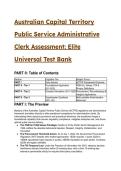
Australian Capital Territory
Public Service Administrative
Clerk Assessment: Elite
Universal Test Bank
PART 0: Table of Contents
Section Cognitive Tier Subject Focus
PART I Core Axioms ACTPS Framework Overview
PART II - Tier 1 Foundational Application PSM Act, Values, FOI &
(Q1–Q10) Privacy Definitions
PART II - Tier 2 Complex Simulation (Q11–Q20) Procurement, Recordkeeping &
Integrity Applications
PART II - Tier 3 Grandmaster Synthesis Multi-variable Administrative
(Q21–30) Dilemmas
PART I: The Preview
Mastery of the Australian Capital Territory Public Service (ACTPS) legislative and administrative
framework translates directly to elite operational competence for administrative clerks. By
internalizing these statutory provisions and procedural directives, the practitioner forges a
foundational capability that ensures regulatory compliance, mitigates enterprise risk, and drives
optimal public service delivery.
● The PSM Act 1994 Values Paradigm: Section 9 of the Public Sector Management Act
1994 codifies the absolute behavioral baseline: Respect, Integrity, Collaboration, and
Innovation.
● The Procurement Threshold Axiom: As of July 1, 2024, the Government Procurement
Regulation 2007 dictates strict market approaches: <$25k requires 1 quote; $25k to
<$500k (goods/services) requires 3 quotes; ≥$500k mandates an open tender. Contracts
≥$25k are legally notifiable.
● The FOI Temporal Law: Under the Freedom of Information Act 2016, statutory decision
timeframes demand resolution within 20 working days, with a strict 15-working-day
extension permissible strictly for required third-party consultation.
, ● The Privacy Mandate: The Information Privacy Act 2014 enforces the Territory Privacy
Principles (TPPs), unequivocally governing the collection, storage, use, and correction of
personal data.
● The Integrity Escalation Protocol: The Senior Executive Responsible for Business
Integrity Risk (SERBIR) serves as the mandatory, centralized escalation authority for all
systemic fraud, corruption, and integrity risks under the Public Sector Management
Standards 2016.
PART II: THE ELITE TEST BANK
Tier 1: Foundational Syntax & Application
Q1: An administrative clerk is tasked with processing a formal access application under the
Freedom of Information Act 2016. The application is received and validated on Tuesday, March
3. Excluding public holidays, what is the MAXIMUM statutory timeframe the agency has to
decide the access application before a deemed refusal occurs, assuming no extensions are
negotiated? A) 10 working days B) 20 working days C) 30 working days D) 45 calendar days
● The Answer: B (20 working days)
● Distractor Analysis:
○ A is incorrect: Ten working days is the timeframe required to acknowledge receipt of
the application and notify the applicant of the decision deadline , not the absolute
deadline for the decision itself.
○ C is incorrect: Thirty working days applies specifically to Ombudsman reviews , not
the initial agency access decision, which operates on a tighter schedule.
○ D is incorrect: FOI timeframes are strictly calculated in working days, not calendar
days, circumventing administrative delays caused by weekends and statutory public
holidays.
The Mentor's Analysis: Statutory compliance in information access relies on rigid adherence to
procedural deadlines. When processing an FOI request, the immediate priority is calculating the
deadline from the date of valid receipt. By utilizing the 20 working day rule , the practitioner
bypasses the common trap of confusing acknowledgment deadlines with decision deadlines.
Professional/Academic Intuition: The universally applicable rule mandates that initial FOI
decisions must be executed within 20 working days to prevent an automatic deemed refusal.
Q2: During a routine audit, an administrative clerk identifies that an ACTPS employee has
repeatedly disclosed confidential public program data to an external contractor without
authorization. Under Section 9 of the Public Sector Management Act 1994, which fundamental
value has been MOST DIRECTLY breached? A) Collaboration B) Respect C) Integrity D)
Innovation
● The Answer: C (Integrity)
● Distractor Analysis:
○ A is incorrect: Collaboration refers to sharing information appropriately to break
down silos and engage with the broader community , not the unauthorized
disclosure of protected data to external entities.
○ B is incorrect: Respect governs interpersonal decency, sensitivity, and equity in the
workplace , not the safeguarding of official government information.
○ D is incorrect: Innovation involves seeking new ways of operating and empowering
colleagues , which is completely irrelevant to unauthorized data breaches.
, The Mentor's Analysis: The Public Sector Management Act 1994 classifies the scrupulous use
of official information as a core tenet of ethical conduct. When handling sensitive data, the
immediate priority is maintaining strict confidentiality. By utilizing the Integrity value framework ,
the candidate bypasses the common trap of assuming information sharing is always protected
under the guise of collaboration. Professional/Academic Intuition: Integrity dictates that public
servants must be scrupulous in their use of official information and equipment; unauthorized
disclosure is a fundamental breach of this statutory duty.
Q3: A Directorate requires the procurement of specialized office furniture valued at $18,000
(including GST). According to the Government Procurement Regulation 2007 (effective July 1,
2024), what is the MINIMUM quotation requirement to execute this procurement legally? A) The
clerk must conduct an open tender process. B) The clerk must seek at least three written
quotations. C) The clerk must seek at least one written quotation. D) The clerk may purchase
the items using a corporate credit card without any written quotation.
● The Answer: C (The clerk must seek at least one written quotation.)
● Distractor Analysis:
○ A is incorrect: Open tenders are exclusively reserved for major procurements
valued at ≥$500,000 for goods/services or ≥$1 million for construction.
○ B is incorrect: Three written quotations are strictly required for procurements valued
between $25,000 and <$500,000 , which exceeds the $18,000 value in this
scenario.
○ D is incorrect: While a corporate credit card may be the payment mechanism, the
overarching procurement framework still legally mandates a minimum of one written
quotation for any transaction under $25,000 to demonstrate value for money.
The Mentor's Analysis: Financial compliance requires strict adherence to value-based
thresholds. When executing low-value procurements, the immediate priority is securing
documented market evidence. By utilizing the single written quotation threshold for
procurements under $25,000 , the administrator bypasses the common trap of over-engineering
minor purchases or bypassing documentation entirely. Professional/Academic Intuition: All
goods and services under $25,000 require exactly one written quotation; this establishes the
baseline for value for money in the ACTPS.
Q4: An ACT citizen contacts an ACTPS agency to correct a typographical error in their recorded
residential address. Which specific component of the Information Privacy Act 2014 explicitly
grants the citizen the right to request this correction? A) Territory Privacy Principle 13 B)
Territory Privacy Principle 12 C) Freedom of Information Act 2016, Section 28 D) Public Sector
Management Standards 2016
● The Answer: A (Territory Privacy Principle 13)
● Distractor Analysis:
○ B is incorrect: TPP 12 governs the right to access personal information, whereas
this scenario specifically requires the correction of that information.
○ C is incorrect: The Freedom of Information Act 2016 handles broad access to
government documents, not the routine correction of personal data governed by
privacy principles.
○ D is incorrect: The PSM Standards govern internal public service employment,
integrity, and operational standards , not external civilian privacy rights.
The Mentor's Analysis: Data integrity is a legally enforceable right for all citizens interacting
with the ACT Government. When a citizen identifies a factual error in their file, the immediate
priority is executing a correction to prevent adverse administrative outcomes. By utilizing TPP
13 , the clerk bypasses the common trap of forcing the citizen through a complex FOI
Public Service Administrative
Clerk Assessment: Elite
Universal Test Bank
PART 0: Table of Contents
Section Cognitive Tier Subject Focus
PART I Core Axioms ACTPS Framework Overview
PART II - Tier 1 Foundational Application PSM Act, Values, FOI &
(Q1–Q10) Privacy Definitions
PART II - Tier 2 Complex Simulation (Q11–Q20) Procurement, Recordkeeping &
Integrity Applications
PART II - Tier 3 Grandmaster Synthesis Multi-variable Administrative
(Q21–30) Dilemmas
PART I: The Preview
Mastery of the Australian Capital Territory Public Service (ACTPS) legislative and administrative
framework translates directly to elite operational competence for administrative clerks. By
internalizing these statutory provisions and procedural directives, the practitioner forges a
foundational capability that ensures regulatory compliance, mitigates enterprise risk, and drives
optimal public service delivery.
● The PSM Act 1994 Values Paradigm: Section 9 of the Public Sector Management Act
1994 codifies the absolute behavioral baseline: Respect, Integrity, Collaboration, and
Innovation.
● The Procurement Threshold Axiom: As of July 1, 2024, the Government Procurement
Regulation 2007 dictates strict market approaches: <$25k requires 1 quote; $25k to
<$500k (goods/services) requires 3 quotes; ≥$500k mandates an open tender. Contracts
≥$25k are legally notifiable.
● The FOI Temporal Law: Under the Freedom of Information Act 2016, statutory decision
timeframes demand resolution within 20 working days, with a strict 15-working-day
extension permissible strictly for required third-party consultation.
, ● The Privacy Mandate: The Information Privacy Act 2014 enforces the Territory Privacy
Principles (TPPs), unequivocally governing the collection, storage, use, and correction of
personal data.
● The Integrity Escalation Protocol: The Senior Executive Responsible for Business
Integrity Risk (SERBIR) serves as the mandatory, centralized escalation authority for all
systemic fraud, corruption, and integrity risks under the Public Sector Management
Standards 2016.
PART II: THE ELITE TEST BANK
Tier 1: Foundational Syntax & Application
Q1: An administrative clerk is tasked with processing a formal access application under the
Freedom of Information Act 2016. The application is received and validated on Tuesday, March
3. Excluding public holidays, what is the MAXIMUM statutory timeframe the agency has to
decide the access application before a deemed refusal occurs, assuming no extensions are
negotiated? A) 10 working days B) 20 working days C) 30 working days D) 45 calendar days
● The Answer: B (20 working days)
● Distractor Analysis:
○ A is incorrect: Ten working days is the timeframe required to acknowledge receipt of
the application and notify the applicant of the decision deadline , not the absolute
deadline for the decision itself.
○ C is incorrect: Thirty working days applies specifically to Ombudsman reviews , not
the initial agency access decision, which operates on a tighter schedule.
○ D is incorrect: FOI timeframes are strictly calculated in working days, not calendar
days, circumventing administrative delays caused by weekends and statutory public
holidays.
The Mentor's Analysis: Statutory compliance in information access relies on rigid adherence to
procedural deadlines. When processing an FOI request, the immediate priority is calculating the
deadline from the date of valid receipt. By utilizing the 20 working day rule , the practitioner
bypasses the common trap of confusing acknowledgment deadlines with decision deadlines.
Professional/Academic Intuition: The universally applicable rule mandates that initial FOI
decisions must be executed within 20 working days to prevent an automatic deemed refusal.
Q2: During a routine audit, an administrative clerk identifies that an ACTPS employee has
repeatedly disclosed confidential public program data to an external contractor without
authorization. Under Section 9 of the Public Sector Management Act 1994, which fundamental
value has been MOST DIRECTLY breached? A) Collaboration B) Respect C) Integrity D)
Innovation
● The Answer: C (Integrity)
● Distractor Analysis:
○ A is incorrect: Collaboration refers to sharing information appropriately to break
down silos and engage with the broader community , not the unauthorized
disclosure of protected data to external entities.
○ B is incorrect: Respect governs interpersonal decency, sensitivity, and equity in the
workplace , not the safeguarding of official government information.
○ D is incorrect: Innovation involves seeking new ways of operating and empowering
colleagues , which is completely irrelevant to unauthorized data breaches.
, The Mentor's Analysis: The Public Sector Management Act 1994 classifies the scrupulous use
of official information as a core tenet of ethical conduct. When handling sensitive data, the
immediate priority is maintaining strict confidentiality. By utilizing the Integrity value framework ,
the candidate bypasses the common trap of assuming information sharing is always protected
under the guise of collaboration. Professional/Academic Intuition: Integrity dictates that public
servants must be scrupulous in their use of official information and equipment; unauthorized
disclosure is a fundamental breach of this statutory duty.
Q3: A Directorate requires the procurement of specialized office furniture valued at $18,000
(including GST). According to the Government Procurement Regulation 2007 (effective July 1,
2024), what is the MINIMUM quotation requirement to execute this procurement legally? A) The
clerk must conduct an open tender process. B) The clerk must seek at least three written
quotations. C) The clerk must seek at least one written quotation. D) The clerk may purchase
the items using a corporate credit card without any written quotation.
● The Answer: C (The clerk must seek at least one written quotation.)
● Distractor Analysis:
○ A is incorrect: Open tenders are exclusively reserved for major procurements
valued at ≥$500,000 for goods/services or ≥$1 million for construction.
○ B is incorrect: Three written quotations are strictly required for procurements valued
between $25,000 and <$500,000 , which exceeds the $18,000 value in this
scenario.
○ D is incorrect: While a corporate credit card may be the payment mechanism, the
overarching procurement framework still legally mandates a minimum of one written
quotation for any transaction under $25,000 to demonstrate value for money.
The Mentor's Analysis: Financial compliance requires strict adherence to value-based
thresholds. When executing low-value procurements, the immediate priority is securing
documented market evidence. By utilizing the single written quotation threshold for
procurements under $25,000 , the administrator bypasses the common trap of over-engineering
minor purchases or bypassing documentation entirely. Professional/Academic Intuition: All
goods and services under $25,000 require exactly one written quotation; this establishes the
baseline for value for money in the ACTPS.
Q4: An ACT citizen contacts an ACTPS agency to correct a typographical error in their recorded
residential address. Which specific component of the Information Privacy Act 2014 explicitly
grants the citizen the right to request this correction? A) Territory Privacy Principle 13 B)
Territory Privacy Principle 12 C) Freedom of Information Act 2016, Section 28 D) Public Sector
Management Standards 2016
● The Answer: A (Territory Privacy Principle 13)
● Distractor Analysis:
○ B is incorrect: TPP 12 governs the right to access personal information, whereas
this scenario specifically requires the correction of that information.
○ C is incorrect: The Freedom of Information Act 2016 handles broad access to
government documents, not the routine correction of personal data governed by
privacy principles.
○ D is incorrect: The PSM Standards govern internal public service employment,
integrity, and operational standards , not external civilian privacy rights.
The Mentor's Analysis: Data integrity is a legally enforceable right for all citizens interacting
with the ACT Government. When a citizen identifies a factual error in their file, the immediate
priority is executing a correction to prevent adverse administrative outcomes. By utilizing TPP
13 , the clerk bypasses the common trap of forcing the citizen through a complex FOI


