

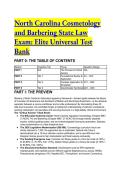
North Carolina Cosmetology
and Barbering State Law
Exam: Elite Universal Test
Bank
PART 0: THE TABLE OF CONTENTS
Section Cognitive Tier Focus Question Range
PART I N/A The Preview & Critical N/A
Axioms
PART II Tier 1 Foundational Syntax & Q1 – Q10
Application
PART II Tier 2 Complex Application & Q11 – Q20
Simulation
PART II Tier 3 Grandmaster Synthesis Q21 – Q30
PART I: THE PREVIEW
Mastery of North Carolina's bifurcated regulatory framework—divided rigidly between the Board
of Cosmetic Art Examiners and the Board of Barber and Electrolysis Examiners—is the absolute
separator between a novice practitioner and an elite professional. By internalizing these 30
elite-level scenarios, the candidate forges a bulletproof understanding of statutory compliance,
averting catastrophic civil penalties and securing licensure in a high-liability clinical environment.
The "Critical Axioms" Cheat Sheet:
● The Bifurcated Authority Axiom: North Carolina regulates Cosmetology (Chapter 88B /
21 NCAC 14) and Barbering (Chapter 86B / 21 NCAC 06) through entirely separate
boards, distinct grading scales, and non-interchangeable licensure parameters. Statutory
cross-contamination is a fatal analytical error.
● The 2026 Legislative Modernization (SB 808): Cosmetology curriculum hours are
strictly reduced to 1,200, the apprentice tier is eradicated, Natural Hair Care is
decentralized into a 10-hour infection control certification, and a new 900-hour Hair
Designer license governs hair manipulation and facial waxing exclusively.
● The Grading Divergence Law: Cosmetic Art Shops grade on a four-tier scale (A: 90%+,
B: 80-89%, C: 70-79%, Fail: <70%). Barber Shops grade on a binary-fail scale (A: 90%+,
B: 80-89%, Fail: <80%).
● The Absolute Disinfection Standard: Disinfectants must be EPA-registered,
hospital-grade, and explicitly proven effective against Staphylococcus aureus, MRSA,
Pseudomonas aeruginosa, HIV, Hepatitis B/C, Trichophyton, and human Coronavirus.
, ● The Clinical Revival Threshold: A license expired for more than five years triggers a
statutory hard reset, mandating the successful passage of clinical and board-prescribed
examinations before practice can resume.
PART II: THE ELITE TEST BANK
Q1: A licensed barber in North Carolina fails to renew their license by the statutory deadline. Six
years later, the individual attempts to restore their license to active status. Based on the
provisions of G.S. 86B-34, which action is the MOST ACCURATE prerequisite for restoration?
A) The barber must pay all lapsed renewal fees, a late fee, and immediately serve a 12-month
apprenticeship under a registered barber. B) The barber must complete 24 hours of continuing
education, pay a $500 civil penalty, and submit a health certificate to the Board. C) The barber
must take and pass the clinical examination prescribed by the Board and comply with all other
Chapter provisions. D) The barber's license is permanently voided; the individual must re-enroll
in a barber school and complete 1,528 hours of fundamental training.
● The Answer: C (The barber must take and pass the clinical examination prescribed by
the Board and comply with all other Chapter provisions.)
● Distractor Analysis:
○ A is incorrect: G.S. 86B-34 explicitly states that no licensed barber who is reissued
a license under the five-year expiration clause is required to serve an
apprenticeship as a prerequisite for license restoration.
○ B is incorrect: While civil penalties may be imposed for practicing with an expired
license, the statutory mandate for an expiration exceeding five years is a clinical
examination, not merely a fine and continuing education hours.
○ D is incorrect: The legislation does not permanently void the license or require the
repetition of the 1,528-hour educational curriculum; it strictly requires clinical
re-examination to prove retained physical competency.
The Mentor's Analysis: Regulatory bodies utilize time thresholds to measure skill decay. Once
a license is dormant for 60 months (five years), the state assumes physical competence has
degraded below the public safety threshold. When facing long-term expiration, the immediate
priority is proving clinical proficiency. By utilizing the clinical re-examination pathway, the
practitioner bypasses the common trap of assuming administrative fees alone can revive a
deeply dormant license. Professional/Academic Intuition: The 5-Year Hard Reset: Any
license expired beyond five years requires clinical re-examination, stripping away all
administrative shortcuts.
Q2: A North Carolina Cosmetic Art Shop undergoes its annual inspection by a Board agent. The
shop receives a sanitary rating of 74%. According to 21 NCAC 14H.0503, what is the
IMMEDIATE and correct classification and consequence of this score? A) The shop is awarded
a Grade C, and the Board may use this score as sufficient cause to revoke or suspend the
shop's license. B) The shop is awarded a Grade C, but because it passed the 70% threshold, no
punitive action can be taken by the Board. C) The shop is awarded a "Failed Inspection Notice,"
and the establishment must close immediately until reinspected. D) The shop is awarded a
Grade B, and the manager has 30 days to correct the violations before a mandatory
reinspection.
● The Answer: A (The shop is awarded a Grade C, and the Board may use this score as
sufficient cause to revoke or suspend the shop's license.)
● Distractor Analysis:
, ○ B is incorrect: Regulation 21 NCAC 14H.0503(e) explicitly states that operating a
shop with a Grade C (70-79%) shall be sufficient cause for revoking or suspending
the license. It does not provide a safe harbor.
○ C is incorrect: A "Failed Inspection Notice" and mandatory immediate closure are
only triggered if the sanitary score falls mathematically below 70%.
○ D is incorrect: A 74% mathematically dictates a Grade C, not a Grade B.
Furthermore, reinspections to raise a rating cannot occur within 30 days unless the
initial score was below 80%, but this window provides no immunity from
suspension.
The Mentor's Analysis: A passing grade in cosmetology does not equate to regulatory
immunity. A Grade C is mathematically recognized on the scale but serves as a massive
epidemiological red flag that legally empowers the Board to pull operational authority. When
facing a Grade C, the immediate priority is radical sanitation overhaul before the Board acts on
its suspension authority. By executing total compliance, the facility bypasses the common trap of
assuming a 74% guarantees continued operation. Professional/Academic Intuition: Grade C
is a suspended animation state; it is mathematically defined (70-79%) but legally
actionable for immediate license revocation.
Q3: A newly established Barber Shop in Raleigh undergoes its initial opening inspection. The
inspector calculates a sanitary rating of 78%. Based on 21 NCAC 06L.0118, what is the MOST
ACCURATE outcome for this facility? A) The shop is awarded a Grade C and may open, but
must request a reinspection within 30 days. B) The shop is awarded a failing grade and is
strictly prohibited from operating until it achieves at least an 80%. C) The shop is awarded a
failing grade and must permanently disband, as new shops must score 90% or higher. D) The
shop is awarded a Grade B on a probationary status until hot and cold running water
parameters are verified.
● The Answer: B (The shop is awarded a failing grade and is strictly prohibited from
operating until it achieves at least an 80%.)
● Distractor Analysis:
○ A is incorrect: The Board of Barber Examiners does not recognize a "Grade C" in its
regulatory framework. Any score below 80% is an outright failure. This is a common
novice trap confusing Cosmetic Art rules with Barber rules.
○ C is incorrect: While new Cosmetic Art Shops must score a 90% to open, newly
established Barber Shops are only required to obtain a sanitary rating card with a
grade of not less than 80%.
○ D is incorrect: There is no probationary Grade B. A score of 78% is mathematically
a failure under Barbering statutes.
The Mentor's Analysis: Statutory boundaries strictly partition Barbering from Cosmetology. The
Barber Board operates on a higher minimum threshold (80%) and eliminates the Grade C buffer
entirely to protect public health. When opening a new barber shop, the immediate priority is
hitting the 80% hard deck. By utilizing the specific grading rubric in 06L.0119, the practitioner
bypasses the common trap of aiming for a 70% passing illusion. Professional/Academic
Intuition: The Barber's Baseline: In North Carolina barbering, 79% is an outright failure,
and the Grade C classification does not exist.
Q4: Under the sweeping modernization of the Cosmetic Art Act via Senate Bill 808, a student
completes 1,200 hours of standard curriculum at a Board-approved cosmetic art school. What is
the NEXT REQUIRED STEP for this individual to achieve full Cosmetologist licensure? A) The
candidate must complete a six-month mandatory apprenticeship under a licensed
cosmetologist. B) The candidate must apply for an Apprentice License and practice for 12
and Barbering State Law
Exam: Elite Universal Test
Bank
PART 0: THE TABLE OF CONTENTS
Section Cognitive Tier Focus Question Range
PART I N/A The Preview & Critical N/A
Axioms
PART II Tier 1 Foundational Syntax & Q1 – Q10
Application
PART II Tier 2 Complex Application & Q11 – Q20
Simulation
PART II Tier 3 Grandmaster Synthesis Q21 – Q30
PART I: THE PREVIEW
Mastery of North Carolina's bifurcated regulatory framework—divided rigidly between the Board
of Cosmetic Art Examiners and the Board of Barber and Electrolysis Examiners—is the absolute
separator between a novice practitioner and an elite professional. By internalizing these 30
elite-level scenarios, the candidate forges a bulletproof understanding of statutory compliance,
averting catastrophic civil penalties and securing licensure in a high-liability clinical environment.
The "Critical Axioms" Cheat Sheet:
● The Bifurcated Authority Axiom: North Carolina regulates Cosmetology (Chapter 88B /
21 NCAC 14) and Barbering (Chapter 86B / 21 NCAC 06) through entirely separate
boards, distinct grading scales, and non-interchangeable licensure parameters. Statutory
cross-contamination is a fatal analytical error.
● The 2026 Legislative Modernization (SB 808): Cosmetology curriculum hours are
strictly reduced to 1,200, the apprentice tier is eradicated, Natural Hair Care is
decentralized into a 10-hour infection control certification, and a new 900-hour Hair
Designer license governs hair manipulation and facial waxing exclusively.
● The Grading Divergence Law: Cosmetic Art Shops grade on a four-tier scale (A: 90%+,
B: 80-89%, C: 70-79%, Fail: <70%). Barber Shops grade on a binary-fail scale (A: 90%+,
B: 80-89%, Fail: <80%).
● The Absolute Disinfection Standard: Disinfectants must be EPA-registered,
hospital-grade, and explicitly proven effective against Staphylococcus aureus, MRSA,
Pseudomonas aeruginosa, HIV, Hepatitis B/C, Trichophyton, and human Coronavirus.
, ● The Clinical Revival Threshold: A license expired for more than five years triggers a
statutory hard reset, mandating the successful passage of clinical and board-prescribed
examinations before practice can resume.
PART II: THE ELITE TEST BANK
Q1: A licensed barber in North Carolina fails to renew their license by the statutory deadline. Six
years later, the individual attempts to restore their license to active status. Based on the
provisions of G.S. 86B-34, which action is the MOST ACCURATE prerequisite for restoration?
A) The barber must pay all lapsed renewal fees, a late fee, and immediately serve a 12-month
apprenticeship under a registered barber. B) The barber must complete 24 hours of continuing
education, pay a $500 civil penalty, and submit a health certificate to the Board. C) The barber
must take and pass the clinical examination prescribed by the Board and comply with all other
Chapter provisions. D) The barber's license is permanently voided; the individual must re-enroll
in a barber school and complete 1,528 hours of fundamental training.
● The Answer: C (The barber must take and pass the clinical examination prescribed by
the Board and comply with all other Chapter provisions.)
● Distractor Analysis:
○ A is incorrect: G.S. 86B-34 explicitly states that no licensed barber who is reissued
a license under the five-year expiration clause is required to serve an
apprenticeship as a prerequisite for license restoration.
○ B is incorrect: While civil penalties may be imposed for practicing with an expired
license, the statutory mandate for an expiration exceeding five years is a clinical
examination, not merely a fine and continuing education hours.
○ D is incorrect: The legislation does not permanently void the license or require the
repetition of the 1,528-hour educational curriculum; it strictly requires clinical
re-examination to prove retained physical competency.
The Mentor's Analysis: Regulatory bodies utilize time thresholds to measure skill decay. Once
a license is dormant for 60 months (five years), the state assumes physical competence has
degraded below the public safety threshold. When facing long-term expiration, the immediate
priority is proving clinical proficiency. By utilizing the clinical re-examination pathway, the
practitioner bypasses the common trap of assuming administrative fees alone can revive a
deeply dormant license. Professional/Academic Intuition: The 5-Year Hard Reset: Any
license expired beyond five years requires clinical re-examination, stripping away all
administrative shortcuts.
Q2: A North Carolina Cosmetic Art Shop undergoes its annual inspection by a Board agent. The
shop receives a sanitary rating of 74%. According to 21 NCAC 14H.0503, what is the
IMMEDIATE and correct classification and consequence of this score? A) The shop is awarded
a Grade C, and the Board may use this score as sufficient cause to revoke or suspend the
shop's license. B) The shop is awarded a Grade C, but because it passed the 70% threshold, no
punitive action can be taken by the Board. C) The shop is awarded a "Failed Inspection Notice,"
and the establishment must close immediately until reinspected. D) The shop is awarded a
Grade B, and the manager has 30 days to correct the violations before a mandatory
reinspection.
● The Answer: A (The shop is awarded a Grade C, and the Board may use this score as
sufficient cause to revoke or suspend the shop's license.)
● Distractor Analysis:
, ○ B is incorrect: Regulation 21 NCAC 14H.0503(e) explicitly states that operating a
shop with a Grade C (70-79%) shall be sufficient cause for revoking or suspending
the license. It does not provide a safe harbor.
○ C is incorrect: A "Failed Inspection Notice" and mandatory immediate closure are
only triggered if the sanitary score falls mathematically below 70%.
○ D is incorrect: A 74% mathematically dictates a Grade C, not a Grade B.
Furthermore, reinspections to raise a rating cannot occur within 30 days unless the
initial score was below 80%, but this window provides no immunity from
suspension.
The Mentor's Analysis: A passing grade in cosmetology does not equate to regulatory
immunity. A Grade C is mathematically recognized on the scale but serves as a massive
epidemiological red flag that legally empowers the Board to pull operational authority. When
facing a Grade C, the immediate priority is radical sanitation overhaul before the Board acts on
its suspension authority. By executing total compliance, the facility bypasses the common trap of
assuming a 74% guarantees continued operation. Professional/Academic Intuition: Grade C
is a suspended animation state; it is mathematically defined (70-79%) but legally
actionable for immediate license revocation.
Q3: A newly established Barber Shop in Raleigh undergoes its initial opening inspection. The
inspector calculates a sanitary rating of 78%. Based on 21 NCAC 06L.0118, what is the MOST
ACCURATE outcome for this facility? A) The shop is awarded a Grade C and may open, but
must request a reinspection within 30 days. B) The shop is awarded a failing grade and is
strictly prohibited from operating until it achieves at least an 80%. C) The shop is awarded a
failing grade and must permanently disband, as new shops must score 90% or higher. D) The
shop is awarded a Grade B on a probationary status until hot and cold running water
parameters are verified.
● The Answer: B (The shop is awarded a failing grade and is strictly prohibited from
operating until it achieves at least an 80%.)
● Distractor Analysis:
○ A is incorrect: The Board of Barber Examiners does not recognize a "Grade C" in its
regulatory framework. Any score below 80% is an outright failure. This is a common
novice trap confusing Cosmetic Art rules with Barber rules.
○ C is incorrect: While new Cosmetic Art Shops must score a 90% to open, newly
established Barber Shops are only required to obtain a sanitary rating card with a
grade of not less than 80%.
○ D is incorrect: There is no probationary Grade B. A score of 78% is mathematically
a failure under Barbering statutes.
The Mentor's Analysis: Statutory boundaries strictly partition Barbering from Cosmetology. The
Barber Board operates on a higher minimum threshold (80%) and eliminates the Grade C buffer
entirely to protect public health. When opening a new barber shop, the immediate priority is
hitting the 80% hard deck. By utilizing the specific grading rubric in 06L.0119, the practitioner
bypasses the common trap of aiming for a 70% passing illusion. Professional/Academic
Intuition: The Barber's Baseline: In North Carolina barbering, 79% is an outright failure,
and the Grade C classification does not exist.
Q4: Under the sweeping modernization of the Cosmetic Art Act via Senate Bill 808, a student
completes 1,200 hours of standard curriculum at a Board-approved cosmetic art school. What is
the NEXT REQUIRED STEP for this individual to achieve full Cosmetologist licensure? A) The
candidate must complete a six-month mandatory apprenticeship under a licensed
cosmetologist. B) The candidate must apply for an Apprentice License and practice for 12


