

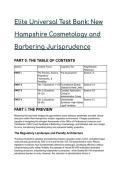
Elite Universal Test Bank: New
Hampshire Cosmetology and
Barbering Jurisprudence
PART 0: THE TABLE OF CONTENTS
Section Content Focus Cognitive Tier Page/Section
Reference
PART I The Preview: Axioms, Pre-Assessment Section I.A
Regulatory
Frameworks, &
Penalties
PART II Tier 1 (Questions 1–15) Foundational Syntax: Section II.A
Statutes & Hard Limits
PART II Tier 2 (Questions Complex Application: Section II.B
16–35) Clinical &
Administrative Crises
PART II Tier 3 (Questions Grandmaster Section II.C
36–60) Synthesis: High-Stakes
Legal Variables
PART I: THE PREVIEW
Mastering this test bank bridges the gap between basic statutory awareness and elite clinical
execution within New Hampshire's modern regulatory environment. It forges practitioners
capable of navigating the stringent frameworks of the Office of Professional Licensure and
Certification (OPLC) and the Board of Barbering, Cosmetology, and Esthetics with zero margin
for error, transforming theoretical policy into real-world liability protection.
The Regulatory Landscape and Penalty Architecture
The New Hampshire aesthetic and barbering industry operates under a strict, centralized legal
code primarily governed by RSA 313-A and the Bar 100-700 administrative rules. Recent
legislative evolutions have fundamentally altered the landscape, prioritizing efficiency without
compromising public safety. Notably, the passage of House Bill 409 eradicated redundant
licensing structures, empowering independent contractors , while Senate Bill 194 streamlined
educational barriers to entry. However, this reduction in administrative friction is
,counterbalanced by a draconian enforcement matrix. Inspectors deploy the Bar 404 point
system to aggressively penalize infection control failures, unlicensed practice, and
unprofessional conduct. To survive an inspection, practitioners must internalize not only the
chemical and biological safety protocols but the exact financial consequences of violating them.
License Classification Mandatory Training Apprenticeship Renewal Cycle (Birth
Hours (School) Equivalent Month)
Cosmetologist 1,200 hours (Updated 3,000 hours Even Years
2025)
Master Barber 1,500 hours 3,000 hours Odd Years
Barber 800 hours 1,600 hours Odd Years
Esthetician 600 hours 1,200 hours Odd Years
Manicurist 300 hours 600 hours Odd Years
Violation Category (Bar 404.09) Administrative Penalty Points Operational Consequence
Minor Facility Failure (e.g., 3 to 5 Points Routine fine compounding
Dirty floors, missing signs)
Unprofessional Conduct 50 Points Escalating fine, disciplinary
(e.g., Yelling at inspector) review
Missing SDS or Eyewash 100 to 250 Points Severe fine, immediate
Station remediation
No EPA-Registered 250 Points Catastrophic fine, major safety
Disinfectant violation
Unlicensed Practice 500 Points per incident Maximum penalty, potential
(Unlicensed worker touching closure
client)
The "Critical Axioms" Cheat Sheet
● The SB 194 Efficiency Standard: As of August 2025, the mandatory training hours for a
cosmetologist in New Hampshire were definitively reduced from 1,500 to 1,200 hours.
Legacy numbers are fatal errors on the modern exam.
● The HB 409 Autonomy Rule: The state eliminated the redundant "booth license".
Independent contractors operating within a licensed shop require only their personal
professional license and the overarching shop license.
● The Expiration Asymmetry: Cosmetology licenses expire on the last day of the
licensee's birth month in even years. Barber, Esthetician, and Manicurist licenses expire in
odd years.
● The Absolute Minor Ban (RSA 313-A:31): Tanning for anyone under 18 is completely
prohibited. Parental consent loopholes have been legislatively eradicated.
● The Blood Spill Prime Directive: When the skin is punctured, the absolute first action is
applying an antiseptic and a sterilized bandage to the wound. Gloves and tool disinfection
occur after hemorrhage control.
PART II: THE ELITE TEST BANK
Tier 1: Foundational Syntax & Application (Questions 1–15)
, Q1: A prospective cosmetology student is reviewing educational requirements to obtain a
personal license in New Hampshire following the recent legislative overhaul in 2025. Based on
the provisions of RSA 313-A:11 amended by SB 194, which represents the MOST ACCURATE
minimum training requirement to sit for the state examination? A) 1,500 hours in a
board-approved school of cosmetology. B) 600 hours in a board-approved school of
cosmetology. C) 1,200 hours in a board-approved school of cosmetology. D) 3,000 hours of
apprenticeship under a licensed barber.
● The Answer: C (1,200 hours in a board-approved school of cosmetology.)
● Distractor Analysis:
○ A is incorrect: 1,500 hours is the outdated legacy requirement. SB 194 explicitly
reduced this to 1,200 hours effective August 2025 to streamline licensure.
○ B is incorrect: 600 hours is the statutory requirement for Estheticians, not
Cosmetologists.
○ D is incorrect: While 3,000 hours is the correct volume for a cosmetology
apprenticeship, it must be served under a licensed cosmetologist, not a barber.
The Mentor's Analysis: Regulatory mastery requires operating strictly on current data. When
facing licensure qualification questions, the immediate priority is discarding legacy statutes. By
utilizing the 2025 SB 194 1,200-hour standard, you bypass the common trap of relying on
outdated educational frameworks. Professional/Academic Intuition: The law is a living
document; memorize the 2025 paradigm shift: Cosmetologists = 1,200 hours; Master Barbers =
1,500 hours; Barbers = 800 hours.
Q2: A licensed cosmetologist and a licensed esthetician, both born in October, are comparing
their license renewal deadlines. According to the renewal frameworks established by the OPLC
in RSA 313-A:20, which of the following statements is the MOST ACCURATE? A) Both licenses
expire biennially on October 31st of every even year. B) The cosmetologist must renew by
October 31st of an even year, while the esthetician must renew by October 31st of an odd year.
C) Both licenses expire biennially on the anniversary of the date they were initially issued. D)
The cosmetologist must renew by October 31st of an odd year, while the esthetician must renew
by October 31st of an even year.
● The Answer: B (The cosmetologist must renew by October 31st of an even year, while
the esthetician must renew by October 31st of an odd year.)
● Distractor Analysis:
○ A is incorrect: The OPLC purposefully bifurcates renewal years to prevent
administrative bottlenecks.
○ C is incorrect: New Hampshire ignores the original issue date for expiration;
everything is anchored to the last day of the licensee's birth month.
○ D is incorrect: This perfectly inverts the statute. Cosmetologists are explicitly
assigned even years; estheticians, barbers, and manicurists are assigned odd
years.
The Mentor's Analysis: Administrative compliance is the bedrock of clinical practice. When
tracking license validity, the immediate priority is mapping your profession to its statutory
calendar cycle. By utilizing the Even-Cosmetology/Odd-Specialty rule, you bypass the common
trap of accidental license expiration and subsequent late fees. Professional/Academic
Intuition: Your birth month is the target; your profession dictates the year. Cosmetologists own
the even years.
Q3: An independent master barber decides to rent a chair inside an established, fully licensed
barbershop in Concord, NH. Under current state law, what must the independent barber FIRST
obtain to legally operate in this space? A) A personal master barber license, a shop license, and
Hampshire Cosmetology and
Barbering Jurisprudence
PART 0: THE TABLE OF CONTENTS
Section Content Focus Cognitive Tier Page/Section
Reference
PART I The Preview: Axioms, Pre-Assessment Section I.A
Regulatory
Frameworks, &
Penalties
PART II Tier 1 (Questions 1–15) Foundational Syntax: Section II.A
Statutes & Hard Limits
PART II Tier 2 (Questions Complex Application: Section II.B
16–35) Clinical &
Administrative Crises
PART II Tier 3 (Questions Grandmaster Section II.C
36–60) Synthesis: High-Stakes
Legal Variables
PART I: THE PREVIEW
Mastering this test bank bridges the gap between basic statutory awareness and elite clinical
execution within New Hampshire's modern regulatory environment. It forges practitioners
capable of navigating the stringent frameworks of the Office of Professional Licensure and
Certification (OPLC) and the Board of Barbering, Cosmetology, and Esthetics with zero margin
for error, transforming theoretical policy into real-world liability protection.
The Regulatory Landscape and Penalty Architecture
The New Hampshire aesthetic and barbering industry operates under a strict, centralized legal
code primarily governed by RSA 313-A and the Bar 100-700 administrative rules. Recent
legislative evolutions have fundamentally altered the landscape, prioritizing efficiency without
compromising public safety. Notably, the passage of House Bill 409 eradicated redundant
licensing structures, empowering independent contractors , while Senate Bill 194 streamlined
educational barriers to entry. However, this reduction in administrative friction is
,counterbalanced by a draconian enforcement matrix. Inspectors deploy the Bar 404 point
system to aggressively penalize infection control failures, unlicensed practice, and
unprofessional conduct. To survive an inspection, practitioners must internalize not only the
chemical and biological safety protocols but the exact financial consequences of violating them.
License Classification Mandatory Training Apprenticeship Renewal Cycle (Birth
Hours (School) Equivalent Month)
Cosmetologist 1,200 hours (Updated 3,000 hours Even Years
2025)
Master Barber 1,500 hours 3,000 hours Odd Years
Barber 800 hours 1,600 hours Odd Years
Esthetician 600 hours 1,200 hours Odd Years
Manicurist 300 hours 600 hours Odd Years
Violation Category (Bar 404.09) Administrative Penalty Points Operational Consequence
Minor Facility Failure (e.g., 3 to 5 Points Routine fine compounding
Dirty floors, missing signs)
Unprofessional Conduct 50 Points Escalating fine, disciplinary
(e.g., Yelling at inspector) review
Missing SDS or Eyewash 100 to 250 Points Severe fine, immediate
Station remediation
No EPA-Registered 250 Points Catastrophic fine, major safety
Disinfectant violation
Unlicensed Practice 500 Points per incident Maximum penalty, potential
(Unlicensed worker touching closure
client)
The "Critical Axioms" Cheat Sheet
● The SB 194 Efficiency Standard: As of August 2025, the mandatory training hours for a
cosmetologist in New Hampshire were definitively reduced from 1,500 to 1,200 hours.
Legacy numbers are fatal errors on the modern exam.
● The HB 409 Autonomy Rule: The state eliminated the redundant "booth license".
Independent contractors operating within a licensed shop require only their personal
professional license and the overarching shop license.
● The Expiration Asymmetry: Cosmetology licenses expire on the last day of the
licensee's birth month in even years. Barber, Esthetician, and Manicurist licenses expire in
odd years.
● The Absolute Minor Ban (RSA 313-A:31): Tanning for anyone under 18 is completely
prohibited. Parental consent loopholes have been legislatively eradicated.
● The Blood Spill Prime Directive: When the skin is punctured, the absolute first action is
applying an antiseptic and a sterilized bandage to the wound. Gloves and tool disinfection
occur after hemorrhage control.
PART II: THE ELITE TEST BANK
Tier 1: Foundational Syntax & Application (Questions 1–15)
, Q1: A prospective cosmetology student is reviewing educational requirements to obtain a
personal license in New Hampshire following the recent legislative overhaul in 2025. Based on
the provisions of RSA 313-A:11 amended by SB 194, which represents the MOST ACCURATE
minimum training requirement to sit for the state examination? A) 1,500 hours in a
board-approved school of cosmetology. B) 600 hours in a board-approved school of
cosmetology. C) 1,200 hours in a board-approved school of cosmetology. D) 3,000 hours of
apprenticeship under a licensed barber.
● The Answer: C (1,200 hours in a board-approved school of cosmetology.)
● Distractor Analysis:
○ A is incorrect: 1,500 hours is the outdated legacy requirement. SB 194 explicitly
reduced this to 1,200 hours effective August 2025 to streamline licensure.
○ B is incorrect: 600 hours is the statutory requirement for Estheticians, not
Cosmetologists.
○ D is incorrect: While 3,000 hours is the correct volume for a cosmetology
apprenticeship, it must be served under a licensed cosmetologist, not a barber.
The Mentor's Analysis: Regulatory mastery requires operating strictly on current data. When
facing licensure qualification questions, the immediate priority is discarding legacy statutes. By
utilizing the 2025 SB 194 1,200-hour standard, you bypass the common trap of relying on
outdated educational frameworks. Professional/Academic Intuition: The law is a living
document; memorize the 2025 paradigm shift: Cosmetologists = 1,200 hours; Master Barbers =
1,500 hours; Barbers = 800 hours.
Q2: A licensed cosmetologist and a licensed esthetician, both born in October, are comparing
their license renewal deadlines. According to the renewal frameworks established by the OPLC
in RSA 313-A:20, which of the following statements is the MOST ACCURATE? A) Both licenses
expire biennially on October 31st of every even year. B) The cosmetologist must renew by
October 31st of an even year, while the esthetician must renew by October 31st of an odd year.
C) Both licenses expire biennially on the anniversary of the date they were initially issued. D)
The cosmetologist must renew by October 31st of an odd year, while the esthetician must renew
by October 31st of an even year.
● The Answer: B (The cosmetologist must renew by October 31st of an even year, while
the esthetician must renew by October 31st of an odd year.)
● Distractor Analysis:
○ A is incorrect: The OPLC purposefully bifurcates renewal years to prevent
administrative bottlenecks.
○ C is incorrect: New Hampshire ignores the original issue date for expiration;
everything is anchored to the last day of the licensee's birth month.
○ D is incorrect: This perfectly inverts the statute. Cosmetologists are explicitly
assigned even years; estheticians, barbers, and manicurists are assigned odd
years.
The Mentor's Analysis: Administrative compliance is the bedrock of clinical practice. When
tracking license validity, the immediate priority is mapping your profession to its statutory
calendar cycle. By utilizing the Even-Cosmetology/Odd-Specialty rule, you bypass the common
trap of accidental license expiration and subsequent late fees. Professional/Academic
Intuition: Your birth month is the target; your profession dictates the year. Cosmetologists own
the even years.
Q3: An independent master barber decides to rent a chair inside an established, fully licensed
barbershop in Concord, NH. Under current state law, what must the independent barber FIRST
obtain to legally operate in this space? A) A personal master barber license, a shop license, and


