

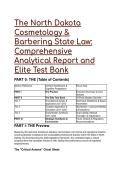
The North Dakota
Cosmetology &
Barbering State Law:
Comprehensive
Analytical Report and
Elite Test Bank
PART 0: THE (Table of Contents)
Section Reference Content Architecture & Focus Area
Cognitive Progression
PART I The Preview Executive Summary & Core
Statutes
PART II The Elite Test Bank 30-Point Mastery Gauntlet
Tier 1 Foundational Syntax & Hard Deck Definitions & Space
Application (Q1–Q10) Parameters
Tier 2 Complex Application & Disinfection, Licensure Mobility,
Simulation (Q11–Q20) & Exemptions
Tier 3 Grandmaster Synthesis Dual-Liability, Medical
(Q21–Q30) Oversight, & Adjudication
PART III Strategic Synthesis & Future Outlook & Regulatory
Conclusions Recommendations
PART I: THE Preview
Mastering this test bank transforms statutory memorization into clinical and operational intuition,
ensuring absolute compliance and unassailable professional practice within the State of North
Dakota. By deconstructing the 2026 legislative framework, the candidate forges a critical
analytical lens that translates directly to elite, liability-free performance across all regulated
establishments.
The "Critical Axioms" Cheat Sheet
, ● The Stratum Corneum Barrier: Under North Dakota Century Code (NDCC) Chapter
43-11, cosmetology and standard esthetics are strictly limited to noninvasive care,
meaning practitioners may not alter, cut, puncture, or damage living cells.
● The Ablative Prohibition: Ablative esthetic procedures (excising, vaporizing, or
disintegrating living tissue) are universally prohibited for all licensees, including Advanced
Estheticians, maintaining a strict firewall between aesthetics and surgery.
● The Structural Firewall: Salons located within residential buildings must be isolated from
living quarters by complete partitioning and solid, self-closing doors, alongside an entirely
separate public entrance.
● The Supervisory Mandate: Every salon must be supervised by a Master Licensee who
must be physically present during business hours, with temporary absences capped
strictly at one hour.
● The Dual-Liability Doctrine: In dual-licensed establishments, the facility owner bears
absolute liability for maintaining compliance across all overlapping jurisdictions, nullifying
independent contractor shields regarding environmental safety.
PART II: THE ELITE TEST BANK
Tier 1 - Foundational Syntax & Application
Q1: A newly licensed esthetician in North Dakota wishes to expand their service menu to
include procedures that vaporize and excise living tissue for deep scar removal. Based on the
principles of North Dakota Century Code (NDCC) Chapter 43-11, which conclusion regarding
this practice is the MOST ACCURATE? A) The esthetician may perform the procedure if they
first obtain a Master Esthetician license. B) The procedure may be performed provided it is
executed under the direct, physical supervision of a licensed health care provider. C) The
procedure is strictly prohibited, as all ablative esthetic procedures fall outside the legal scope of
practice for any cosmetology or esthetics licensee. D) The esthetician may perform the
procedure after completing an 1,100-hour Advanced Esthetics curriculum and obtaining board
certification.
● The Answer: C (The procedure is strictly prohibited, as all ablative esthetic procedures
fall outside the legal scope of practice for any cosmetology or esthetics licensee.)
● Distractor Analysis:
○ A is incorrect: A Master Esthetician license grants supervisory and managerial
authority over an establishment; it does not expand the clinical scope of practice to
include medical-grade tissue excision.
○ B is incorrect: While Advanced Estheticians may perform nonablative procedures
under the collaborative agreement of a health care provider, ablative procedures
remain explicitly forbidden for all board licensees, regardless of medical oversight.
○ D is incorrect: Completing the 1,100-hour Advanced Esthetics curriculum permits
procedures like microneedling and advanced chemical peels, but the statutory
definition still explicitly prohibits ablative tissue destruction.
The Mentor's Analysis: Scope of practice statutes establish rigid clinical boundaries to protect
public safety and prevent the unauthorized practice of medicine. The evidence suggests that the
North Dakota legislature deliberately isolated aesthetic skin care from surgical intervention by
codifying the prohibition of ablative acts. When facing questions of tissue manipulation, the
immediate priority is identifying whether the procedure is noninvasive, nonablative, or ablative.
, By utilizing the ablative prohibition rule, the practitioner bypasses the common trap of assuming
advanced licensure permits surgical interventions. Furthermore, the analysis indicates that
bridging the gap into tissue vaporization introduces severe medical liabilities that cosmetic
boards are not equipped to adjudicate. Professional/Academic Intuition: Never breach the
living tissue threshold; ablative procedures are the exclusive domain of medical
practitioners and remain universally banned under Title 43.
Q2: A student is preparing to enroll in a North Dakota cosmetology school in 2026. Based on
the current educational standards established by the Board of Cosmetology, which baseline
hourly requirement is the MOST ACCURATE for standard cosmetology licensure via the
traditional school pathway? A) 1,000 hours of didactic and practical training. B) 1,800 hours of
didactic and practical training. C) 1,500 hours of didactic and practical training. D) 2,500 hours
of didactic and practical training.
● The Answer: C (1,500 hours of didactic and practical training.)
● Distractor Analysis:
○ A is incorrect: While 1,000 hours represents the standard for deregulated
jurisdictions, it falls severely short of North Dakota's minimum competency
framework.
○ B is incorrect: The 1,800-hour metric was the legacy requirement in North Dakota
prior to the statutory reduction that took effect on August 1, 2021.
○ D is incorrect: The 2,500-hour requirement is specific to a registered apprenticeship
program in cosmetology, not a formal school curriculum.
The Mentor's Analysis: Academic minimums dictate the baseline for clinical competency,
public safety, and state reciprocity. The historical data indicates a nationwide trend toward
reducing occupational licensing barriers, which influenced North Dakota to lower the
cosmetology school requirement from 1,800 to 1,500 hours in 2021. Concurrently, the state
introduced robust apprenticeship pathways by 2026 to offer alternative educational access
without compromising total experiential exposure. When facing licensure qualifications, the
immediate priority is verifying the current statutory hours against the chosen pathway. By
utilizing the 1,500-hour cosmetology benchmark, the candidate bypasses the common trap of
citing outdated legacy laws or confusing school hours with apprenticeship hours.
Professional/Academic Intuition: Current standard school hours are fixed: Cosmetology
requires 1,500 hours, Advanced Esthetics requires 1,100 hours, and standard Esthetics
requires 600 hours.
Q3: A licensed cosmetologist wishes to convert a spare room in their residential home into a
fully functional salon. Based on the principles of North Dakota Administrative Code (NDAC)
Chapter 32-02-01, which structural modification is FIRST required to achieve compliance? A)
Installing a ventilation system capable of 10 air exchanges per hour. B) Constructing complete
partitioning with a solid, self-closing door and establishing a separate public entrance. C)
Ensuring the room provides a minimum of 100 square feet of primary workspace. D) Labeling
the internal household restroom for dual use by both family members and paying clientele.
● The Answer: B (Constructing complete partitioning with a solid, self-closing door and
establishing a separate public entrance.)
● Distractor Analysis:
○ A is incorrect: While exhaust systems are required for salons to mitigate chemical
fumes, the foundational necessity for a residential salon is structural isolation from
the living quarters.
○ C is incorrect: The 100-square-foot minimum is specific to the Board of Barber
Examiners' spatial requirements, not the Cosmetology Board's structural rules.
Cosmetology &
Barbering State Law:
Comprehensive
Analytical Report and
Elite Test Bank
PART 0: THE (Table of Contents)
Section Reference Content Architecture & Focus Area
Cognitive Progression
PART I The Preview Executive Summary & Core
Statutes
PART II The Elite Test Bank 30-Point Mastery Gauntlet
Tier 1 Foundational Syntax & Hard Deck Definitions & Space
Application (Q1–Q10) Parameters
Tier 2 Complex Application & Disinfection, Licensure Mobility,
Simulation (Q11–Q20) & Exemptions
Tier 3 Grandmaster Synthesis Dual-Liability, Medical
(Q21–Q30) Oversight, & Adjudication
PART III Strategic Synthesis & Future Outlook & Regulatory
Conclusions Recommendations
PART I: THE Preview
Mastering this test bank transforms statutory memorization into clinical and operational intuition,
ensuring absolute compliance and unassailable professional practice within the State of North
Dakota. By deconstructing the 2026 legislative framework, the candidate forges a critical
analytical lens that translates directly to elite, liability-free performance across all regulated
establishments.
The "Critical Axioms" Cheat Sheet
, ● The Stratum Corneum Barrier: Under North Dakota Century Code (NDCC) Chapter
43-11, cosmetology and standard esthetics are strictly limited to noninvasive care,
meaning practitioners may not alter, cut, puncture, or damage living cells.
● The Ablative Prohibition: Ablative esthetic procedures (excising, vaporizing, or
disintegrating living tissue) are universally prohibited for all licensees, including Advanced
Estheticians, maintaining a strict firewall between aesthetics and surgery.
● The Structural Firewall: Salons located within residential buildings must be isolated from
living quarters by complete partitioning and solid, self-closing doors, alongside an entirely
separate public entrance.
● The Supervisory Mandate: Every salon must be supervised by a Master Licensee who
must be physically present during business hours, with temporary absences capped
strictly at one hour.
● The Dual-Liability Doctrine: In dual-licensed establishments, the facility owner bears
absolute liability for maintaining compliance across all overlapping jurisdictions, nullifying
independent contractor shields regarding environmental safety.
PART II: THE ELITE TEST BANK
Tier 1 - Foundational Syntax & Application
Q1: A newly licensed esthetician in North Dakota wishes to expand their service menu to
include procedures that vaporize and excise living tissue for deep scar removal. Based on the
principles of North Dakota Century Code (NDCC) Chapter 43-11, which conclusion regarding
this practice is the MOST ACCURATE? A) The esthetician may perform the procedure if they
first obtain a Master Esthetician license. B) The procedure may be performed provided it is
executed under the direct, physical supervision of a licensed health care provider. C) The
procedure is strictly prohibited, as all ablative esthetic procedures fall outside the legal scope of
practice for any cosmetology or esthetics licensee. D) The esthetician may perform the
procedure after completing an 1,100-hour Advanced Esthetics curriculum and obtaining board
certification.
● The Answer: C (The procedure is strictly prohibited, as all ablative esthetic procedures
fall outside the legal scope of practice for any cosmetology or esthetics licensee.)
● Distractor Analysis:
○ A is incorrect: A Master Esthetician license grants supervisory and managerial
authority over an establishment; it does not expand the clinical scope of practice to
include medical-grade tissue excision.
○ B is incorrect: While Advanced Estheticians may perform nonablative procedures
under the collaborative agreement of a health care provider, ablative procedures
remain explicitly forbidden for all board licensees, regardless of medical oversight.
○ D is incorrect: Completing the 1,100-hour Advanced Esthetics curriculum permits
procedures like microneedling and advanced chemical peels, but the statutory
definition still explicitly prohibits ablative tissue destruction.
The Mentor's Analysis: Scope of practice statutes establish rigid clinical boundaries to protect
public safety and prevent the unauthorized practice of medicine. The evidence suggests that the
North Dakota legislature deliberately isolated aesthetic skin care from surgical intervention by
codifying the prohibition of ablative acts. When facing questions of tissue manipulation, the
immediate priority is identifying whether the procedure is noninvasive, nonablative, or ablative.
, By utilizing the ablative prohibition rule, the practitioner bypasses the common trap of assuming
advanced licensure permits surgical interventions. Furthermore, the analysis indicates that
bridging the gap into tissue vaporization introduces severe medical liabilities that cosmetic
boards are not equipped to adjudicate. Professional/Academic Intuition: Never breach the
living tissue threshold; ablative procedures are the exclusive domain of medical
practitioners and remain universally banned under Title 43.
Q2: A student is preparing to enroll in a North Dakota cosmetology school in 2026. Based on
the current educational standards established by the Board of Cosmetology, which baseline
hourly requirement is the MOST ACCURATE for standard cosmetology licensure via the
traditional school pathway? A) 1,000 hours of didactic and practical training. B) 1,800 hours of
didactic and practical training. C) 1,500 hours of didactic and practical training. D) 2,500 hours
of didactic and practical training.
● The Answer: C (1,500 hours of didactic and practical training.)
● Distractor Analysis:
○ A is incorrect: While 1,000 hours represents the standard for deregulated
jurisdictions, it falls severely short of North Dakota's minimum competency
framework.
○ B is incorrect: The 1,800-hour metric was the legacy requirement in North Dakota
prior to the statutory reduction that took effect on August 1, 2021.
○ D is incorrect: The 2,500-hour requirement is specific to a registered apprenticeship
program in cosmetology, not a formal school curriculum.
The Mentor's Analysis: Academic minimums dictate the baseline for clinical competency,
public safety, and state reciprocity. The historical data indicates a nationwide trend toward
reducing occupational licensing barriers, which influenced North Dakota to lower the
cosmetology school requirement from 1,800 to 1,500 hours in 2021. Concurrently, the state
introduced robust apprenticeship pathways by 2026 to offer alternative educational access
without compromising total experiential exposure. When facing licensure qualifications, the
immediate priority is verifying the current statutory hours against the chosen pathway. By
utilizing the 1,500-hour cosmetology benchmark, the candidate bypasses the common trap of
citing outdated legacy laws or confusing school hours with apprenticeship hours.
Professional/Academic Intuition: Current standard school hours are fixed: Cosmetology
requires 1,500 hours, Advanced Esthetics requires 1,100 hours, and standard Esthetics
requires 600 hours.
Q3: A licensed cosmetologist wishes to convert a spare room in their residential home into a
fully functional salon. Based on the principles of North Dakota Administrative Code (NDAC)
Chapter 32-02-01, which structural modification is FIRST required to achieve compliance? A)
Installing a ventilation system capable of 10 air exchanges per hour. B) Constructing complete
partitioning with a solid, self-closing door and establishing a separate public entrance. C)
Ensuring the room provides a minimum of 100 square feet of primary workspace. D) Labeling
the internal household restroom for dual use by both family members and paying clientele.
● The Answer: B (Constructing complete partitioning with a solid, self-closing door and
establishing a separate public entrance.)
● Distractor Analysis:
○ A is incorrect: While exhaust systems are required for salons to mitigate chemical
fumes, the foundational necessity for a residential salon is structural isolation from
the living quarters.
○ C is incorrect: The 100-square-foot minimum is specific to the Board of Barber
Examiners' spatial requirements, not the Cosmetology Board's structural rules.


