

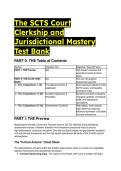
The SCTS Court
Clerkship and
Jurisdictional Mastery
Test Bank
PART 0: THE Table of Contents
Section Cognitive Tier Objective / Area of Focus
PART I: THE Preview N/A High-impact overview and
essential procedural cheat
sheet.
PART II: THE ELITE TEST N/A The core 30-question
BANK assessment gauntlet.
├─ Tier 1 (Questions 1–10) Foundational Syntax & Direct testing of statutory limits,
Application SCTS values, and baseline
procedural rules.
├─ Tier 2 (Questions 11–20) Complex Application & Dynamic scenarios evaluating
Simulation changing variables, procedural
shifts, and operational
calculations.
└─ Tier 3 (Questions 21–30) Grandmaster Synthesis High-stakes, multi-variable
legal dilemmas requiring
advanced synthesis of Scottish
civil and criminal law.
PART I: THE Preview
Mastering the Scottish Courts and Tribunals Service (SCTS) clerkship and jurisdictional
assessment ensures a flawless transition from theoretical procedural rules to precise,
high-performance courtroom execution. This elite test bank bridges the gap between academic
civil and criminal frameworks and the high-speed operational demands of the Scottish judicial
administration.
The "Critical Axioms" Cheat Sheet
The administration of justice within the Scottish legal system relies on several non-negotiable
statutory frameworks and operational boundaries:
● Criminal Sentencing Caps: The Justice of the Peace (JP) Court is limited to 60 days
, imprisonment and a £2,500 fine. The Sheriff Summary Court is capped at 12 months
imprisonment and a £10,000 fine, subject to specific statutory augmentations such as bail
aggravations. The Sheriff Solemn Court is capped at 5 years imprisonment but possesses
unlimited fine capability, with cases exceeding this sentencing requirement remitted
directly to the High Court of Justiciary.
● Judicial Interest Configurations: The default judicial interest rate in Scotland is 8% per
annum, running from the date of citation (service) until payment. However, under the
Interest on Damages (Scotland) Act 1958, judges maintain broad equitable discretion to
apply split interest rates (such as a reduced 4% pre-decree rate and a full 8% post-decree
rate) to align with post-2008 market conditions and prevent windfall bonuses for pursuers.
Commercial debts fall under the Late Payment of Commercial Debts (Interest) Act 1998,
running at 8% above the Bank of England base rate.
● Court of Session Architectural Quorums: The Outer House operates as a court of first
instance presided over by a single Lord Ordinary. The Inner House is primarily an
appellate court divided into the First and Second Divisions (presided over by the Lord
President and Lord Justice Clerk, respectively), which require a minimum quorum of three
judges for reclaiming motions but permit a single judge to preside over administrative and
procedural motions.
● SCTS Information Security and Public Access: Court rolls must be updated and
published under UK GDPR Article 6(1)(e) public interest provisions. High Court rolls are
published five weeks in advance and updated twice daily; Sheriff Court rolls are published
five days in advance and updated twice daily. Closed-court proceedings are strictly
excluded from public rolls to prevent unlawful exposure of protected identities.
PART II: THE ELITE TEST BANK
Tier 1: Foundational Syntax & Application (Questions 1–10)
Q1: A candidate applies for an Administrative Officer (AO) position within the SCTS Tribunal
Operations Directorate. During the background check phase, the candidate requests to withhold
disclosure of a conviction that has been classified as "spent" under standard UK employment
guidelines. Based on SCTS recruitment regulations, which conclusion is the MOST
ACCURATE? A) The candidate is legally permitted to withhold the spent conviction under the
Rehabilitation of Offenders Act 1974. B) The candidate must disclose both spent and unspent
convictions because the SCTS is entirely exempt from the protections of the Rehabilitation of
Offenders Act 1974. C) The candidate only needs to disclose spent convictions if applying for
higher-level positions (HEO and above). D) The candidate must disclose unspent convictions,
but spent convictions are automatically anonymized by the recruitment system.
● The Answer: B (The candidate must disclose both spent and unspent convictions
because the SCTS is entirely exempt from the protections of the Rehabilitation of
Offenders Act 1974.)
● Distractor Analysis:
○ A is incorrect: While standard UK employers must respect spent convictions, the
SCTS is specifically exempt under the Rehabilitation of Offenders Act 1974
(Exclusions and Exceptions) (Scotland) Order.
○ C is incorrect: The exemption applies to all levels of recruitment within the SCTS,
including entry-level administrative positions, Macers, and Jury Minders.
, ○ D is incorrect: The SCTS recruitment system anonymizes personal identity details
during initial selection panel reviews, but it does not bypass the mandatory standard
Disclosure check which requires full transparency of all convictions.
The Mentor's Analysis: The Scottish legal system demands absolute institutional integrity.
Because the SCTS supports the administration of justice and handles sensitive information, it is
legally permitted to bypass standard rehabilitation protections. By requiring a standard-level
Disclosure check for all successful applicants, the service protects the public interest and the
security of court proceedings. Professional/Academic Intuition: Every candidate entering
SCTS employment must undergo comprehensive criminal history disclosure, as spent
convictions are never legally hidden from judicial administrative employers.
Double-space
Q2: A court officer is tasked with publishing the upcoming court rolls on the official SCTS public
portal. Following the established SCTS privacy guidelines and statutory requirements, what are
the MOST ACCURATE advance publication and update frequencies for Sheriff Court rolls? A)
Published 5 weeks in advance, updated once daily at 06:00. B) Published 5 days in advance,
updated twice daily, Monday to Friday. C) Published 12 weeks in advance, updated daily at
approximately 14:00. D) Published 5 days in advance, updated once daily at 18:00, Monday to
Friday.
● The Answer: B (Published 5 days in advance, updated twice daily, Monday to Friday.)
● Distractor Analysis:
○ A is incorrect: This is the publication standard for High Court rolls, which are
available five weeks in advance and updated at approximately 06:00 and 18:00.
○ C is incorrect: This refers to the duration that Court of Session daily rolls remain
archived on the website (12 weeks), not the active advance publication timeline for
Sheriff Courts.
○ D is incorrect: While the previous day's rolls are removed at 18:00, Sheriff Court
rolls must be updated twice daily to capture rapid summary-level procedural
changes.
The Mentor's Analysis: Court rolls are vital public documents published under the public
interest mandate of UK GDPR Article 6(1)(e). The difference in publication timelines between
the High Court (five weeks) and Sheriff Courts (five days) reflects the higher operational velocity
and case volume of local summary jurisdictions. Professional/Academic Intuition: Sheriff
Court rolls must balance public accessibility with operational fluidity by maintaining a
tight five-day rolling window updated twice daily.
Double-space
Q3: During a busy court session, a clerk is confronted by an agitated party who claims their
hearing details are incorrect on the public notice board. The clerk politely listens, cross-checks
the physical file with the digital database, identifies a clerical error, corrects it immediately, and
explains the correction to the individual. Which combination of SCTS core values has the clerk
MOST DIRECTLY demonstrated? A) Innovation and Accountability. B) Respect and Service. C)
Collaboration and Continuous Improvement. D) Openness and Corporate Governance.
● The Answer: B (Respect and Service.)
● Distractor Analysis:
○ A is incorrect: While the clerk took responsibility, the primary action involved treating
the individual with dignity and delivering a professional service, which falls under
the Respect and Service value categories.
○ C is incorrect: Collaboration and continuous improvement refer to
inter-organizational system-wide reforms, whereas this was a direct, front-line
Clerkship and
Jurisdictional Mastery
Test Bank
PART 0: THE Table of Contents
Section Cognitive Tier Objective / Area of Focus
PART I: THE Preview N/A High-impact overview and
essential procedural cheat
sheet.
PART II: THE ELITE TEST N/A The core 30-question
BANK assessment gauntlet.
├─ Tier 1 (Questions 1–10) Foundational Syntax & Direct testing of statutory limits,
Application SCTS values, and baseline
procedural rules.
├─ Tier 2 (Questions 11–20) Complex Application & Dynamic scenarios evaluating
Simulation changing variables, procedural
shifts, and operational
calculations.
└─ Tier 3 (Questions 21–30) Grandmaster Synthesis High-stakes, multi-variable
legal dilemmas requiring
advanced synthesis of Scottish
civil and criminal law.
PART I: THE Preview
Mastering the Scottish Courts and Tribunals Service (SCTS) clerkship and jurisdictional
assessment ensures a flawless transition from theoretical procedural rules to precise,
high-performance courtroom execution. This elite test bank bridges the gap between academic
civil and criminal frameworks and the high-speed operational demands of the Scottish judicial
administration.
The "Critical Axioms" Cheat Sheet
The administration of justice within the Scottish legal system relies on several non-negotiable
statutory frameworks and operational boundaries:
● Criminal Sentencing Caps: The Justice of the Peace (JP) Court is limited to 60 days
, imprisonment and a £2,500 fine. The Sheriff Summary Court is capped at 12 months
imprisonment and a £10,000 fine, subject to specific statutory augmentations such as bail
aggravations. The Sheriff Solemn Court is capped at 5 years imprisonment but possesses
unlimited fine capability, with cases exceeding this sentencing requirement remitted
directly to the High Court of Justiciary.
● Judicial Interest Configurations: The default judicial interest rate in Scotland is 8% per
annum, running from the date of citation (service) until payment. However, under the
Interest on Damages (Scotland) Act 1958, judges maintain broad equitable discretion to
apply split interest rates (such as a reduced 4% pre-decree rate and a full 8% post-decree
rate) to align with post-2008 market conditions and prevent windfall bonuses for pursuers.
Commercial debts fall under the Late Payment of Commercial Debts (Interest) Act 1998,
running at 8% above the Bank of England base rate.
● Court of Session Architectural Quorums: The Outer House operates as a court of first
instance presided over by a single Lord Ordinary. The Inner House is primarily an
appellate court divided into the First and Second Divisions (presided over by the Lord
President and Lord Justice Clerk, respectively), which require a minimum quorum of three
judges for reclaiming motions but permit a single judge to preside over administrative and
procedural motions.
● SCTS Information Security and Public Access: Court rolls must be updated and
published under UK GDPR Article 6(1)(e) public interest provisions. High Court rolls are
published five weeks in advance and updated twice daily; Sheriff Court rolls are published
five days in advance and updated twice daily. Closed-court proceedings are strictly
excluded from public rolls to prevent unlawful exposure of protected identities.
PART II: THE ELITE TEST BANK
Tier 1: Foundational Syntax & Application (Questions 1–10)
Q1: A candidate applies for an Administrative Officer (AO) position within the SCTS Tribunal
Operations Directorate. During the background check phase, the candidate requests to withhold
disclosure of a conviction that has been classified as "spent" under standard UK employment
guidelines. Based on SCTS recruitment regulations, which conclusion is the MOST
ACCURATE? A) The candidate is legally permitted to withhold the spent conviction under the
Rehabilitation of Offenders Act 1974. B) The candidate must disclose both spent and unspent
convictions because the SCTS is entirely exempt from the protections of the Rehabilitation of
Offenders Act 1974. C) The candidate only needs to disclose spent convictions if applying for
higher-level positions (HEO and above). D) The candidate must disclose unspent convictions,
but spent convictions are automatically anonymized by the recruitment system.
● The Answer: B (The candidate must disclose both spent and unspent convictions
because the SCTS is entirely exempt from the protections of the Rehabilitation of
Offenders Act 1974.)
● Distractor Analysis:
○ A is incorrect: While standard UK employers must respect spent convictions, the
SCTS is specifically exempt under the Rehabilitation of Offenders Act 1974
(Exclusions and Exceptions) (Scotland) Order.
○ C is incorrect: The exemption applies to all levels of recruitment within the SCTS,
including entry-level administrative positions, Macers, and Jury Minders.
, ○ D is incorrect: The SCTS recruitment system anonymizes personal identity details
during initial selection panel reviews, but it does not bypass the mandatory standard
Disclosure check which requires full transparency of all convictions.
The Mentor's Analysis: The Scottish legal system demands absolute institutional integrity.
Because the SCTS supports the administration of justice and handles sensitive information, it is
legally permitted to bypass standard rehabilitation protections. By requiring a standard-level
Disclosure check for all successful applicants, the service protects the public interest and the
security of court proceedings. Professional/Academic Intuition: Every candidate entering
SCTS employment must undergo comprehensive criminal history disclosure, as spent
convictions are never legally hidden from judicial administrative employers.
Double-space
Q2: A court officer is tasked with publishing the upcoming court rolls on the official SCTS public
portal. Following the established SCTS privacy guidelines and statutory requirements, what are
the MOST ACCURATE advance publication and update frequencies for Sheriff Court rolls? A)
Published 5 weeks in advance, updated once daily at 06:00. B) Published 5 days in advance,
updated twice daily, Monday to Friday. C) Published 12 weeks in advance, updated daily at
approximately 14:00. D) Published 5 days in advance, updated once daily at 18:00, Monday to
Friday.
● The Answer: B (Published 5 days in advance, updated twice daily, Monday to Friday.)
● Distractor Analysis:
○ A is incorrect: This is the publication standard for High Court rolls, which are
available five weeks in advance and updated at approximately 06:00 and 18:00.
○ C is incorrect: This refers to the duration that Court of Session daily rolls remain
archived on the website (12 weeks), not the active advance publication timeline for
Sheriff Courts.
○ D is incorrect: While the previous day's rolls are removed at 18:00, Sheriff Court
rolls must be updated twice daily to capture rapid summary-level procedural
changes.
The Mentor's Analysis: Court rolls are vital public documents published under the public
interest mandate of UK GDPR Article 6(1)(e). The difference in publication timelines between
the High Court (five weeks) and Sheriff Courts (five days) reflects the higher operational velocity
and case volume of local summary jurisdictions. Professional/Academic Intuition: Sheriff
Court rolls must balance public accessibility with operational fluidity by maintaining a
tight five-day rolling window updated twice daily.
Double-space
Q3: During a busy court session, a clerk is confronted by an agitated party who claims their
hearing details are incorrect on the public notice board. The clerk politely listens, cross-checks
the physical file with the digital database, identifies a clerical error, corrects it immediately, and
explains the correction to the individual. Which combination of SCTS core values has the clerk
MOST DIRECTLY demonstrated? A) Innovation and Accountability. B) Respect and Service. C)
Collaboration and Continuous Improvement. D) Openness and Corporate Governance.
● The Answer: B (Respect and Service.)
● Distractor Analysis:
○ A is incorrect: While the clerk took responsibility, the primary action involved treating
the individual with dignity and delivering a professional service, which falls under
the Respect and Service value categories.
○ C is incorrect: Collaboration and continuous improvement refer to
inter-organizational system-wide reforms, whereas this was a direct, front-line


