

Anatomy and Physiology- The Skeletal System
Study online at https://quizlet.com/_jn1hlv
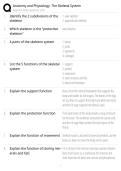
1. Identify the 2 subdivisions of the 1. axial skeleton
skeleton 2. appendicular skeleton
2. Which skeleton is the "protective axial skeleton
skeleton"
3. 4 parts of the skeleton system 1. bones
2. joints
3. ligaments
4. cartilages
4. List the 5 functions of the skeletal 1. support
system 2. protect
3. movement
4. store minerals and fats
5. blood cell formation
5. Explain the support function Bones form the internal framework that supports the
body and cradles its soft organs. The bones of the legs
act as pillars to support the body trunk when we stand,
and the rib cage supports the thoracic wall.
6. Explain the protection function The fused bones of the skull provide a snug enclosure
for the brain. The vertebrae surrounds the spinal cord,
and the rib cage helps protect the vital organs of the
thorax.
7. Explain the function of movement Skeletal muscles, attached to bones by tendons, use the
bones as levers to move the body and its parts.
8. Explain the function of storing min- Fat is stored in the internal (marrow) cavities of bones.
erals and fats Bone itself serves as a storehouse for minerals, the
most important of which are calcium and phosphorus.
, Anatomy and Physiology- The Skeletal System
Study online at https://quizlet.com/_jn1hlv
Most of the body's calcium is deposited in the bones as
calcium salt.
9. Explain the function of blood cell hematopoiesis, occurs within the marrow cavities of cer-
formation tain bones.
10. osseous tissue bone tissue that makes up the skeletal system
11. How many bones does the adult 206
skeleton have?
12. 2 types of bone (osseous) tissue 1. compact bone
2. spongy bone
13. Describe compact bone dense, smooth, and homogenous
14. Describe spongy bone -small needle-like pieces of bone
-many open spaces
15. 4 classifications of bones 1. long bones
2. short bones
3. flat bones
4. irregular bones
16. Long bones -typically longer than they are wide
-shaft with heads situated at both ends
-contains mostly compact bone
-all of the bones of the limbs (except wrist, ankle, and
kneecap bones) are long bones
17. Examples of long bones -femur
-humerous
-ulna
-radius
Study online at https://quizlet.com/_jn1hlv
1. Identify the 2 subdivisions of the 1. axial skeleton
skeleton 2. appendicular skeleton
2. Which skeleton is the "protective axial skeleton
skeleton"
3. 4 parts of the skeleton system 1. bones
2. joints
3. ligaments
4. cartilages
4. List the 5 functions of the skeletal 1. support
system 2. protect
3. movement
4. store minerals and fats
5. blood cell formation
5. Explain the support function Bones form the internal framework that supports the
body and cradles its soft organs. The bones of the legs
act as pillars to support the body trunk when we stand,
and the rib cage supports the thoracic wall.
6. Explain the protection function The fused bones of the skull provide a snug enclosure
for the brain. The vertebrae surrounds the spinal cord,
and the rib cage helps protect the vital organs of the
thorax.
7. Explain the function of movement Skeletal muscles, attached to bones by tendons, use the
bones as levers to move the body and its parts.
8. Explain the function of storing min- Fat is stored in the internal (marrow) cavities of bones.
erals and fats Bone itself serves as a storehouse for minerals, the
most important of which are calcium and phosphorus.
, Anatomy and Physiology- The Skeletal System
Study online at https://quizlet.com/_jn1hlv
Most of the body's calcium is deposited in the bones as
calcium salt.
9. Explain the function of blood cell hematopoiesis, occurs within the marrow cavities of cer-
formation tain bones.
10. osseous tissue bone tissue that makes up the skeletal system
11. How many bones does the adult 206
skeleton have?
12. 2 types of bone (osseous) tissue 1. compact bone
2. spongy bone
13. Describe compact bone dense, smooth, and homogenous
14. Describe spongy bone -small needle-like pieces of bone
-many open spaces
15. 4 classifications of bones 1. long bones
2. short bones
3. flat bones
4. irregular bones
16. Long bones -typically longer than they are wide
-shaft with heads situated at both ends
-contains mostly compact bone
-all of the bones of the limbs (except wrist, ankle, and
kneecap bones) are long bones
17. Examples of long bones -femur
-humerous
-ulna
-radius


