

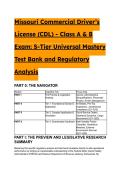
Missouri Commercial Driver’s
License (CDL) - Class A & B
Exam: S-Tier Universal Mastery
Test Bank and Regulatory
Analysis
PART 0: THE NAVIGATOR
Section Cognitive Tier Focus Area
PART I The Preview & Legislative Axioms, Administrative
Analysis Disqualifications, Pneumatic
Physics, Kinetic Management
PART II Tier 1: Foundational Syntax & Air Brakes, Pre-Trip
Application Inspections, Jurisdictional
Compliance (Q1–Q10)
PART II Tier 2: Complex Application & Out-of-Service Orders,
Simulation Clearance Dynamics, Cargo
Securement (Q11–Q20)
PART II Tier 3: Grandmaster Synthesis Multi-Variable Failure
Cascades, Hazardous
Materials, Extreme
Environment Survival
(Q21–Q30)
PART I: THE PREVIEW AND LEGISLATIVE RESEARCH
SUMMARY
Mastering this specific regulatory analysis and test bank translates directly to elite operational
performance by forging an impenetrable understanding of the Federal Motor Carrier Safety
Administration (FMCSA) and Missouri Department of Revenue statutory frameworks. By
,internalizing these complex mechanical and administrative variables, operators evolve from
novice drivers into master tacticians capable of averting catastrophic equipment failures and
navigating complex compliance matrices.
The "Critical Axioms" Cheat Sheet
● The Air Brake Absolute: Static system leakage must not exceed 2 psi/min (single
vehicle) or 3 psi/min (combination). Applied leakage must not exceed 3 psi/min (single) or
4 psi/min (combination).
● The BAC Hard Deck: A Blood Alcohol Content (BAC) of 0.04% in a Commercial Motor
Vehicle (CMV) is the absolute federal threshold. A first offense triggers a mandatory
1-year disqualification, escalating to 3 years if transporting placarded hazardous
materials.
● The Serious Violation Escalator: Accumulating two "serious traffic violations" (e.g., 15+
mph over the limit, reckless driving) in three years results in a 60-day disqualification.
Three violations in three years equal a 120-day disqualification.
● The Grade Crossing Imperative: Placarded vehicles, hazardous material transports,
and passenger-carrying commercial vehicles MUST stop entirely between 15 and 50 feet
from the nearest rail. Operators must never shift gears while actively crossing the tracks.
● The 10 B:C Mandate: Standard freight vehicles require a 5 B:C fire extinguisher.
Placarded hazardous materials vehicles require a minimum 10 B:C Underwriter's
Laboratories (UL) rating.
Jurisdictional Frameworks and Commercial Privileges
The architecture of Missouri’s commercial driving privilege is built upon strict vehicle weight
definitions and the origin-destination flow of commerce. A Class A commercial vehicle is defined
mathematically as any combination of vehicles with a Gross Combination Weight Rating
(GCWR) of 26,001 or more pounds, provided the Gross Vehicle Weight Rating (GVWR) of the
towed vehicle strictly exceeds 10,000 pounds. Should the towed unit fall to 10,000 pounds or
below, the combination downgrades to a Class B requirement, assuming the power unit
exceeds 26,001 pounds. Furthermore, operators must self-certify their medical status with the
Missouri Department of Revenue. The FMCSA categorizes commerce based on the ultimate
origin and destination of the freight, not merely the physical path of the truck. If a driver operates
entirely within Missouri (e.g., St. Louis to Kansas City) but hauls freight that originated overseas
or in another state, the operation is legally defined as Interstate Commerce. Consequently, the
driver must self-certify as Non-excepted Interstate (NI) and maintain a federal Department of
Transportation (DOT) medical card.
Pneumatic Imperatives and Mechanical Diagnostics
The commercial air brake system operates through a cascading hierarchy of pneumatic
pressures and mechanical fail-safes. The air compressor is governed to cut-out between 120
and 140 psi, establishing the operational ceiling of the system. Should the system suffer a
catastrophic breach, the low-pressure warning signal—a mandatory auditory and visual
alarm—must activate before the primary tanks drop below 55 psi. If pressure continues to bleed,
the parking brake controls (spring brakes) will automatically actuate when the system drops into
the critical range of 20 to 45 psi. This fail-safe ensures that powerful mechanical springs apply
, the braking force when pneumatic pressure is no longer viable.
During pre-trip inspections, mechanical tolerances are ruthlessly scrutinized. Slack adjusters,
which convert pneumatic pressure into mechanical friction against the brake drum, must be
checked manually. If a slack adjuster can be pulled more than one inch by hand, the brakes are
out of adjustment, creating a severe downgrade hazard and warranting an immediate
Out-of-Service (OOS) violation. Suspension systems are equally critical; missing or broken
leaves in a leaf spring assembly equating to one-fourth (25%) or more of the total leaves
mandate that the vehicle be immediately removed from service.
The FMCSA Administrative Penalty Matrix
The FMCSA enforces compliance through a severe, unforgiving administrative penalty matrix. A
commercial driver's license (CDL) is entirely tethered to the operator's base driving privilege. If a
driver receives a Driving While Intoxicated (DWI) charge in their personal Class F vehicle, the
conviction triggers a mandatory 1-year commercial disqualification, destroying their professional
livelihood regardless of the vehicle driven at the time of the offense. Similarly, refusing a
chemical breath test under Missouri's Implied Consent law is classified as a Major Offense,
triggering an identical 1-year CDL ban.
The regulatory framework distinguishes heavily between "serious traffic violations" and "major
offenses." Serious violations include excessive speeding (15 mph or more above the limit),
reckless driving, erratic lane changes, and operating a CMV while texting. Accruing two such
violations within a rolling three-year window results in a 60-day disqualification; a third elevates
the penalty to 120 days. Furthermore, Missouri assesses points against the license.
Accumulating 12 points in 12 months, 18 points in 24 months, or 24 points in 36 months triggers
a hard 1-year revocation of the license. Defying a federal Out-of-Service order is considered an
egregious breach of public trust, resulting in a 180-day disqualification for a first offense,
escalating to three years if the defiance involves a hazardous materials transport.
Disqualification Trigger Threshold / Condition Penalty Duration
Major Offense (DWI/Refusal) 1st Offense (CMV or Personal) 1-Year Disqualification
Major Offense (Hazmat) 1st Offense while placarded 3-Year Disqualification
Serious Traffic Violation 2 offenses within 3 years 60-Day Disqualification
Serious Traffic Violation 3 offenses within 3 years 120-Day Disqualification
Out-of-Service (OOS) 1st Offense driving while under 180-Day Disqualification
Violation OOS
Failure to Appear (Interstate) Ticket in non-member state Indefinite until resolved
(e.g., CA)
Kinetic Management and Hazardous Logistics
Commercial logistics require precise management of kinetic energy. The safe following distance
for heavy vehicles is mathematically standardized: drivers must maintain a minimum of one
second of space for every 10 feet of vehicle length at speeds below 40 mph. For speeds
exceeding 40 mph, an additional one second must be added to the total formula to account for
high-velocity braking distance. When transporting hazardous materials, drivers face extreme
procedural modifications. A placarded vehicle must carry a fire extinguisher with an enhanced
UL rating of 10 B:C or more. Furthermore, when staging or resting with a placarded cargo tank
containing Class 3 flammable liquids or Division 2.1 gases, no individual may smoke or carry a
lighted cigarette within a strict 25-foot perimeter of the vehicle. Failure to maintain this vapor
License (CDL) - Class A & B
Exam: S-Tier Universal Mastery
Test Bank and Regulatory
Analysis
PART 0: THE NAVIGATOR
Section Cognitive Tier Focus Area
PART I The Preview & Legislative Axioms, Administrative
Analysis Disqualifications, Pneumatic
Physics, Kinetic Management
PART II Tier 1: Foundational Syntax & Air Brakes, Pre-Trip
Application Inspections, Jurisdictional
Compliance (Q1–Q10)
PART II Tier 2: Complex Application & Out-of-Service Orders,
Simulation Clearance Dynamics, Cargo
Securement (Q11–Q20)
PART II Tier 3: Grandmaster Synthesis Multi-Variable Failure
Cascades, Hazardous
Materials, Extreme
Environment Survival
(Q21–Q30)
PART I: THE PREVIEW AND LEGISLATIVE RESEARCH
SUMMARY
Mastering this specific regulatory analysis and test bank translates directly to elite operational
performance by forging an impenetrable understanding of the Federal Motor Carrier Safety
Administration (FMCSA) and Missouri Department of Revenue statutory frameworks. By
,internalizing these complex mechanical and administrative variables, operators evolve from
novice drivers into master tacticians capable of averting catastrophic equipment failures and
navigating complex compliance matrices.
The "Critical Axioms" Cheat Sheet
● The Air Brake Absolute: Static system leakage must not exceed 2 psi/min (single
vehicle) or 3 psi/min (combination). Applied leakage must not exceed 3 psi/min (single) or
4 psi/min (combination).
● The BAC Hard Deck: A Blood Alcohol Content (BAC) of 0.04% in a Commercial Motor
Vehicle (CMV) is the absolute federal threshold. A first offense triggers a mandatory
1-year disqualification, escalating to 3 years if transporting placarded hazardous
materials.
● The Serious Violation Escalator: Accumulating two "serious traffic violations" (e.g., 15+
mph over the limit, reckless driving) in three years results in a 60-day disqualification.
Three violations in three years equal a 120-day disqualification.
● The Grade Crossing Imperative: Placarded vehicles, hazardous material transports,
and passenger-carrying commercial vehicles MUST stop entirely between 15 and 50 feet
from the nearest rail. Operators must never shift gears while actively crossing the tracks.
● The 10 B:C Mandate: Standard freight vehicles require a 5 B:C fire extinguisher.
Placarded hazardous materials vehicles require a minimum 10 B:C Underwriter's
Laboratories (UL) rating.
Jurisdictional Frameworks and Commercial Privileges
The architecture of Missouri’s commercial driving privilege is built upon strict vehicle weight
definitions and the origin-destination flow of commerce. A Class A commercial vehicle is defined
mathematically as any combination of vehicles with a Gross Combination Weight Rating
(GCWR) of 26,001 or more pounds, provided the Gross Vehicle Weight Rating (GVWR) of the
towed vehicle strictly exceeds 10,000 pounds. Should the towed unit fall to 10,000 pounds or
below, the combination downgrades to a Class B requirement, assuming the power unit
exceeds 26,001 pounds. Furthermore, operators must self-certify their medical status with the
Missouri Department of Revenue. The FMCSA categorizes commerce based on the ultimate
origin and destination of the freight, not merely the physical path of the truck. If a driver operates
entirely within Missouri (e.g., St. Louis to Kansas City) but hauls freight that originated overseas
or in another state, the operation is legally defined as Interstate Commerce. Consequently, the
driver must self-certify as Non-excepted Interstate (NI) and maintain a federal Department of
Transportation (DOT) medical card.
Pneumatic Imperatives and Mechanical Diagnostics
The commercial air brake system operates through a cascading hierarchy of pneumatic
pressures and mechanical fail-safes. The air compressor is governed to cut-out between 120
and 140 psi, establishing the operational ceiling of the system. Should the system suffer a
catastrophic breach, the low-pressure warning signal—a mandatory auditory and visual
alarm—must activate before the primary tanks drop below 55 psi. If pressure continues to bleed,
the parking brake controls (spring brakes) will automatically actuate when the system drops into
the critical range of 20 to 45 psi. This fail-safe ensures that powerful mechanical springs apply
, the braking force when pneumatic pressure is no longer viable.
During pre-trip inspections, mechanical tolerances are ruthlessly scrutinized. Slack adjusters,
which convert pneumatic pressure into mechanical friction against the brake drum, must be
checked manually. If a slack adjuster can be pulled more than one inch by hand, the brakes are
out of adjustment, creating a severe downgrade hazard and warranting an immediate
Out-of-Service (OOS) violation. Suspension systems are equally critical; missing or broken
leaves in a leaf spring assembly equating to one-fourth (25%) or more of the total leaves
mandate that the vehicle be immediately removed from service.
The FMCSA Administrative Penalty Matrix
The FMCSA enforces compliance through a severe, unforgiving administrative penalty matrix. A
commercial driver's license (CDL) is entirely tethered to the operator's base driving privilege. If a
driver receives a Driving While Intoxicated (DWI) charge in their personal Class F vehicle, the
conviction triggers a mandatory 1-year commercial disqualification, destroying their professional
livelihood regardless of the vehicle driven at the time of the offense. Similarly, refusing a
chemical breath test under Missouri's Implied Consent law is classified as a Major Offense,
triggering an identical 1-year CDL ban.
The regulatory framework distinguishes heavily between "serious traffic violations" and "major
offenses." Serious violations include excessive speeding (15 mph or more above the limit),
reckless driving, erratic lane changes, and operating a CMV while texting. Accruing two such
violations within a rolling three-year window results in a 60-day disqualification; a third elevates
the penalty to 120 days. Furthermore, Missouri assesses points against the license.
Accumulating 12 points in 12 months, 18 points in 24 months, or 24 points in 36 months triggers
a hard 1-year revocation of the license. Defying a federal Out-of-Service order is considered an
egregious breach of public trust, resulting in a 180-day disqualification for a first offense,
escalating to three years if the defiance involves a hazardous materials transport.
Disqualification Trigger Threshold / Condition Penalty Duration
Major Offense (DWI/Refusal) 1st Offense (CMV or Personal) 1-Year Disqualification
Major Offense (Hazmat) 1st Offense while placarded 3-Year Disqualification
Serious Traffic Violation 2 offenses within 3 years 60-Day Disqualification
Serious Traffic Violation 3 offenses within 3 years 120-Day Disqualification
Out-of-Service (OOS) 1st Offense driving while under 180-Day Disqualification
Violation OOS
Failure to Appear (Interstate) Ticket in non-member state Indefinite until resolved
(e.g., CA)
Kinetic Management and Hazardous Logistics
Commercial logistics require precise management of kinetic energy. The safe following distance
for heavy vehicles is mathematically standardized: drivers must maintain a minimum of one
second of space for every 10 feet of vehicle length at speeds below 40 mph. For speeds
exceeding 40 mph, an additional one second must be added to the total formula to account for
high-velocity braking distance. When transporting hazardous materials, drivers face extreme
procedural modifications. A placarded vehicle must carry a fire extinguisher with an enhanced
UL rating of 10 B:C or more. Furthermore, when staging or resting with a placarded cargo tank
containing Class 3 flammable liquids or Division 2.1 gases, no individual may smoke or carry a
lighted cigarette within a strict 25-foot perimeter of the vehicle. Failure to maintain this vapor


