

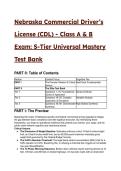
Nebraska Commercial Driver’s
License (CDL) - Class A & B
Exam: S-Tier Universal Mastery
Test Bank
PART 0: Table of Contents
Section Content Focus Cognitive Tier
PART I The Preview: Mission & Critical Hard Deck Fundamentals
Axioms
PART II The Elite Test Bank
Tier 1 Questions 1–15: Foundational Syntax & Recall
Syntax & Application
Tier 2 Questions 16–35: Complex Variable Analysis
Application & Simulation
Tier 3 Questions 36–60: Grandmaster High-Stakes Synthesis
Synthesis
PART I: The Preview
Mastering this matrix of Nebraska-specific and federal commercial driving regulations bridges
the gap between basic compliance and elite logistical execution. By internalizing these
frameworks, you forge an operational resilience that protects your license, your cargo, and the
public under extreme cognitive and mechanical stress.
Critical Axioms:
● The Dimension & Weight Baseline: Nebraska enforces a strict 14 feet 6 inches height
limit, an 8 feet 6 inches width limit, and an 80,000-pound maximum interstate gross
weight limit governed by the Federal Bridge Formula.
● The 0.04% Absolute Threshold: The legal blood alcohol concentration (BAC) limit for a
CMV operator is 0.04%. Breaching this, or refusing a chemical test, triggers an immediate
one-year disqualification.
● The Tri-Phase Warning Sequence: Broken down vehicles require warning devices at 10
feet, 100 feet, and 200 feet on divided highways. On two-lane roads with an obstructed
, view (hill/curve), the rear device must be pushed back 100 to 500 feet to establish visual
intercept.
● The Certification Mandate: Category A (Interstate Non-Excepted) drivers must maintain
an active, unexpired Medical Examiner's Certificate (MEC) linked directly to the National
Registry.
● The Air Brake Pressure Matrix: A combination vehicle air system cannot leak more than
4 psi per minute on a fully applied brake test. Low air alarms must trigger before 55 psi,
and spring brakes must mechanically deploy between 20 and 45 psi.
PART II: THE ELITE TEST BANK
Tier 1: Foundational Syntax & Application
Q1: You are preparing to route a standard 53-foot dry van combination vehicle across
Nebraska. Based on the principles of Nebraska commercial dimensions, which absolute
maximum height allowance must you calculate against bridge clearances? A) 13 feet 6 inches,
adhering to the standard federal highway limit. B) 14 feet 0 inches, specifically designated for
rural interstates. C) 14 feet 6 inches, assuming liability for any overhead obstruction damage. D)
15 feet 0 inches, provided the vehicle is transporting exempt agricultural goods.
● The Answer: C (14 feet 6 inches, assuming liability for any overhead obstruction
damage.)
● Distractor Analysis:
○ A is incorrect: While 13'6" is a common national standard in many states, Nebraska
law explicitly sets the maximum overall height at 14 feet 6 inches.
○ B is incorrect: The limit is universally 14'6" across the state, not restricted or
lowered for rural interstates.
○ D is incorrect: There are no blanket 15-foot height exemptions for agricultural
goods; owners assume liability for overhead damage if exceeding 12'6", but the
legal cap remains 14'6".
The Mentor's Analysis: Route planning is a geometric absolute. When establishing a
clearance route, the immediate priority is verifying the physical constraints of the jurisdiction. By
utilizing Nebraska's explicit 14'6" height ceiling, you bypass the common trap of relying on
generalized out-of-state parameters that lead to bridge strikes. Professional/Academic
Intuition: The trailer's height dictates your routing reality; in Nebraska, 14'6" is the absolute
mechanical ceiling.
Q2: A Nebraska CDL holder transports commercial freight from Lincoln, NE to Omaha, NE, but
the cargo ultimately originated in Chicago, IL. Based on the principles of FMCSA
self-certification, which category must this driver declare? A) Category A: Interstate
Non-Excepted B) Category B: Interstate Excepted C) Category C: Intrastate Non-Excepted D)
Category D: Intrastate Excepted
● The Answer: A (Category A: Interstate Non-Excepted)
● Distractor Analysis:
○ B is incorrect: The driver is hauling standard freight, not excepted cargo (like apiary
bees, custom harvesting, or government transport).
○ C is incorrect: Because the cargo originated outside the state (Illinois), the cargo is
crossing state lines, making it interstate commerce, regardless of the driver's
localized route.
, ○ D is incorrect: This operation is neither intrastate nor excepted.
The Mentor's Analysis: Commerce classification is dictated by the cargo's entire journey, not
just the driver's leg. When hauling goods, the immediate priority is tracing the freight's point of
origin. By classifying this as Interstate Non-Excepted, you bypass the common trap of assuming
a route entirely within Nebraska is automatically intrastate commerce. Professional/Academic
Intuition: The cargo's destination dictates the jurisdiction; if the box crossed a state line, you
are an interstate driver.
Q3: During a pre-trip inspection of a Class A combination vehicle, you perform the applied air
leakage rate test. Based on the principles of air brake mechanics, what is the maximum
allowable pressure loss over one minute? A) 2 psi with the engine idling. B) 3 psi with the
service brakes released. C) 4 psi with the engine off and the foot brake fully applied. D) 5 psi
with the parking brake engaged.
● The Answer: C (4 psi with the engine off and the foot brake fully applied.)
● Distractor Analysis:
○ A is incorrect: The test must be performed with the engine off to isolate the tanks
from the compressor; otherwise, the compressor masks the leak.
○ B is incorrect: 3 psi is the limit for a single vehicle, not a combination vehicle, and
the brake must be fully applied to test the service lines.
○ D is incorrect: 5 psi indicates a critical out-of-service leak and is mathematically
beyond the 4 psi legal threshold.
The Mentor's Analysis: Pneumatic integrity prevents catastrophic braking failure. When
verifying the air system, the immediate priority is testing the sealed system under maximum
mechanical load. By utilizing the 4 psi combination limit, you bypass the common trap of
confusing single-vehicle parameters with tractor-trailer mechanics. Professional/Academic
Intuition: Combination air limits are mathematically strict: 3 psi for singles, 4 psi for combos.
Q4: A driver operates a combination vehicle on I-80 in Nebraska. Based on the principles of
statutory speed limits, what is the maximum legal speed for a heavy commercial truck on a rural
interstate? A) 65 mph, to accommodate the Federal Bridge Formula limits. B) 70 mph, as trucks
are restricted 5 mph below passenger vehicles. C) 75 mph, which is identical to the passenger
vehicle speed limit. D) 80 mph, on specifically marked rural expressways.
● The Answer: C (75 mph, which is identical to the passenger vehicle speed limit.)
● Distractor Analysis:
○ A is incorrect: The Federal Bridge Formula dictates weight distribution, not kinetic
speed limits.
○ B is incorrect: Unlike certain states (e.g., California or Indiana), Nebraska does not
enforce a split speed limit for heavy trucks.
○ D is incorrect: Nebraska's statutory maximum on rural interstates is 75 mph, not 80
mph.
The Mentor's Analysis: Velocity management relies on jurisdictional awareness. When
entering a new state, the immediate priority is identifying uniform or split speed limits. By
utilizing Nebraska's uniform 75 mph rural interstate limit, you bypass the common trap of
arbitrarily driving dangerously below the flow of traffic out of an abundance of misplaced caution.
Professional/Academic Intuition: In Nebraska, trucks and passenger cars share the exact
same rural interstate kinetic ceiling of 75 mph.
Q5: An applicant arrives for a CDL skills test driving a heavy straight truck equipped with "Air
over Hydraulic" brakes. Based on the principles of CDL restrictions, which designation will be
placed on their license upon passing? A) L - Vehicles Without Air Brakes B) Z - No Full Air
Brakes C) E - No Manual Transmission D) O - Except Tractor Trailer
, ● The Answer: B (Z - No Full Air Brakes)
● Distractor Analysis:
○ A is incorrect: The L restriction applies to vehicles with no air brake components
whatsoever.
○ C is incorrect: The E restriction applies strictly to transmission types (automatics),
not braking systems.
○ D is incorrect: The O restriction prevents the operation of a 5th-wheel tractor-trailer,
which is irrelevant to the brake system designation.
The Mentor's Analysis: Mechanical endorsements mirror the exact hardware operated during
the skills test. When testing in hybrid braking systems, the immediate priority is recognizing the
limitations of the hydraulic components. By applying the Z Restriction, the state bypasses the
common trap of licensing a driver for full-pneumatic S-cam systems when they have only proven
competence on hybrid setups. Professional/Academic Intuition: If the brakes use fluid and air,
the license gets a Z.
Q6: A commercial driver is cited for traveling 16 mph over the posted speed limit. Three months
later, they are cited for making improper lane changes. Based on the principles of the Motor
Carrier Safety Improvement Act (MCSIA), what is the immediate administrative consequence?
A) A lifetime CDL disqualification. B) A 1-year CDL disqualification. C) A 60-day CDL
disqualification. D) Mandatory enrollment in the Entry Level Driver Training (ELDT) program.
● The Answer: C (A 60-day CDL disqualification.)
● Distractor Analysis:
○ A is incorrect: Lifetime bans are reserved for second Major offenses or felony drug
manufacturing.
○ B is incorrect: A 1-year ban applies to a first Major offense (e.g., DUI, leaving the
scene), not Serious traffic violations.
○ D is incorrect: ELDT is a prerequisite for new licenses or upgrades, not a punitive
rehabilitation program for moving violations.
The Mentor's Analysis: Consecutive behavioral failures compound rapidly under the MCSIA.
When accumulating moving violations, the immediate priority is understanding the "Serious
Offense" timeline. By recognizing that two Serious Traffic Violations within three years trigger a
60-day suspension, you bypass the common trap of treating commercial citations like standard
passenger tickets. Professional/Academic Intuition: 15 mph over the limit is the threshold
where a simple speeding ticket morphs into a career-threatening Serious Violation.
Q7: You are connecting a tractor to a semitrailer. Based on the principles of safe coupling, what
must the visual inspection of the fifth wheel confirm before raising the landing gear? A) The
locking jaws are fully open and resting against the kingpin head. B) The fifth wheel skid plate is
completely dry to prevent sliding. C) The locking jaws are securely closed around the shank of
the kingpin. D) The release handle is pulled outward in the extended position.
● The Answer: C (The locking jaws are securely closed around the shank of the kingpin.)
● Distractor Analysis:
○ A is incorrect: Open jaws indicate a failed couple; moving the vehicle will drop the
trailer.
○ B is incorrect: The skid plate must be thoroughly lubricated with grease to allow
proper articulation and prevent binding.
○ D is incorrect: The release handle must be pushed completely in (locked position)
to mechanically secure the jaws.
The Mentor's Analysis: The fifth-wheel coupling is the single point of failure between control
and catastrophe. When finalizing a connection, the immediate priority is visual confirmation of
License (CDL) - Class A & B
Exam: S-Tier Universal Mastery
Test Bank
PART 0: Table of Contents
Section Content Focus Cognitive Tier
PART I The Preview: Mission & Critical Hard Deck Fundamentals
Axioms
PART II The Elite Test Bank
Tier 1 Questions 1–15: Foundational Syntax & Recall
Syntax & Application
Tier 2 Questions 16–35: Complex Variable Analysis
Application & Simulation
Tier 3 Questions 36–60: Grandmaster High-Stakes Synthesis
Synthesis
PART I: The Preview
Mastering this matrix of Nebraska-specific and federal commercial driving regulations bridges
the gap between basic compliance and elite logistical execution. By internalizing these
frameworks, you forge an operational resilience that protects your license, your cargo, and the
public under extreme cognitive and mechanical stress.
Critical Axioms:
● The Dimension & Weight Baseline: Nebraska enforces a strict 14 feet 6 inches height
limit, an 8 feet 6 inches width limit, and an 80,000-pound maximum interstate gross
weight limit governed by the Federal Bridge Formula.
● The 0.04% Absolute Threshold: The legal blood alcohol concentration (BAC) limit for a
CMV operator is 0.04%. Breaching this, or refusing a chemical test, triggers an immediate
one-year disqualification.
● The Tri-Phase Warning Sequence: Broken down vehicles require warning devices at 10
feet, 100 feet, and 200 feet on divided highways. On two-lane roads with an obstructed
, view (hill/curve), the rear device must be pushed back 100 to 500 feet to establish visual
intercept.
● The Certification Mandate: Category A (Interstate Non-Excepted) drivers must maintain
an active, unexpired Medical Examiner's Certificate (MEC) linked directly to the National
Registry.
● The Air Brake Pressure Matrix: A combination vehicle air system cannot leak more than
4 psi per minute on a fully applied brake test. Low air alarms must trigger before 55 psi,
and spring brakes must mechanically deploy between 20 and 45 psi.
PART II: THE ELITE TEST BANK
Tier 1: Foundational Syntax & Application
Q1: You are preparing to route a standard 53-foot dry van combination vehicle across
Nebraska. Based on the principles of Nebraska commercial dimensions, which absolute
maximum height allowance must you calculate against bridge clearances? A) 13 feet 6 inches,
adhering to the standard federal highway limit. B) 14 feet 0 inches, specifically designated for
rural interstates. C) 14 feet 6 inches, assuming liability for any overhead obstruction damage. D)
15 feet 0 inches, provided the vehicle is transporting exempt agricultural goods.
● The Answer: C (14 feet 6 inches, assuming liability for any overhead obstruction
damage.)
● Distractor Analysis:
○ A is incorrect: While 13'6" is a common national standard in many states, Nebraska
law explicitly sets the maximum overall height at 14 feet 6 inches.
○ B is incorrect: The limit is universally 14'6" across the state, not restricted or
lowered for rural interstates.
○ D is incorrect: There are no blanket 15-foot height exemptions for agricultural
goods; owners assume liability for overhead damage if exceeding 12'6", but the
legal cap remains 14'6".
The Mentor's Analysis: Route planning is a geometric absolute. When establishing a
clearance route, the immediate priority is verifying the physical constraints of the jurisdiction. By
utilizing Nebraska's explicit 14'6" height ceiling, you bypass the common trap of relying on
generalized out-of-state parameters that lead to bridge strikes. Professional/Academic
Intuition: The trailer's height dictates your routing reality; in Nebraska, 14'6" is the absolute
mechanical ceiling.
Q2: A Nebraska CDL holder transports commercial freight from Lincoln, NE to Omaha, NE, but
the cargo ultimately originated in Chicago, IL. Based on the principles of FMCSA
self-certification, which category must this driver declare? A) Category A: Interstate
Non-Excepted B) Category B: Interstate Excepted C) Category C: Intrastate Non-Excepted D)
Category D: Intrastate Excepted
● The Answer: A (Category A: Interstate Non-Excepted)
● Distractor Analysis:
○ B is incorrect: The driver is hauling standard freight, not excepted cargo (like apiary
bees, custom harvesting, or government transport).
○ C is incorrect: Because the cargo originated outside the state (Illinois), the cargo is
crossing state lines, making it interstate commerce, regardless of the driver's
localized route.
, ○ D is incorrect: This operation is neither intrastate nor excepted.
The Mentor's Analysis: Commerce classification is dictated by the cargo's entire journey, not
just the driver's leg. When hauling goods, the immediate priority is tracing the freight's point of
origin. By classifying this as Interstate Non-Excepted, you bypass the common trap of assuming
a route entirely within Nebraska is automatically intrastate commerce. Professional/Academic
Intuition: The cargo's destination dictates the jurisdiction; if the box crossed a state line, you
are an interstate driver.
Q3: During a pre-trip inspection of a Class A combination vehicle, you perform the applied air
leakage rate test. Based on the principles of air brake mechanics, what is the maximum
allowable pressure loss over one minute? A) 2 psi with the engine idling. B) 3 psi with the
service brakes released. C) 4 psi with the engine off and the foot brake fully applied. D) 5 psi
with the parking brake engaged.
● The Answer: C (4 psi with the engine off and the foot brake fully applied.)
● Distractor Analysis:
○ A is incorrect: The test must be performed with the engine off to isolate the tanks
from the compressor; otherwise, the compressor masks the leak.
○ B is incorrect: 3 psi is the limit for a single vehicle, not a combination vehicle, and
the brake must be fully applied to test the service lines.
○ D is incorrect: 5 psi indicates a critical out-of-service leak and is mathematically
beyond the 4 psi legal threshold.
The Mentor's Analysis: Pneumatic integrity prevents catastrophic braking failure. When
verifying the air system, the immediate priority is testing the sealed system under maximum
mechanical load. By utilizing the 4 psi combination limit, you bypass the common trap of
confusing single-vehicle parameters with tractor-trailer mechanics. Professional/Academic
Intuition: Combination air limits are mathematically strict: 3 psi for singles, 4 psi for combos.
Q4: A driver operates a combination vehicle on I-80 in Nebraska. Based on the principles of
statutory speed limits, what is the maximum legal speed for a heavy commercial truck on a rural
interstate? A) 65 mph, to accommodate the Federal Bridge Formula limits. B) 70 mph, as trucks
are restricted 5 mph below passenger vehicles. C) 75 mph, which is identical to the passenger
vehicle speed limit. D) 80 mph, on specifically marked rural expressways.
● The Answer: C (75 mph, which is identical to the passenger vehicle speed limit.)
● Distractor Analysis:
○ A is incorrect: The Federal Bridge Formula dictates weight distribution, not kinetic
speed limits.
○ B is incorrect: Unlike certain states (e.g., California or Indiana), Nebraska does not
enforce a split speed limit for heavy trucks.
○ D is incorrect: Nebraska's statutory maximum on rural interstates is 75 mph, not 80
mph.
The Mentor's Analysis: Velocity management relies on jurisdictional awareness. When
entering a new state, the immediate priority is identifying uniform or split speed limits. By
utilizing Nebraska's uniform 75 mph rural interstate limit, you bypass the common trap of
arbitrarily driving dangerously below the flow of traffic out of an abundance of misplaced caution.
Professional/Academic Intuition: In Nebraska, trucks and passenger cars share the exact
same rural interstate kinetic ceiling of 75 mph.
Q5: An applicant arrives for a CDL skills test driving a heavy straight truck equipped with "Air
over Hydraulic" brakes. Based on the principles of CDL restrictions, which designation will be
placed on their license upon passing? A) L - Vehicles Without Air Brakes B) Z - No Full Air
Brakes C) E - No Manual Transmission D) O - Except Tractor Trailer
, ● The Answer: B (Z - No Full Air Brakes)
● Distractor Analysis:
○ A is incorrect: The L restriction applies to vehicles with no air brake components
whatsoever.
○ C is incorrect: The E restriction applies strictly to transmission types (automatics),
not braking systems.
○ D is incorrect: The O restriction prevents the operation of a 5th-wheel tractor-trailer,
which is irrelevant to the brake system designation.
The Mentor's Analysis: Mechanical endorsements mirror the exact hardware operated during
the skills test. When testing in hybrid braking systems, the immediate priority is recognizing the
limitations of the hydraulic components. By applying the Z Restriction, the state bypasses the
common trap of licensing a driver for full-pneumatic S-cam systems when they have only proven
competence on hybrid setups. Professional/Academic Intuition: If the brakes use fluid and air,
the license gets a Z.
Q6: A commercial driver is cited for traveling 16 mph over the posted speed limit. Three months
later, they are cited for making improper lane changes. Based on the principles of the Motor
Carrier Safety Improvement Act (MCSIA), what is the immediate administrative consequence?
A) A lifetime CDL disqualification. B) A 1-year CDL disqualification. C) A 60-day CDL
disqualification. D) Mandatory enrollment in the Entry Level Driver Training (ELDT) program.
● The Answer: C (A 60-day CDL disqualification.)
● Distractor Analysis:
○ A is incorrect: Lifetime bans are reserved for second Major offenses or felony drug
manufacturing.
○ B is incorrect: A 1-year ban applies to a first Major offense (e.g., DUI, leaving the
scene), not Serious traffic violations.
○ D is incorrect: ELDT is a prerequisite for new licenses or upgrades, not a punitive
rehabilitation program for moving violations.
The Mentor's Analysis: Consecutive behavioral failures compound rapidly under the MCSIA.
When accumulating moving violations, the immediate priority is understanding the "Serious
Offense" timeline. By recognizing that two Serious Traffic Violations within three years trigger a
60-day suspension, you bypass the common trap of treating commercial citations like standard
passenger tickets. Professional/Academic Intuition: 15 mph over the limit is the threshold
where a simple speeding ticket morphs into a career-threatening Serious Violation.
Q7: You are connecting a tractor to a semitrailer. Based on the principles of safe coupling, what
must the visual inspection of the fifth wheel confirm before raising the landing gear? A) The
locking jaws are fully open and resting against the kingpin head. B) The fifth wheel skid plate is
completely dry to prevent sliding. C) The locking jaws are securely closed around the shank of
the kingpin. D) The release handle is pulled outward in the extended position.
● The Answer: C (The locking jaws are securely closed around the shank of the kingpin.)
● Distractor Analysis:
○ A is incorrect: Open jaws indicate a failed couple; moving the vehicle will drop the
trailer.
○ B is incorrect: The skid plate must be thoroughly lubricated with grease to allow
proper articulation and prevent binding.
○ D is incorrect: The release handle must be pushed completely in (locked position)
to mechanically secure the jaws.
The Mentor's Analysis: The fifth-wheel coupling is the single point of failure between control
and catastrophe. When finalizing a connection, the immediate priority is visual confirmation of


