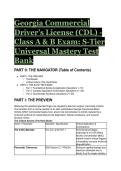
Georgia Commercial
Driver’s License (CDL) -
Class A & B Exam: S-Tier
Universal Mastery Test
Bank
PART 0: THE NAVIGATOR (Table of Contents)
● PART I: THE PREVIEW
○ The Mission
○ Critical Axioms (The Hard Deck)
● PART II: THE ELITE TEST BANK
○ Tier 1: Foundational Syntax & Application (Questions 1–10)
○ Tier 2: Complex Application & Simulation (Questions 11–20)
○ Tier 3: Grandmaster Synthesis (Questions 21–30)
PART I: THE PREVIEW
Mastering this analytical gauntlet forges raw regulatory data into surgical, road-ready intuition.
The transition from a novice operator to an elite, authoritative Georgia Commercial Motor
Vehicle (CMV) Commander begins here, where rote memorization is entirely replaced by a
profound synthesis of modernized pre-trip diagnostics, federal compliance, and dynamic
physical control.
The Critical Axioms (The Hard Deck):
Axiom / Parameter Standard / Specification Critical Application &
Consequence
The 0.04% Mandate O.C.G.A. § 40-5-67.1 Commercial privileges
evaporate at a 0.04% Blood
Alcohol Concentration (BAC).
Implied consent refusal triggers
a mandatory one-year minimum
disqualification.
Pneumatic Tolerances DDS Section 5.3 / FMCSA During an applied leakage test,
maximum allowable loss is
strictly 3 psi for single vehicles
,Axiom / Parameter Standard / Specification Critical Application &
Consequence
and 4 psi for combination
vehicles per minute.
Spring Brake Override DDS Section 5.2 The tractor protection valve and
parking brake valves must
autonomously pop out when
system pressure bleeds to the
critical 20–45 psi threshold.
Super Speeder Matrix O.C.G.A. § 40-6-189 Georgia explicitly fines
operators $200 for exceeding
75 mph on two-lane roads or 85
mph on highways. Unpaid fees
yield total suspension.
Weight Parameters O.C.G.A. § 32-6-26 Maximum gross weight is
80,000 lbs. Legal limit for a
single axle is 20,340 lbs;
tandem sets max out at 34,000
lbs.
PART II: THE ELITE TEST BANK
Tier 1: Foundational Syntax & Application (Questions 1–10)
Q1: A commercial driver is operating a Class A combination vehicle. During a roadside
inspection, the driver is subjected to a state-administered breathalyzer test. Based on the
principles of the Georgia Implied Consent law, which blood alcohol concentration (BAC) reading
IMMEDIATELY disqualifies the driver from operating a commercial motor vehicle? A) 0.02% B)
0.08% C) 0.04% D) 0.10%
● The Answer: C (0.04%)
● Distractor Analysis:
○ A is incorrect: 0.02% is the threshold for civilian drivers under the age of 21, but it
does not independently trigger the statutory commercial disqualification for adult
CMV operators.
○ B is incorrect: 0.08% represents the standard non-commercial threshold. Novices
frequently conflate passenger vehicle laws with federal commercial mandates.
○ D is incorrect: 0.10% is an outdated legacy metric that is no longer recognized in
modern Georgia DUI enforcement protocols.
The Mentor's Analysis: Commercial operators function under a hyper-restricted legal
framework dictated by both state and federal authorities. When evaluating intoxication, the
immediate priority is recognizing that commercial mandates strictly supersede civilian codes. By
utilizing the 0.04% BAC limit, you bypass the novice error of applying standard passenger
vehicle tolerances to commercial operations. Professional/Academic Intuition: The CDL is an
elite privilege; a 0.04% BAC is the absolute hard deck for immediate commercial
disqualification.
Q2: During a modernized pre-trip inspection, an applicant conducts an applied leakage test on a
Class A combination vehicle. With the engine shut off and the service brakes firmly applied,
what is the maximum allowable air pressure loss over a one-minute period? A) 2 psi B) 3 psi C)
, 4 psi D) 5 psi
● The Answer: C (4 psi)
● Distractor Analysis:
○ A is incorrect: 2 psi is the maximum static leakage rate for a single vehicle without
the service brakes applied, not a combination vehicle under pressure.
○ B is incorrect: 3 psi is the strict applied leakage limit for a single, non-combination
vehicle (e.g., Class B straight truck).
○ D is incorrect: 5 psi applies only to triple-trailer combinations or specialized
extended equipment configurations, not a standard Class A combination.
The Mentor's Analysis: Air brake integrity is the sole mechanical barrier between a controlled
descent and catastrophic kinetic failure. When verifying system limits, the immediate priority is
distinguishing between single and combined pneumatic volumes. By utilizing the 4 psi
combination limit, you bypass the common trap of under-calculating the volume loss required for
larger tractor-trailer air systems. Professional/Academic Intuition: Applied pressure tests
demand structural precision: 3 psi for straight trucks, 4 psi for standard combinations.
Q3: Under Georgia commercial pneumatic regulations, what specific mechanical action MUST
occur when a vehicle's air system pressure bleeds down to the 20 to 45 psi range? A) The
governor must cut in and immediately restart the air compressor. B) The low air pressure
warning light and buzzer must activate. C) The tractor protection valve and parking brake valve
must automatically pop out. D) The hydraulic service brakes must lock the steering axle.
● The Answer: C (The tractor protection valve and parking brake valve must automatically
pop out.)
● Distractor Analysis:
○ A is incorrect: The governor cut-in occurs at a much higher pressure (typically
around 100 psi), ensuring the tanks remain fully charged during normal operation.
○ B is incorrect: The low air pressure warning must trigger before the pressure drops
below 60 psi, well before reaching the critical 20-45 psi threshold.
○ D is incorrect: Service brakes operate strictly via pedal application and pneumatic
pressure; they do not lock via spring action, nor do CMVs mix primary hydraulic and
air systems.
The Mentor's Analysis: The emergency braking system relies entirely on heavy mechanical
springs held back by compressed air. When facing a catastrophic air loss, the immediate priority
is autonomous mechanical engagement. By utilizing the 20-45 psi pop-out threshold, you
bypass the novice error of confusing early warning systems (60 psi) with the final mechanical
fail-safe. Professional/Academic Intuition: Warning at 60, lock-down at 20-45. The spring
brakes are the final, unyielding line of defense.
Q4: A commercial driver receives a citation for speeding at 86 mph on a Georgia interstate
highway. In addition to standard traffic fines, what distinct administrative penalty is FIRST
generated under the Georgia Super Speeder Law? A) A mandatory 60-day CDL disqualification.
B) An automatic assessment of 6 points against the driver’s license. C) A $200 state fee
administered directly by the Department of Driver Services (DDS). D) An immediate
Out-of-Service (OOS) order for 24 hours.
● The Answer: C (A $200 state fee administered directly by the Department of Driver
Services (DDS).)
● Distractor Analysis:
○ A is incorrect: While 15+ mph over the limit is a Serious Traffic Violation, a 60-day
disqualification strictly requires two such violations within a three-year period.
○ B is incorrect: 86 mph in a 70 mph zone (16 over) incurs 2 points, not 6. Six points
Driver’s License (CDL) -
Class A & B Exam: S-Tier
Universal Mastery Test
Bank
PART 0: THE NAVIGATOR (Table of Contents)
● PART I: THE PREVIEW
○ The Mission
○ Critical Axioms (The Hard Deck)
● PART II: THE ELITE TEST BANK
○ Tier 1: Foundational Syntax & Application (Questions 1–10)
○ Tier 2: Complex Application & Simulation (Questions 11–20)
○ Tier 3: Grandmaster Synthesis (Questions 21–30)
PART I: THE PREVIEW
Mastering this analytical gauntlet forges raw regulatory data into surgical, road-ready intuition.
The transition from a novice operator to an elite, authoritative Georgia Commercial Motor
Vehicle (CMV) Commander begins here, where rote memorization is entirely replaced by a
profound synthesis of modernized pre-trip diagnostics, federal compliance, and dynamic
physical control.
The Critical Axioms (The Hard Deck):
Axiom / Parameter Standard / Specification Critical Application &
Consequence
The 0.04% Mandate O.C.G.A. § 40-5-67.1 Commercial privileges
evaporate at a 0.04% Blood
Alcohol Concentration (BAC).
Implied consent refusal triggers
a mandatory one-year minimum
disqualification.
Pneumatic Tolerances DDS Section 5.3 / FMCSA During an applied leakage test,
maximum allowable loss is
strictly 3 psi for single vehicles
,Axiom / Parameter Standard / Specification Critical Application &
Consequence
and 4 psi for combination
vehicles per minute.
Spring Brake Override DDS Section 5.2 The tractor protection valve and
parking brake valves must
autonomously pop out when
system pressure bleeds to the
critical 20–45 psi threshold.
Super Speeder Matrix O.C.G.A. § 40-6-189 Georgia explicitly fines
operators $200 for exceeding
75 mph on two-lane roads or 85
mph on highways. Unpaid fees
yield total suspension.
Weight Parameters O.C.G.A. § 32-6-26 Maximum gross weight is
80,000 lbs. Legal limit for a
single axle is 20,340 lbs;
tandem sets max out at 34,000
lbs.
PART II: THE ELITE TEST BANK
Tier 1: Foundational Syntax & Application (Questions 1–10)
Q1: A commercial driver is operating a Class A combination vehicle. During a roadside
inspection, the driver is subjected to a state-administered breathalyzer test. Based on the
principles of the Georgia Implied Consent law, which blood alcohol concentration (BAC) reading
IMMEDIATELY disqualifies the driver from operating a commercial motor vehicle? A) 0.02% B)
0.08% C) 0.04% D) 0.10%
● The Answer: C (0.04%)
● Distractor Analysis:
○ A is incorrect: 0.02% is the threshold for civilian drivers under the age of 21, but it
does not independently trigger the statutory commercial disqualification for adult
CMV operators.
○ B is incorrect: 0.08% represents the standard non-commercial threshold. Novices
frequently conflate passenger vehicle laws with federal commercial mandates.
○ D is incorrect: 0.10% is an outdated legacy metric that is no longer recognized in
modern Georgia DUI enforcement protocols.
The Mentor's Analysis: Commercial operators function under a hyper-restricted legal
framework dictated by both state and federal authorities. When evaluating intoxication, the
immediate priority is recognizing that commercial mandates strictly supersede civilian codes. By
utilizing the 0.04% BAC limit, you bypass the novice error of applying standard passenger
vehicle tolerances to commercial operations. Professional/Academic Intuition: The CDL is an
elite privilege; a 0.04% BAC is the absolute hard deck for immediate commercial
disqualification.
Q2: During a modernized pre-trip inspection, an applicant conducts an applied leakage test on a
Class A combination vehicle. With the engine shut off and the service brakes firmly applied,
what is the maximum allowable air pressure loss over a one-minute period? A) 2 psi B) 3 psi C)
, 4 psi D) 5 psi
● The Answer: C (4 psi)
● Distractor Analysis:
○ A is incorrect: 2 psi is the maximum static leakage rate for a single vehicle without
the service brakes applied, not a combination vehicle under pressure.
○ B is incorrect: 3 psi is the strict applied leakage limit for a single, non-combination
vehicle (e.g., Class B straight truck).
○ D is incorrect: 5 psi applies only to triple-trailer combinations or specialized
extended equipment configurations, not a standard Class A combination.
The Mentor's Analysis: Air brake integrity is the sole mechanical barrier between a controlled
descent and catastrophic kinetic failure. When verifying system limits, the immediate priority is
distinguishing between single and combined pneumatic volumes. By utilizing the 4 psi
combination limit, you bypass the common trap of under-calculating the volume loss required for
larger tractor-trailer air systems. Professional/Academic Intuition: Applied pressure tests
demand structural precision: 3 psi for straight trucks, 4 psi for standard combinations.
Q3: Under Georgia commercial pneumatic regulations, what specific mechanical action MUST
occur when a vehicle's air system pressure bleeds down to the 20 to 45 psi range? A) The
governor must cut in and immediately restart the air compressor. B) The low air pressure
warning light and buzzer must activate. C) The tractor protection valve and parking brake valve
must automatically pop out. D) The hydraulic service brakes must lock the steering axle.
● The Answer: C (The tractor protection valve and parking brake valve must automatically
pop out.)
● Distractor Analysis:
○ A is incorrect: The governor cut-in occurs at a much higher pressure (typically
around 100 psi), ensuring the tanks remain fully charged during normal operation.
○ B is incorrect: The low air pressure warning must trigger before the pressure drops
below 60 psi, well before reaching the critical 20-45 psi threshold.
○ D is incorrect: Service brakes operate strictly via pedal application and pneumatic
pressure; they do not lock via spring action, nor do CMVs mix primary hydraulic and
air systems.
The Mentor's Analysis: The emergency braking system relies entirely on heavy mechanical
springs held back by compressed air. When facing a catastrophic air loss, the immediate priority
is autonomous mechanical engagement. By utilizing the 20-45 psi pop-out threshold, you
bypass the novice error of confusing early warning systems (60 psi) with the final mechanical
fail-safe. Professional/Academic Intuition: Warning at 60, lock-down at 20-45. The spring
brakes are the final, unyielding line of defense.
Q4: A commercial driver receives a citation for speeding at 86 mph on a Georgia interstate
highway. In addition to standard traffic fines, what distinct administrative penalty is FIRST
generated under the Georgia Super Speeder Law? A) A mandatory 60-day CDL disqualification.
B) An automatic assessment of 6 points against the driver’s license. C) A $200 state fee
administered directly by the Department of Driver Services (DDS). D) An immediate
Out-of-Service (OOS) order for 24 hours.
● The Answer: C (A $200 state fee administered directly by the Department of Driver
Services (DDS).)
● Distractor Analysis:
○ A is incorrect: While 15+ mph over the limit is a Serious Traffic Violation, a 60-day
disqualification strictly requires two such violations within a three-year period.
○ B is incorrect: 86 mph in a 70 mph zone (16 over) incurs 2 points, not 6. Six points