Elite Universal Test Bank:
Illinois Commercial Driver’s
License (CDL) - Class A & B
Exam
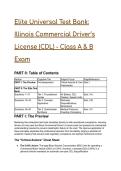
PART 0: Table of Contents
Section Cognitive Tier Subject Focus Page/Reference
PART I: The Preview Pre-Assessment Critical Axioms & Core Sect. I
Frameworks
PART II: The Elite Test
Bank
Questions 1–15 Tier 1: Foundational Air Brakes, CDL Sect. II-A
Syntax Classes, Speed Limits
Questions 16–35 Tier 2: Complex Railroads, Sect. II-B
Application Disqualifications,
Dimensions
Questions 36–60 Tier 3: Grandmaster Medical Protocols, Sect. II-C
Synthesis Coupling, Emergency
PART I: The Preview
Mastering this exhaustive test bank translates directly to elite operational competence, ensuring
drivers not only pass the Illinois Commercial Driver’s License exam but possess the mechanistic
understanding required to prevent catastrophic failure on the road. The rigorous application of
these principles separates the professional operator from the liability, forging a standard of
academic mastery that ensures total regulatory compliance and optimal mechanical control.
The "Critical Axioms" Cheat Sheet
● The 0.04% Axiom: The legal Blood Alcohol Concentration (BAC) limit for operating a
Commercial Motor Vehicle (CMV) is 0.04%. However, a standard DUI (0.08%) in a
personal vehicle mandates an automatic one-year CDL disqualification.
, ● The Pneumatic Baseline: A fully charged combination air brake system must not lose
more than 4 psi in one minute under full brake application. A single unit must not lose
more than 3 psi.
● The Two-Strike Rule: Accumulating two serious traffic violations (e.g., 15+ mph
speeding, improper lane change) within three years results in a mandatory 60-day CDL
disqualification.
● The 1/10 Following Distance Rule: Operators must maintain one second of following
distance for every 10 feet of vehicle length at speeds under 40 mph, adding one
additional second for speeds exceeding 40 mph.
● The "Crack-the-Whip" Multiplier: Rearward amplification in articulated vehicles
exponentially increases with each trailing unit, making the rear trailer in a triple
combination the most likely to roll over during evasive maneuvers.
Core Regulatory Matrices
Vehicle Type / Zone Legal Maximum Speed Limit Source Statute
Rural Interstate (All Vehicles) 70 mph
Urban Collar Counties (>8,000 60 mph on Interstates
lbs)
School Bus (Non-Interstate 55 mph
Highway)
Active School Zone (Children 20 mph (7:00 AM - 4:00 PM)
Present)
Oversize Load (Under Permit) 45 mph (or 5 mph above min)
PART II: The Elite Test Bank
Tier 1: Foundational Syntax & Application
Q1: An operator is conducting an applied Air Leakage Rate Test on a Class A combination
vehicle. The engine is shut off, the electrical system is energized, and the tractor protection
valve is released. After the air gauge stabilizes, the foot brake is fully applied. Based on
pneumatic inspection standards, what is the maximum acceptable pressure loss over a
one-minute duration? A) 2 psi B) 3 psi C) 4 psi D) 5 psi
● The Answer: C (4 psi)
● Distractor Analysis:
○ A is incorrect: The 2 psi limit applies strictly to the unapplied (static) test for a single
vehicle, not an applied combination rig.
○ B is incorrect: The 3 psi limit applies to an applied single vehicle or an unapplied
combination vehicle.
○ D is incorrect: A 5 psi drop indicates a critical failure requiring an immediate
out-of-service order.
The Mentor's Analysis: The pneumatic integrity of an articulated vehicle is its sole defense
against catastrophic failure. When testing the applied leakage rate, the system is under
maximum stress; combination vehicles permit a slightly higher tolerance (4 psi) due to the
extended gladhands and trailer reservoirs. By verifying this metric, the professional bypasses
the trap of driving a rig that will exhaust its compressed air during heavy traffic braking.
,Professional/Academic Intuition: A combination rig under full brake application must not
bleed more than 4 psi per minute; anything greater requires immediate mechanical
intervention.
Q2: A commercial vehicle is traveling downhill when the primary air system fails. At what exact
pressure range will the tractor and straight truck spring brakes automatically engage to initiate
an emergency stop? A) 55 to 60 psi B) 40 to 55 psi C) 20 to 45 psi D) 10 to 15 psi
● The Answer: C (20 to 45 psi)
● Distractor Analysis:
○ A is incorrect: The 55 psi threshold triggers the low-air warning devices (buzzer and
light), not the spring brakes.
○ B is incorrect: This range is a common novice estimation, but it precedes the
mechanical activation of the emergency springs.
○ D is incorrect: Waiting for pressure to drop below 15 psi ensures the vehicle is
completely out of control before spring activation occurs.
The Mentor's Analysis: Spring brakes are mechanically held in the "off" position by air
pressure. When the system suffers a massive leak, this pneumatic counter-force is lost. The
system is engineered to deploy the springs between 20 to 45 psi (typically 20 to 30 psi) to
prevent a total runaway. By anticipating this activation, the operator bypasses the fatal error of
waiting for automatic deployment instead of initiating a controlled emergency stop.
Professional/Academic Intuition: Warning devices sound at 55 psi; the emergency
anchor drops between 20 and 45 psi.
Q3: A driver is operating a single vehicle with a Gross Vehicle Weight Rating (GVWR) of 27,000
pounds, which is towing a flatbed trailer with a GVWR of 9,500 pounds. Under Illinois
commercial classification rules, which license class is required? A) Class A B) Class B C) Class
C D) Class D
● The Answer: B (Class B)
● Distractor Analysis:
○ A is incorrect: Class A requires the towed unit to possess a GVWR strictly
exceeding 10,000 pounds.
○ C is incorrect: Class C is reserved for vehicles under 26,001 pounds that haul
hazardous materials or 16+ passengers.
○ D is incorrect: The power unit exceeds the 26,000-pound non-commercial
threshold.
The Mentor's Analysis: The distinction between Class A and Class B hinges entirely on the
weight of the trailing unit. Because the trailer is rated at 9,500 pounds, it fails to breach the
10,000-pound threshold required to trigger Class A status. By strictly evaluating the trailer's data
plate, the operator bypasses the novice error of upgrading license classes unnecessarily.
Professional/Academic Intuition: If the power unit exceeds 26,000 lbs, it requires a Class
B; it only escalates to a Class A if the trailing unit exceeds 10,000 lbs.
Q4: An operator holds a Class B CDL and wishes to drive a tractor-trailer combination
exclusively for agricultural purposes without completing standard Entry-Level Driver Training
(ELDT). Which specific Illinois license restriction permits this exact scenario? A) Restriction L B)
Restriction J52 C) Restriction O D) Restriction E
● The Answer: B (Restriction J52)
● Distractor Analysis:
○ A is incorrect: Restriction L prohibits the operation of vehicles equipped with air
brakes.
○ C is incorrect: Restriction O prohibits the operation of articulated combination
, vehicles for standard CDL holders without farm exemptions.
○ D is incorrect: Restriction E prohibits the operation of a manual transmission.
The Mentor's Analysis: The agricultural industry requires regulatory flexibility to maintain
supply chains. The J52 restriction acts as a surgical exemption, allowing Class B holders to
operate Class A covered farm vehicles without upgrading their fundamental license tier. By
utilizing this restriction, operators bypass the prohibitive time and cost barriers of full ELDT
requirements. Professional/Academic Intuition: The J52 restriction is the agricultural
loophole that legally upgrades a Class B driver to a Class A farm operator.
Q5: A truck tractor semitrailer weighing 75,000 pounds is traveling on an Illinois rural interstate
highway outside the counties of Cook, DuPage, Kane, Lake, McHenry, and Will. Assuming
optimal weather conditions, what is the absolute maximum legal speed limit for this vehicle? A)
55 mph B) 60 mph C) 65 mph D) 70 mph
● The Answer: D (70 mph)
● Distractor Analysis:
○ A is incorrect: 55 mph is the maximum speed limit for interstates near major cities
or on non-interstate highways.
○ B is incorrect: 60 mph is the limit for second division vehicles exceeding 8,000
pounds when operating inside the specific Chicago collar counties.
○ C is incorrect: 65 mph was the historical rural limit prior to the uniform speed limit
upgrade.
The Mentor's Analysis: Illinois vehicle code specifies that the maximum speed limit on rural
interstate highways, outside of heavily urbanized collar counties, is 70 miles per hour for all
vehicles, including heavy trucks. By correctly identifying the geographic zone, the operator
bypasses the risk of impeding traffic flow or incurring enforcement penalties.
Professional/Academic Intuition: On Illinois rural interstates, heavy trucks run at 70 mph;
crossing into the collar counties immediately drops the legal ceiling.
Q6: A commercial driver is operating a school bus with passengers onboard on an Illinois
highway not under the jurisdiction of the Department or Toll Highway Authority. What is the
absolute maximum speed limit the bus may travel? A) 45 mph B) 50 mph C) 55 mph D) 65 mph
● The Answer: C (55 mph)
● Distractor Analysis:
○ A is incorrect: 45 mph is the maximum speed limit for vehicles hauling an oversize
load under permit.
○ B is incorrect: 50 mph has no statutory basis for school buses in Illinois.
○ D is incorrect: While other vehicles may travel up to 70 mph on certain highways,
school buses are strictly capped to ensure passenger safety.
The Mentor's Analysis: The kinetic energy of a school bus must be strictly managed to protect
vulnerable passengers. Illinois law imposes a hard ceiling of 55 mph on buses operating on
local highways, overriding any standard passenger vehicle speed limits. By adhering to this
ceiling, the operator bypasses the trap of pacing faster traffic at the expense of legal
compliance. Professional/Academic Intuition: Regardless of the flow of traffic, a loaded
school bus on a secondary highway never exceeds 55 mph.
Q7: A commercial vehicle carrying placarded hazardous materials approaches a railroad grade
crossing. What is the precise statutory distance the driver must stop the vehicle from the nearest
rail? A) Within 50 feet but not less than 15 feet B) Within 30 feet but not less than 10 feet C)
Within 100 feet but not less than 20 feet D) Exactly 15 feet
● The Answer: A (Within 50 feet but not less than 15 feet)
● Distractor Analysis:
Illinois Commercial Driver’s
License (CDL) - Class A & B
Exam
PART 0: Table of Contents
Section Cognitive Tier Subject Focus Page/Reference
PART I: The Preview Pre-Assessment Critical Axioms & Core Sect. I
Frameworks
PART II: The Elite Test
Bank
Questions 1–15 Tier 1: Foundational Air Brakes, CDL Sect. II-A
Syntax Classes, Speed Limits
Questions 16–35 Tier 2: Complex Railroads, Sect. II-B
Application Disqualifications,
Dimensions
Questions 36–60 Tier 3: Grandmaster Medical Protocols, Sect. II-C
Synthesis Coupling, Emergency
PART I: The Preview
Mastering this exhaustive test bank translates directly to elite operational competence, ensuring
drivers not only pass the Illinois Commercial Driver’s License exam but possess the mechanistic
understanding required to prevent catastrophic failure on the road. The rigorous application of
these principles separates the professional operator from the liability, forging a standard of
academic mastery that ensures total regulatory compliance and optimal mechanical control.
The "Critical Axioms" Cheat Sheet
● The 0.04% Axiom: The legal Blood Alcohol Concentration (BAC) limit for operating a
Commercial Motor Vehicle (CMV) is 0.04%. However, a standard DUI (0.08%) in a
personal vehicle mandates an automatic one-year CDL disqualification.
, ● The Pneumatic Baseline: A fully charged combination air brake system must not lose
more than 4 psi in one minute under full brake application. A single unit must not lose
more than 3 psi.
● The Two-Strike Rule: Accumulating two serious traffic violations (e.g., 15+ mph
speeding, improper lane change) within three years results in a mandatory 60-day CDL
disqualification.
● The 1/10 Following Distance Rule: Operators must maintain one second of following
distance for every 10 feet of vehicle length at speeds under 40 mph, adding one
additional second for speeds exceeding 40 mph.
● The "Crack-the-Whip" Multiplier: Rearward amplification in articulated vehicles
exponentially increases with each trailing unit, making the rear trailer in a triple
combination the most likely to roll over during evasive maneuvers.
Core Regulatory Matrices
Vehicle Type / Zone Legal Maximum Speed Limit Source Statute
Rural Interstate (All Vehicles) 70 mph
Urban Collar Counties (>8,000 60 mph on Interstates
lbs)
School Bus (Non-Interstate 55 mph
Highway)
Active School Zone (Children 20 mph (7:00 AM - 4:00 PM)
Present)
Oversize Load (Under Permit) 45 mph (or 5 mph above min)
PART II: The Elite Test Bank
Tier 1: Foundational Syntax & Application
Q1: An operator is conducting an applied Air Leakage Rate Test on a Class A combination
vehicle. The engine is shut off, the electrical system is energized, and the tractor protection
valve is released. After the air gauge stabilizes, the foot brake is fully applied. Based on
pneumatic inspection standards, what is the maximum acceptable pressure loss over a
one-minute duration? A) 2 psi B) 3 psi C) 4 psi D) 5 psi
● The Answer: C (4 psi)
● Distractor Analysis:
○ A is incorrect: The 2 psi limit applies strictly to the unapplied (static) test for a single
vehicle, not an applied combination rig.
○ B is incorrect: The 3 psi limit applies to an applied single vehicle or an unapplied
combination vehicle.
○ D is incorrect: A 5 psi drop indicates a critical failure requiring an immediate
out-of-service order.
The Mentor's Analysis: The pneumatic integrity of an articulated vehicle is its sole defense
against catastrophic failure. When testing the applied leakage rate, the system is under
maximum stress; combination vehicles permit a slightly higher tolerance (4 psi) due to the
extended gladhands and trailer reservoirs. By verifying this metric, the professional bypasses
the trap of driving a rig that will exhaust its compressed air during heavy traffic braking.
,Professional/Academic Intuition: A combination rig under full brake application must not
bleed more than 4 psi per minute; anything greater requires immediate mechanical
intervention.
Q2: A commercial vehicle is traveling downhill when the primary air system fails. At what exact
pressure range will the tractor and straight truck spring brakes automatically engage to initiate
an emergency stop? A) 55 to 60 psi B) 40 to 55 psi C) 20 to 45 psi D) 10 to 15 psi
● The Answer: C (20 to 45 psi)
● Distractor Analysis:
○ A is incorrect: The 55 psi threshold triggers the low-air warning devices (buzzer and
light), not the spring brakes.
○ B is incorrect: This range is a common novice estimation, but it precedes the
mechanical activation of the emergency springs.
○ D is incorrect: Waiting for pressure to drop below 15 psi ensures the vehicle is
completely out of control before spring activation occurs.
The Mentor's Analysis: Spring brakes are mechanically held in the "off" position by air
pressure. When the system suffers a massive leak, this pneumatic counter-force is lost. The
system is engineered to deploy the springs between 20 to 45 psi (typically 20 to 30 psi) to
prevent a total runaway. By anticipating this activation, the operator bypasses the fatal error of
waiting for automatic deployment instead of initiating a controlled emergency stop.
Professional/Academic Intuition: Warning devices sound at 55 psi; the emergency
anchor drops between 20 and 45 psi.
Q3: A driver is operating a single vehicle with a Gross Vehicle Weight Rating (GVWR) of 27,000
pounds, which is towing a flatbed trailer with a GVWR of 9,500 pounds. Under Illinois
commercial classification rules, which license class is required? A) Class A B) Class B C) Class
C D) Class D
● The Answer: B (Class B)
● Distractor Analysis:
○ A is incorrect: Class A requires the towed unit to possess a GVWR strictly
exceeding 10,000 pounds.
○ C is incorrect: Class C is reserved for vehicles under 26,001 pounds that haul
hazardous materials or 16+ passengers.
○ D is incorrect: The power unit exceeds the 26,000-pound non-commercial
threshold.
The Mentor's Analysis: The distinction between Class A and Class B hinges entirely on the
weight of the trailing unit. Because the trailer is rated at 9,500 pounds, it fails to breach the
10,000-pound threshold required to trigger Class A status. By strictly evaluating the trailer's data
plate, the operator bypasses the novice error of upgrading license classes unnecessarily.
Professional/Academic Intuition: If the power unit exceeds 26,000 lbs, it requires a Class
B; it only escalates to a Class A if the trailing unit exceeds 10,000 lbs.
Q4: An operator holds a Class B CDL and wishes to drive a tractor-trailer combination
exclusively for agricultural purposes without completing standard Entry-Level Driver Training
(ELDT). Which specific Illinois license restriction permits this exact scenario? A) Restriction L B)
Restriction J52 C) Restriction O D) Restriction E
● The Answer: B (Restriction J52)
● Distractor Analysis:
○ A is incorrect: Restriction L prohibits the operation of vehicles equipped with air
brakes.
○ C is incorrect: Restriction O prohibits the operation of articulated combination
, vehicles for standard CDL holders without farm exemptions.
○ D is incorrect: Restriction E prohibits the operation of a manual transmission.
The Mentor's Analysis: The agricultural industry requires regulatory flexibility to maintain
supply chains. The J52 restriction acts as a surgical exemption, allowing Class B holders to
operate Class A covered farm vehicles without upgrading their fundamental license tier. By
utilizing this restriction, operators bypass the prohibitive time and cost barriers of full ELDT
requirements. Professional/Academic Intuition: The J52 restriction is the agricultural
loophole that legally upgrades a Class B driver to a Class A farm operator.
Q5: A truck tractor semitrailer weighing 75,000 pounds is traveling on an Illinois rural interstate
highway outside the counties of Cook, DuPage, Kane, Lake, McHenry, and Will. Assuming
optimal weather conditions, what is the absolute maximum legal speed limit for this vehicle? A)
55 mph B) 60 mph C) 65 mph D) 70 mph
● The Answer: D (70 mph)
● Distractor Analysis:
○ A is incorrect: 55 mph is the maximum speed limit for interstates near major cities
or on non-interstate highways.
○ B is incorrect: 60 mph is the limit for second division vehicles exceeding 8,000
pounds when operating inside the specific Chicago collar counties.
○ C is incorrect: 65 mph was the historical rural limit prior to the uniform speed limit
upgrade.
The Mentor's Analysis: Illinois vehicle code specifies that the maximum speed limit on rural
interstate highways, outside of heavily urbanized collar counties, is 70 miles per hour for all
vehicles, including heavy trucks. By correctly identifying the geographic zone, the operator
bypasses the risk of impeding traffic flow or incurring enforcement penalties.
Professional/Academic Intuition: On Illinois rural interstates, heavy trucks run at 70 mph;
crossing into the collar counties immediately drops the legal ceiling.
Q6: A commercial driver is operating a school bus with passengers onboard on an Illinois
highway not under the jurisdiction of the Department or Toll Highway Authority. What is the
absolute maximum speed limit the bus may travel? A) 45 mph B) 50 mph C) 55 mph D) 65 mph
● The Answer: C (55 mph)
● Distractor Analysis:
○ A is incorrect: 45 mph is the maximum speed limit for vehicles hauling an oversize
load under permit.
○ B is incorrect: 50 mph has no statutory basis for school buses in Illinois.
○ D is incorrect: While other vehicles may travel up to 70 mph on certain highways,
school buses are strictly capped to ensure passenger safety.
The Mentor's Analysis: The kinetic energy of a school bus must be strictly managed to protect
vulnerable passengers. Illinois law imposes a hard ceiling of 55 mph on buses operating on
local highways, overriding any standard passenger vehicle speed limits. By adhering to this
ceiling, the operator bypasses the trap of pacing faster traffic at the expense of legal
compliance. Professional/Academic Intuition: Regardless of the flow of traffic, a loaded
school bus on a secondary highway never exceeds 55 mph.
Q7: A commercial vehicle carrying placarded hazardous materials approaches a railroad grade
crossing. What is the precise statutory distance the driver must stop the vehicle from the nearest
rail? A) Within 50 feet but not less than 15 feet B) Within 30 feet but not less than 10 feet C)
Within 100 feet but not less than 20 feet D) Exactly 15 feet
● The Answer: A (Within 50 feet but not less than 15 feet)
● Distractor Analysis: