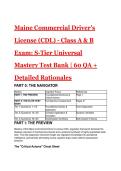
Maine Commercial Driver’s
License (CDL) - Class A & B
Exam: S-Tier Universal
Mastery Test Bank | 60 QA +
Detailed Rationales
PART 0: THE NAVIGATOR
Section Cognitive Focus References
PART I: THE PREVIEW Foundational Directives & Page 1
Critical Axioms
PART II: THE ELITE TEST Full Spectrum Assessment Pages 2+
BANK
Tier 1 (Questions 1–15) Foundational Syntax & Core Diagnostics
Application
Tier 2 (Questions 16–35) Complex Application & Dynamic Variables
Simulation
Tier 3 (Questions 36–60) Grandmaster Synthesis Multi-System Failures
PART I: THE PREVIEW
Mastery of the Maine Commercial Driver’s License (CDL) regulatory framework demands the
flawless execution of mechanical protocols and a profound synthesis of highly specialized state
laws. This elite diagnostic instrument forges raw regulatory knowledge into operational
intelligence, permanently eliminating novice cognitive traps under extreme assessment
pressure.
The "Critical Axioms" Cheat Sheet
,Axiom Category Critical Rule/Framework Operational Impact
The Title 29-A Axle Matrix Maine permits extreme-weight Overrides standard
commodity transport; a 6-axle 80,000-pound federal limits on
combination vehicle (3-axle Maine interstates without
tractor, tri-axle semi-trailer) special permits.
operates legally up to 100,000
pounds.
Air Brake Leakage Applied pressure loss limits Ensures pneumatic integrity
Imperatives dictate immediate before the introduction of heavy
out-of-service status: >3 dynamic kinetic loads.
psi/minute for single vehicles
and >4 psi/minute for
combinations.
Intrastate Exemption Law Operators functioning strictly Shielding local operators from
within a 100-air-mile radius of federal bureaucracy, voided
their reporting location in Maine instantly by state lines or
intrastate commerce are hazmat placards.
exempt from logbooks and
medical cards.
The Spring Thaw Protocol Posted secondary roads strictly Protects saturated
limit non-exempt traffic to infrastructure, universally
23,000 pounds gross weight voided if the roadway is
during mud season. structurally frozen (<32°F, zero
standing water).
Disqualification Cascade A second conviction for an Treats operator judgment as a
alcohol or felony violation in a monolithic trait across all
personal vehicle triggers a vehicle classes.
lifetime commercial driving
disqualification.
PART II: THE ELITE TEST BANK
Tier 1: Foundational Syntax & Application
Q1: A commercial operator commands a 6-axle combination vehicle (3-axle tractor, tri-axle
semi-trailer) carrying general freight. Based on the principles of Maine Title 29-A statutory
weight limits, which gross vehicle weight is the MAXIMUM allowable on state highways without
securing a special overweight permit? A) 80,000 pounds B) 94,000 pounds C) 100,000 pounds
D) 129,000 pounds
● The Answer: C (100,000 pounds)
● Distractor Analysis:
○ A is incorrect: 80,000 pounds is the standard federal interstate limit for a standard
5-axle combination, failing to account for Maine’s specific 6-axle allowance.
○ B is incorrect: 94,000 pounds applies strictly to specific sub-configurations (e.g.,
3-axle truck with a 2-axle trailer) under commodity exceptions.
○ D is incorrect: 129,000 pounds is an extreme multi-axle configuration requiring 9
axles and highly specialized permitting.
The Mentor's Analysis: Maine’s infrastructure historically accommodates heavy industrial
, sectors, uniquely establishing the 100,000-pound baseline for properly configured 6-axle rigs on
both state and interstate highways. When assessing maximums, the combination of the 3-axle
tractor and tri-axle trailer is the specific trigger for this elevated threshold.
Professional/Academic Intuition: Always link the tri-axle semi-trailer 6-axle configuration
directly to the 100,000-pound general law maximum.
Q2: During a pre-trip inspection, the operator is conducting the static air leakage test. Based on
the principles of the Federal Motor Carrier Safety Administration (FMCSA) Air Brake
parameters, which action is FIRST required after achieving a fully charged system? A) Step
firmly on the service brake pedal and hold it for one minute. B) Turn off the engine and release
the parking brake. C) Pump the service brake pedal to bleed pressure down to 60 psi. D) Wait
for the governor cut-in valve to engage.
● The Answer: B (Turn off the engine and release the parking brake.)
● Distractor Analysis:
○ A is incorrect: This action executes the applied leakage test, which must only be
performed after the static test is fully completed.
○ C is incorrect: Fanning the brakes tests the low-pressure warning signal and spring
brake deployment, which occurs later in the 7-step sequence.
○ D is incorrect: The governor cut-in point is tested during the compressor cycle
evaluation, not during the static leak evaluation.
The Mentor's Analysis: Testing leakage requires an isolated pneumatic environment. The
engine must be disabled to prevent the compressor from masking a leak, and the parking brake
must be released to introduce air into the primary delivery lines to expose systemic
vulnerabilities. Professional/Academic Intuition: System isolation (Engine Off, Brakes
Released) strictly precedes pressure observation.
Q3: An operator transports cargo exclusively within the state of Maine. Based on the principles
of the Maine Motor Carrier Safety Regulations, which condition EXEMPTS the operator from
carrying a valid medical certificate? A) Operating a 34,000-pound vehicle on interstate highways
within New England. B) Transporting placarded hazardous materials on local municipal roads.
C) Operating within a 150-air-mile radius of the primary work reporting location. D) Operating
exclusively in intrastate commerce within a 100-air-mile radius of the work reporting location.
● The Answer: D (Operating exclusively in intrastate commerce within a 100-air-mile radius
of the work reporting location.)
● Distractor Analysis:
○ A is incorrect: Interstate commerce operations immediately negate the Maine
intrastate medical exemption entirely.
○ B is incorrect: Transporting hazardous materials requiring placards voids the
excepted status regardless of operating distance.
○ C is incorrect: The 150-air-mile rule is a federal Hours of Service logbook
exemption parameter, but the medical exemption specifically requires a 100-air-mile
threshold in Maine.
The Mentor's Analysis: The intrastate exemption framework protects local operators from
federal medical bureaucracies, provided their operational footprint remains tightly localized and
entirely free of high-risk cargo. Professional/Academic Intuition: Placards and state borders
instantly terminate all local medical exemptions.
Q4: A commercial vehicle’s air brake system utilizes a mechanical governor to regulate the air
compressor. Based on the principles of standard commercial air systems, at what pressure
range does the governor typically "cut-in" to resume pumping air? A) 60 psi B) 100 psi C) 125
psi D) 150 psi
License (CDL) - Class A & B
Exam: S-Tier Universal
Mastery Test Bank | 60 QA +
Detailed Rationales
PART 0: THE NAVIGATOR
Section Cognitive Focus References
PART I: THE PREVIEW Foundational Directives & Page 1
Critical Axioms
PART II: THE ELITE TEST Full Spectrum Assessment Pages 2+
BANK
Tier 1 (Questions 1–15) Foundational Syntax & Core Diagnostics
Application
Tier 2 (Questions 16–35) Complex Application & Dynamic Variables
Simulation
Tier 3 (Questions 36–60) Grandmaster Synthesis Multi-System Failures
PART I: THE PREVIEW
Mastery of the Maine Commercial Driver’s License (CDL) regulatory framework demands the
flawless execution of mechanical protocols and a profound synthesis of highly specialized state
laws. This elite diagnostic instrument forges raw regulatory knowledge into operational
intelligence, permanently eliminating novice cognitive traps under extreme assessment
pressure.
The "Critical Axioms" Cheat Sheet
,Axiom Category Critical Rule/Framework Operational Impact
The Title 29-A Axle Matrix Maine permits extreme-weight Overrides standard
commodity transport; a 6-axle 80,000-pound federal limits on
combination vehicle (3-axle Maine interstates without
tractor, tri-axle semi-trailer) special permits.
operates legally up to 100,000
pounds.
Air Brake Leakage Applied pressure loss limits Ensures pneumatic integrity
Imperatives dictate immediate before the introduction of heavy
out-of-service status: >3 dynamic kinetic loads.
psi/minute for single vehicles
and >4 psi/minute for
combinations.
Intrastate Exemption Law Operators functioning strictly Shielding local operators from
within a 100-air-mile radius of federal bureaucracy, voided
their reporting location in Maine instantly by state lines or
intrastate commerce are hazmat placards.
exempt from logbooks and
medical cards.
The Spring Thaw Protocol Posted secondary roads strictly Protects saturated
limit non-exempt traffic to infrastructure, universally
23,000 pounds gross weight voided if the roadway is
during mud season. structurally frozen (<32°F, zero
standing water).
Disqualification Cascade A second conviction for an Treats operator judgment as a
alcohol or felony violation in a monolithic trait across all
personal vehicle triggers a vehicle classes.
lifetime commercial driving
disqualification.
PART II: THE ELITE TEST BANK
Tier 1: Foundational Syntax & Application
Q1: A commercial operator commands a 6-axle combination vehicle (3-axle tractor, tri-axle
semi-trailer) carrying general freight. Based on the principles of Maine Title 29-A statutory
weight limits, which gross vehicle weight is the MAXIMUM allowable on state highways without
securing a special overweight permit? A) 80,000 pounds B) 94,000 pounds C) 100,000 pounds
D) 129,000 pounds
● The Answer: C (100,000 pounds)
● Distractor Analysis:
○ A is incorrect: 80,000 pounds is the standard federal interstate limit for a standard
5-axle combination, failing to account for Maine’s specific 6-axle allowance.
○ B is incorrect: 94,000 pounds applies strictly to specific sub-configurations (e.g.,
3-axle truck with a 2-axle trailer) under commodity exceptions.
○ D is incorrect: 129,000 pounds is an extreme multi-axle configuration requiring 9
axles and highly specialized permitting.
The Mentor's Analysis: Maine’s infrastructure historically accommodates heavy industrial
, sectors, uniquely establishing the 100,000-pound baseline for properly configured 6-axle rigs on
both state and interstate highways. When assessing maximums, the combination of the 3-axle
tractor and tri-axle trailer is the specific trigger for this elevated threshold.
Professional/Academic Intuition: Always link the tri-axle semi-trailer 6-axle configuration
directly to the 100,000-pound general law maximum.
Q2: During a pre-trip inspection, the operator is conducting the static air leakage test. Based on
the principles of the Federal Motor Carrier Safety Administration (FMCSA) Air Brake
parameters, which action is FIRST required after achieving a fully charged system? A) Step
firmly on the service brake pedal and hold it for one minute. B) Turn off the engine and release
the parking brake. C) Pump the service brake pedal to bleed pressure down to 60 psi. D) Wait
for the governor cut-in valve to engage.
● The Answer: B (Turn off the engine and release the parking brake.)
● Distractor Analysis:
○ A is incorrect: This action executes the applied leakage test, which must only be
performed after the static test is fully completed.
○ C is incorrect: Fanning the brakes tests the low-pressure warning signal and spring
brake deployment, which occurs later in the 7-step sequence.
○ D is incorrect: The governor cut-in point is tested during the compressor cycle
evaluation, not during the static leak evaluation.
The Mentor's Analysis: Testing leakage requires an isolated pneumatic environment. The
engine must be disabled to prevent the compressor from masking a leak, and the parking brake
must be released to introduce air into the primary delivery lines to expose systemic
vulnerabilities. Professional/Academic Intuition: System isolation (Engine Off, Brakes
Released) strictly precedes pressure observation.
Q3: An operator transports cargo exclusively within the state of Maine. Based on the principles
of the Maine Motor Carrier Safety Regulations, which condition EXEMPTS the operator from
carrying a valid medical certificate? A) Operating a 34,000-pound vehicle on interstate highways
within New England. B) Transporting placarded hazardous materials on local municipal roads.
C) Operating within a 150-air-mile radius of the primary work reporting location. D) Operating
exclusively in intrastate commerce within a 100-air-mile radius of the work reporting location.
● The Answer: D (Operating exclusively in intrastate commerce within a 100-air-mile radius
of the work reporting location.)
● Distractor Analysis:
○ A is incorrect: Interstate commerce operations immediately negate the Maine
intrastate medical exemption entirely.
○ B is incorrect: Transporting hazardous materials requiring placards voids the
excepted status regardless of operating distance.
○ C is incorrect: The 150-air-mile rule is a federal Hours of Service logbook
exemption parameter, but the medical exemption specifically requires a 100-air-mile
threshold in Maine.
The Mentor's Analysis: The intrastate exemption framework protects local operators from
federal medical bureaucracies, provided their operational footprint remains tightly localized and
entirely free of high-risk cargo. Professional/Academic Intuition: Placards and state borders
instantly terminate all local medical exemptions.
Q4: A commercial vehicle’s air brake system utilizes a mechanical governor to regulate the air
compressor. Based on the principles of standard commercial air systems, at what pressure
range does the governor typically "cut-in" to resume pumping air? A) 60 psi B) 100 psi C) 125
psi D) 150 psi