

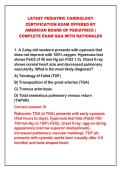
LATEST PEDIATRIC CARDIOLOGY
CERTIFICATION EXAM OFFERED BY
AMERICAN BOARD OF PEDIATRICS |
COMPLETE EXAM Q&A WITH RATIONALES
1. A 2-day-old newborn presents with cyanosis that
does not improve with 100% oxygen. Hyperoxia test
shows PaO2 of 45 mm Hg (on FiO2 1.0). Chest X-ray
shows normal heart size and decreased pulmonary
vascularity. What is the most likely diagnosis?
A) Tetralogy of Fallot (TOF)
B) Transposition of the great arteries (TGA)
C) Truncus arteriosus
D) Total anomalous pulmonary venous return
(TAPVR)
Correct answer: B
Rationale: TGA (d-TGA) presents with early cyanosis
(first hours to days), hyperoxia test fails (PaO2 <50-
100 mm Hg on 100% FiO2), chest X-ray: egg-on-string
appearance (narrow superior mediastinum),
increased pulmonary vascular markings. TOF (A)
presents with cyanotic spells later (usually after 2-6
months) and boot-shaped heart.
,2. A 6-week-old infant presents with poor feeding,
tachypnea, and failure to thrive. On examination,
there is a grade 3/6 holosystolic murmur at the left
lower sternal border with a palpable thrill. Chest X-
ray shows cardiomegaly and increased pulmonary
vascular markings. What is the most likely diagnosis?
A) Ventricular septal defect (VSD)
B) Atrial septal defect (ASD)
C) Patent ductus arteriosus (PDA)
D) Pulmonic stenosis (PS)
Correct answer: A
Rationale: VSD is the most common congenital heart
defect. Large VSD presents at 4-8 weeks (when
pulmonary vascular resistance drops) with heart
failure (tachypnea, poor feeding, failure to thrive).
Murmur: holosystolic (LLSB). X-ray: cardiomegaly,
increased pulmonary vascularity. ASD (B) usually has
a systolic ejection murmur (pulmonic flow) and is
often asymptomatic.
3. A 3-day-old newborn is noted to have a continuous
"machinery" murmur at the left upper sternal border,
bounding pulses, and a wide pulse pressure. The
infant is born at 28 weeks gestation and has
respiratory distress syndrome (RDS). What is the
most likely diagnosis?
,A) Patent ductus arteriosus (PDA)
B) Aortopulmonary window (AP window)
C) Truncus arteriosus
D) Venous hum
Correct answer: A
Rationale: PDA in preterm infants (due to immature
ductal closure) presents with a continuous murmur
(machinery), bounding pulses, wide pulse pressure,
and signs of heart failure (if large). Treatment:
indomethacin or ibuprofen (medical closure) or
surgical ligation if refractory.
4. A 5-year-old child with Down syndrome presents
with exercise intolerance and cyanosis.
Echocardiogram shows a complete atrioventricular
septal defect (CAVSD) with common atrioventricular
valve. What is the most common genetic syndrome
associated with AVSD?
A) Down syndrome (trisomy 21)
B) Turner syndrome (45,XO)
C) Noonan syndrome (PTPN11)
D) Marfan syndrome (FBN1)
Correct answer: A
, Rationale: Atrioventricular septal defect (AVSD, also
called atrioventricular canal defect) is strongly
associated with Down syndrome (trisomy 21).
Complete AVSD includes primum ASD, inlet VSD, and
a common AV valve. Other associations: heterotaxy
syndromes.
5. A 2-year-old child has a history of hypercyanotic
(Tet) spells. During a spell, the child becomes
cyanotic, tachypneic, and lethargic. What is the most
appropriate initial management?
A) Knee-chest position (to increase systemic
vascular resistance, SVR) and oxygen
B) Morphine (0.1 mg/kg IV) (to decrease infundibular
spasm)
C) Propranolol (0.1 mg/kg IV) (to decrease heart rate
and infundibular spasm)
D) All of the above
Correct answer: D
Rationale: Tetralogy of Fallot (TOF) hypercyanotic
spell management: 1) Knee-chest position (increases
SVR, decreases right-to-left shunt), 2) Oxygen (to
treat hypoxemia, mild pulmonary vasodilation), 3)
Morphine (to decrease infundibular spasm), 4)
Propranolol (beta-blocker, to decrease heart rate
CERTIFICATION EXAM OFFERED BY
AMERICAN BOARD OF PEDIATRICS |
COMPLETE EXAM Q&A WITH RATIONALES
1. A 2-day-old newborn presents with cyanosis that
does not improve with 100% oxygen. Hyperoxia test
shows PaO2 of 45 mm Hg (on FiO2 1.0). Chest X-ray
shows normal heart size and decreased pulmonary
vascularity. What is the most likely diagnosis?
A) Tetralogy of Fallot (TOF)
B) Transposition of the great arteries (TGA)
C) Truncus arteriosus
D) Total anomalous pulmonary venous return
(TAPVR)
Correct answer: B
Rationale: TGA (d-TGA) presents with early cyanosis
(first hours to days), hyperoxia test fails (PaO2 <50-
100 mm Hg on 100% FiO2), chest X-ray: egg-on-string
appearance (narrow superior mediastinum),
increased pulmonary vascular markings. TOF (A)
presents with cyanotic spells later (usually after 2-6
months) and boot-shaped heart.
,2. A 6-week-old infant presents with poor feeding,
tachypnea, and failure to thrive. On examination,
there is a grade 3/6 holosystolic murmur at the left
lower sternal border with a palpable thrill. Chest X-
ray shows cardiomegaly and increased pulmonary
vascular markings. What is the most likely diagnosis?
A) Ventricular septal defect (VSD)
B) Atrial septal defect (ASD)
C) Patent ductus arteriosus (PDA)
D) Pulmonic stenosis (PS)
Correct answer: A
Rationale: VSD is the most common congenital heart
defect. Large VSD presents at 4-8 weeks (when
pulmonary vascular resistance drops) with heart
failure (tachypnea, poor feeding, failure to thrive).
Murmur: holosystolic (LLSB). X-ray: cardiomegaly,
increased pulmonary vascularity. ASD (B) usually has
a systolic ejection murmur (pulmonic flow) and is
often asymptomatic.
3. A 3-day-old newborn is noted to have a continuous
"machinery" murmur at the left upper sternal border,
bounding pulses, and a wide pulse pressure. The
infant is born at 28 weeks gestation and has
respiratory distress syndrome (RDS). What is the
most likely diagnosis?
,A) Patent ductus arteriosus (PDA)
B) Aortopulmonary window (AP window)
C) Truncus arteriosus
D) Venous hum
Correct answer: A
Rationale: PDA in preterm infants (due to immature
ductal closure) presents with a continuous murmur
(machinery), bounding pulses, wide pulse pressure,
and signs of heart failure (if large). Treatment:
indomethacin or ibuprofen (medical closure) or
surgical ligation if refractory.
4. A 5-year-old child with Down syndrome presents
with exercise intolerance and cyanosis.
Echocardiogram shows a complete atrioventricular
septal defect (CAVSD) with common atrioventricular
valve. What is the most common genetic syndrome
associated with AVSD?
A) Down syndrome (trisomy 21)
B) Turner syndrome (45,XO)
C) Noonan syndrome (PTPN11)
D) Marfan syndrome (FBN1)
Correct answer: A
, Rationale: Atrioventricular septal defect (AVSD, also
called atrioventricular canal defect) is strongly
associated with Down syndrome (trisomy 21).
Complete AVSD includes primum ASD, inlet VSD, and
a common AV valve. Other associations: heterotaxy
syndromes.
5. A 2-year-old child has a history of hypercyanotic
(Tet) spells. During a spell, the child becomes
cyanotic, tachypneic, and lethargic. What is the most
appropriate initial management?
A) Knee-chest position (to increase systemic
vascular resistance, SVR) and oxygen
B) Morphine (0.1 mg/kg IV) (to decrease infundibular
spasm)
C) Propranolol (0.1 mg/kg IV) (to decrease heart rate
and infundibular spasm)
D) All of the above
Correct answer: D
Rationale: Tetralogy of Fallot (TOF) hypercyanotic
spell management: 1) Knee-chest position (increases
SVR, decreases right-to-left shunt), 2) Oxygen (to
treat hypoxemia, mild pulmonary vasodilation), 3)
Morphine (to decrease infundibular spasm), 4)
Propranolol (beta-blocker, to decrease heart rate


