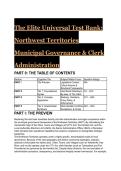
The Elite Universal Test Bank:
Northwest Territories
Municipal Governance & Clerk
Administration
PART 0: THE TABLE OF CONTENTS
Section Cognitive Tier Subject Matter Focus Question Range
PART I The Preview Legislative Context, N/A
Critical Axioms &
Structural Frameworks
PART II Tier 1: Foundational Hard-Deck Definitions, Q1 – Q10
Syntax By-laws, & The LAEA
PART II Tier 2: Complex Statutory Violations, Q11 – Q20
Application Proxy Rules, &
Enforcement
PART II Tier 3: Grandmaster Multi-Variable Conflicts, Q21 – Q30
Synthesis Escalations, & Crises
PART I: THE PREVIEW
Mastering this test bank translates directly into elite administrative and legal competence within
the municipal governance frameworks of the Northwest Territories (NWT). By internalizing the
mechanistic logic of the Cities, Towns and Villages Act (CTV Act), the Hamlets Act, and the
Local Authorities Elections Act (LAEA), the Senior Administrative Officer (SAO) or Municipal
Clerk elevates their operational capability from passive compliance to impregnable strategic
leadership.
The Northwest Territories operates under a highly specific, decentralized model of local
governance. Because of the vast geography and distinct community typologies, statutory
authority is bifurcated into distinct acts. Cities, Towns, and Villages (such as Yellowknife, Hay
River, and Inuvik) operate under the CTV Act, while Hamlets (such as Tuktoyaktuk and Fort
Providence) are governed by the Hamlets Act. Despite these divisions, the core principles of
administrative procedure, transparency, and electoral integrity remain harmonized. For example,
,municipal elections universally fall under the jurisdiction of the LAEA, which establishes
uncompromising rules for candidate eligibility, proxy voting, and recount triggers.
A critical evolution in NWT municipal administration involves information access. While the
Access to Information and Protection of Privacy Act (ATIPPA) was amended in 2021 to
eventually include municipalities, structural implementation delays mean that residents cannot
yet file formal ATIPPA requests against local governments. However, this does not shield
municipalities from transparency. The CTV Act and Hamlets Act possess localized transparency
mandates, strictly requiring that all adopted minutes and passed by-laws be available for public
inspection during business hours.
The true power of the SAO lies in understanding the friction points between council ambition
and statutory limits. The SAO is the singular employee of the council, tasked with ensuring that
political desires do not breach territorial law. This requires surgical precision when interpreting
by-law readings, managing conflict-of-interest declarations, and navigating the lethal
administrative traps embedded within municipal contracts.
The Critical Axioms Cheat Sheet
● The By-Law Reading Axiom: Under the CTV Act and Hamlets Act, a by-law must
receive three distinct readings. However, a council is strictly prohibited from giving a
by-law more than two readings at a single meeting unless all council members are
present and agree by unanimous consent to proceed to the third reading.
● The 48-Hour Notice Directive: For any Special Meeting of Council, the SAO must
provide exactly 48 hours of advance notice detailing the time, place, and specific nature of
the business. No other business may be transacted unless all members are present and
unanimously agree.
● The Election Recount Trigger: Under the LAEA, an automatic administrative recount is
legally mandated if the difference in votes between the winning and losing candidates for
a final seat is exactly four (4) or fewer votes.
● The Proxy Cap Rule: A single individual cannot act as a proxy voter for more than three
(3) eligible voters during a municipal election. Attempting to cast a fourth is a major
election offence.
● The SAO Conflict Execution: An SAO who acquires a direct or indirect pecuniary
interest in a contract with the municipal corporation must be dismissed immediately,
without notice, and without compensation.
● The 500/90 Candidate Debt Rule: Under the LAEA, a citizen is definitively disqualified
from running for municipal office if they are indebted to the municipality for a sum
exceeding $500 for more than 90 days.
Structural Frameworks for NWT Municipal Operations
Administrative Framework Primary Governing Statute Core Operational Mandate
Corporate Establishment & Cities, Towns and Villages Act Defines the incorporation of
Officer Duties & Hamlets Act municipalities, mandates the
appointment of the SAO via
by-law, and outlines the lethal
penalties for SAO conflicts of
interest.
, Administrative Framework Primary Governing Statute Core Operational Mandate
Legislative Procedures CTV Act (ss. 27-38) Controls meeting schedules,
the 48-hour Special Meeting
notice, emergency meeting
overrides, and the rigid
three-reading by-law
progression rules.
Democratic & Electoral Local Authorities Elections Act Centralizes all voting
Integrity (LAEA) mechanics, proxy limitations,
ballot custody, 48-hour
withdrawal windows, and
recount protocols for municipal
elections.
Council Accountability Conflict of Interest Act Dictates that elected officials
with pecuniary interests must
disclose, vacate the chamber,
and abstain from voting, under
threat of 7-year disqualification.
PART II: THE ELITE TEST BANK
Tier 1: Foundational Syntax & Application
Q1: A municipal council in the Northwest Territories is attempting to pass a critical zoning by-law
during a regular meeting. One council member is absent due to illness. The council successfully
passes the first and second readings. The Mayor proposes moving immediately to the third
reading to expedite the zoning change. Based on the Cities, Towns and Villages Act, which
action is the MOST ACCURATE? A) The council may proceed to the third reading if a two-thirds
majority of the present members votes in favor of the motion. B) The council is strictly prohibited
from proceeding to the third reading during this meeting. C) The council may proceed to the
third reading because unanimous consent is only required for financial by-laws. D) The SAO
may override the requirement for unanimous consent by declaring a state of local administrative
urgency.
● The Answer: B (The council is strictly prohibited from proceeding to the third reading
during this meeting.)
● Distractor Analysis:
○ A is incorrect: The CTV Act does not recognize a two-thirds majority for advancing
a third reading; it requires the unanimous consent of all elected council members.
○ C is incorrect: The requirement applies universally to all by-laws, not just financial
ones.
○ D is incorrect: The SAO has no statutory authority to override legislative by-law
reading procedures.
The Mentor's Analysis: The absolute rule of by-law progression under the CTV Act prevents
the railroading of legislation. A third reading at a single meeting requires that all council
members be present and that they unanimously agree to proceed. Because one member is
absent, this condition cannot be met, rendering a third reading illegal. Professional/Academic
Intuition: No full quorum, no third reading. Never attempt to pass three readings in one night
without a completely full, unanimously agreeing chamber.
Northwest Territories
Municipal Governance & Clerk
Administration
PART 0: THE TABLE OF CONTENTS
Section Cognitive Tier Subject Matter Focus Question Range
PART I The Preview Legislative Context, N/A
Critical Axioms &
Structural Frameworks
PART II Tier 1: Foundational Hard-Deck Definitions, Q1 – Q10
Syntax By-laws, & The LAEA
PART II Tier 2: Complex Statutory Violations, Q11 – Q20
Application Proxy Rules, &
Enforcement
PART II Tier 3: Grandmaster Multi-Variable Conflicts, Q21 – Q30
Synthesis Escalations, & Crises
PART I: THE PREVIEW
Mastering this test bank translates directly into elite administrative and legal competence within
the municipal governance frameworks of the Northwest Territories (NWT). By internalizing the
mechanistic logic of the Cities, Towns and Villages Act (CTV Act), the Hamlets Act, and the
Local Authorities Elections Act (LAEA), the Senior Administrative Officer (SAO) or Municipal
Clerk elevates their operational capability from passive compliance to impregnable strategic
leadership.
The Northwest Territories operates under a highly specific, decentralized model of local
governance. Because of the vast geography and distinct community typologies, statutory
authority is bifurcated into distinct acts. Cities, Towns, and Villages (such as Yellowknife, Hay
River, and Inuvik) operate under the CTV Act, while Hamlets (such as Tuktoyaktuk and Fort
Providence) are governed by the Hamlets Act. Despite these divisions, the core principles of
administrative procedure, transparency, and electoral integrity remain harmonized. For example,
,municipal elections universally fall under the jurisdiction of the LAEA, which establishes
uncompromising rules for candidate eligibility, proxy voting, and recount triggers.
A critical evolution in NWT municipal administration involves information access. While the
Access to Information and Protection of Privacy Act (ATIPPA) was amended in 2021 to
eventually include municipalities, structural implementation delays mean that residents cannot
yet file formal ATIPPA requests against local governments. However, this does not shield
municipalities from transparency. The CTV Act and Hamlets Act possess localized transparency
mandates, strictly requiring that all adopted minutes and passed by-laws be available for public
inspection during business hours.
The true power of the SAO lies in understanding the friction points between council ambition
and statutory limits. The SAO is the singular employee of the council, tasked with ensuring that
political desires do not breach territorial law. This requires surgical precision when interpreting
by-law readings, managing conflict-of-interest declarations, and navigating the lethal
administrative traps embedded within municipal contracts.
The Critical Axioms Cheat Sheet
● The By-Law Reading Axiom: Under the CTV Act and Hamlets Act, a by-law must
receive three distinct readings. However, a council is strictly prohibited from giving a
by-law more than two readings at a single meeting unless all council members are
present and agree by unanimous consent to proceed to the third reading.
● The 48-Hour Notice Directive: For any Special Meeting of Council, the SAO must
provide exactly 48 hours of advance notice detailing the time, place, and specific nature of
the business. No other business may be transacted unless all members are present and
unanimously agree.
● The Election Recount Trigger: Under the LAEA, an automatic administrative recount is
legally mandated if the difference in votes between the winning and losing candidates for
a final seat is exactly four (4) or fewer votes.
● The Proxy Cap Rule: A single individual cannot act as a proxy voter for more than three
(3) eligible voters during a municipal election. Attempting to cast a fourth is a major
election offence.
● The SAO Conflict Execution: An SAO who acquires a direct or indirect pecuniary
interest in a contract with the municipal corporation must be dismissed immediately,
without notice, and without compensation.
● The 500/90 Candidate Debt Rule: Under the LAEA, a citizen is definitively disqualified
from running for municipal office if they are indebted to the municipality for a sum
exceeding $500 for more than 90 days.
Structural Frameworks for NWT Municipal Operations
Administrative Framework Primary Governing Statute Core Operational Mandate
Corporate Establishment & Cities, Towns and Villages Act Defines the incorporation of
Officer Duties & Hamlets Act municipalities, mandates the
appointment of the SAO via
by-law, and outlines the lethal
penalties for SAO conflicts of
interest.
, Administrative Framework Primary Governing Statute Core Operational Mandate
Legislative Procedures CTV Act (ss. 27-38) Controls meeting schedules,
the 48-hour Special Meeting
notice, emergency meeting
overrides, and the rigid
three-reading by-law
progression rules.
Democratic & Electoral Local Authorities Elections Act Centralizes all voting
Integrity (LAEA) mechanics, proxy limitations,
ballot custody, 48-hour
withdrawal windows, and
recount protocols for municipal
elections.
Council Accountability Conflict of Interest Act Dictates that elected officials
with pecuniary interests must
disclose, vacate the chamber,
and abstain from voting, under
threat of 7-year disqualification.
PART II: THE ELITE TEST BANK
Tier 1: Foundational Syntax & Application
Q1: A municipal council in the Northwest Territories is attempting to pass a critical zoning by-law
during a regular meeting. One council member is absent due to illness. The council successfully
passes the first and second readings. The Mayor proposes moving immediately to the third
reading to expedite the zoning change. Based on the Cities, Towns and Villages Act, which
action is the MOST ACCURATE? A) The council may proceed to the third reading if a two-thirds
majority of the present members votes in favor of the motion. B) The council is strictly prohibited
from proceeding to the third reading during this meeting. C) The council may proceed to the
third reading because unanimous consent is only required for financial by-laws. D) The SAO
may override the requirement for unanimous consent by declaring a state of local administrative
urgency.
● The Answer: B (The council is strictly prohibited from proceeding to the third reading
during this meeting.)
● Distractor Analysis:
○ A is incorrect: The CTV Act does not recognize a two-thirds majority for advancing
a third reading; it requires the unanimous consent of all elected council members.
○ C is incorrect: The requirement applies universally to all by-laws, not just financial
ones.
○ D is incorrect: The SAO has no statutory authority to override legislative by-law
reading procedures.
The Mentor's Analysis: The absolute rule of by-law progression under the CTV Act prevents
the railroading of legislation. A third reading at a single meeting requires that all council
members be present and that they unanimously agree to proceed. Because one member is
absent, this condition cannot be met, rendering a third reading illegal. Professional/Academic
Intuition: No full quorum, no third reading. Never attempt to pass three readings in one night
without a completely full, unanimously agreeing chamber.